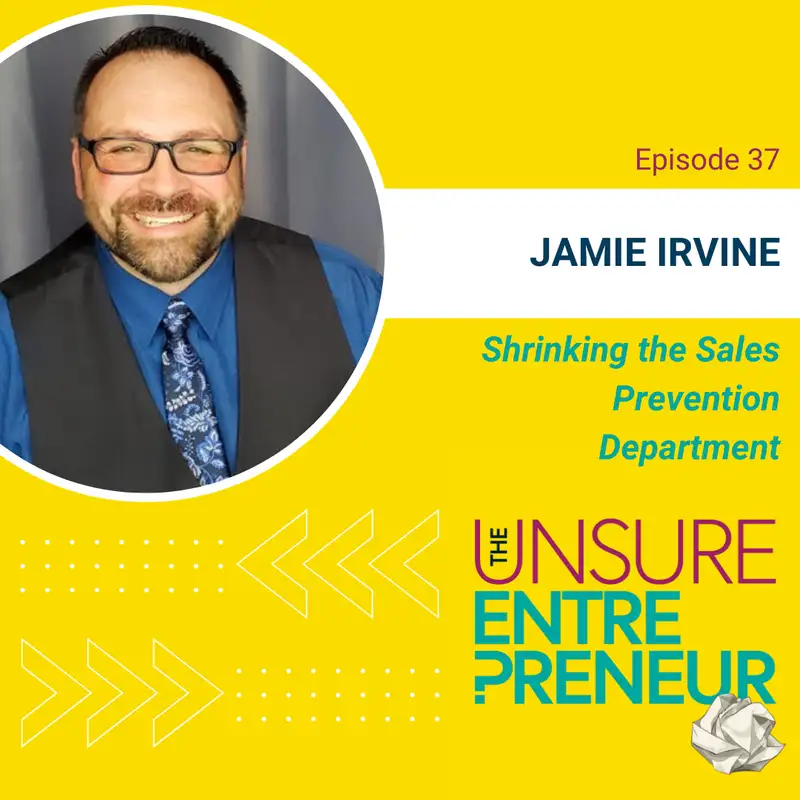
Shrinking the Sales Prevention Department (w/Jamie Irvine)
Jamie Irvine on The Unsure Entrepreneur
Episode 37
SUMMARY KEYWORDS
Entrepreneurship, sales prevention department, customer relationship management, business development, heavy duty parts, trucking industry, sales strategies, customer service, order fulfillment, ideal customer profile, sales closing, psychological selling, niche market, sales training, business growth.
SPEAKERS
Roger Pierce, Jamie Irvine
Jamie Irvine 00:00
You need to immediately separate the business development role from the customer relationship management role, the sales account management role.
Intro 00:11
You're listening to the unsure entrepreneur podcast with Roger Pierce, whether you're scribbling business ideas on a napkin or wrestling with the should I shouldn't I question. Get ready to explore the realities, the risks and the rewards of entrepreneurship as we share the stories, scars and successes of small business owners.
Roger Pierce 00:32
Welcome back to the Unsure Entrepreneur Podcast. My guest today is no stranger to our show. Jamie Irvine joined me last summer to talk about the business of podcasting, and it was such a valuable conversation, we just had to have him back.
My favorite quote from Jamie in that episode was when he said, “podcasting has horrible ROI metrics. If you just want quick conversions on a product, go buy some Facebook advertising or something.” Listeners, including me, appreciated his straightforward advice. So I want more of that and some more advice on sales and marketing. But let me tell you a little bit more about Jamie.
He's worked in the heavy duty parts industry since 1998 building expertise across manufacturing, distribution and service. He's built and sold businesses, co founded others, and today leads the Heavy Duty Consulting Corporation, where he helps companies grow, execute strategy and dismantle what he calls the sales prevention department that quietly kills revenue. We'll talk more about that soon. Now. Jamie is also the creator and longtime host of the Heavy Duty Parts Report, which produced over 350 episodes and counting, and earned more than 25 million impressions. I am so jealous. Podcast is back on the air after a brief hiatus, and today we'll hear what Jamie has planned and draw upon his experience in sales, in business building. Welcome back, Jamie.
Jamie Irvine 01:58
I really appreciate that intro. Very happy to be back and you make, you make me sound like I'm doing okay.
Roger Pierce 02:06
You're doing great. You're doing great. I was on the website. I saw all these sponsors. I listening to a couple of new pods. I love it.
Jamie Irvine 02:14
Yeah, it's been. It's been good. It's been we were talking about that before we started recording. It's been a whirlwind couple months here for me, but the whole experience that I've had in this industry over the last since 2019 has been phenomenal. And I definitely if you're if you're someone who works in a niche industry like I do, but an important one man, there's big opportunity if you just put the work in
Roger Pierce 02:38
absolutely now, heavy duty parts report, took a short break, but it's back, and it's been a huge part of your career and influence. So can you catch us up and tell us what audiences can expect and what's going to be in this next chapter for you?
Jamie Irvine 02:51
Yeah, so we came back with season eight, and we've aired episode 350, and 351 we've got a couple more coming. We've switched to a bi weekly format, so every two weeks, and instead of weekly, that allows me to spend a little more time on each episode and also have time to work with my clients that come from the podcast, we are really going to focus on the subjects that are really important to not Just the trucking industry, but also important to everyday people, because it's my opinion that the trucking industry is the backbone of society, and without it, you know, people's lives and our way of life kind of hang in the balance. And so we're going to talk about things like the impact of tariffs on our economy, which affects the movement of goods in the trucking industry. We're going to talk about policy around natural resources and the development of those kinds of projects, which, of course, affect the trucking industry in a huge way, but affect everyday people. And we're going to talk about, really, the strategies that companies that operate heavy equipment should be deploying to try to maximize their profitability and put them in the best position to take care of everyday people, men, women and children that rely on that industry every single day for not just their iPhones and, you know, the things that they enjoy, but the very things they need for survival, like energy to heat their homes, food, medicine, those kinds of things.
Roger Pierce 04:19
Let's give a shout out to the trucking industry, because what's the expression, if you bought it or you ate it, a truck brought it to you? Absolutely.
Jamie Irvine 04:25
So thank a trucker. Thank a trucker. I actually have that T shirt. Thank you. That's great.
Roger Pierce 04:31
You should put that on your merch page if, yeah, I was thinking about transport trailers was I was stuck on the 401, on Sunday night, driving back my daughter to university. And man, you know, it's true, we rely on everything for trucks. It's that last few miles that we need, right the trains and ships can't fulfill. How important is the trucking industry to Canada?
Jamie Irvine 04:50
Basically, in 30 days, if the trucks stopped rolling, our entire society would grind to a complete halt. And people. People would start dying. Actually, within a few days people start dying. Not to be overly dramatic, but you just have to think about the oxygen at a hospital and the people who rely on oxygen to stay alive right now, while they're maybe recovering from something, you know, traumatic or some sort of disease, if you can't refill the oxygen tanks, those people start to die. If you can't deliver insulin, the diabetics start to die. Most Costcos and your supermarkets have three days worth of supplies for the area that they serve. So in three days you're out of food. Wow. And then God help us if it happened in winter, because then natural gas and all of that that goes that heats our homes, the production would cease, and the reserves would be, you know, in no time flat, your vehicles, you wouldn't be able to charge them if they're electric. You wouldn't be able to fill them up if they're if they're gas or diesel, within a few days. So now and then, within a few more days after that, public transport would completely stop.
So it's not just trucks and trailers on the road, it's busses, it's all the other commercial vehicles that we rely on. And I don't know if you've watched any movies, but when that stuff starts to fall apart, then things get real, really quick.
The American Trucking Association did a deep study on this, and they've published information about it, and yeah, within 30 days, we're talking about basically martial law and total anarchy.
Give the guy who's driving a truck and trailer a little bit of space on the highway and a little bit of respect, because the work that those people are doing, starting in construction, mining, logging, oil and gas all the way down to final mile delivery, every man woman involved in that industry is the work that they do literally makes your life possible. So give them a little space, give them a little respect and maybe a wave and a thing, because that's all that, that's all that these people want. They just want to go to work every day, take care of their families and support the industry that they're part of, and so they deserve our respect. Hug a trucker today. Hug a trucker today.
Roger Pierce 07:03
Yeah, is the industry…I've been curious now, how's the job situation? Are they? Are they screaming for more drivers?
Jamie Irvine 07:10
Historically, drivers, heavy duty mechanics and repair technicians and parts people have been there's been a just terrible shortage of those people, and they call it the silver tsunami, because we've got all of these people retiring, and the attrition rate is much higher than the recruitment rate, so we're losing more people than we're gaining now, I will say for the first time in my career, parts, people, drivers and heavy duty mechanics and technicians are being laid off in this country, and that is a reflection of the economic condition of this country. We are in trouble, and the trucking industry is the canary in the coal mine. It is the early warning system that detects the total health of the economy. And when the trucking industry is down, the economy follows very shortly after that. Now, on the flip side of that, the trucking industry is usually the early indicator that we're recovering, but we're in trouble right now. Canada is not doing very well economically. No matter what you hear about potential upside in 2026 I really can tell you that, on the street, on the ground, the fact that those positions that we're seeing layoffs that's unheard of, because up until now, for the last 25 years, we've had a progressively deepening shortage of those key positions.
So that tells you a lot about how how much shrinkage there's been in the volume of freight being moved in our country. Now, some of it as tariffs, absolutely, but a lot of it is policy decisions that have been made for years now that are slowly strangling, you know, our natural resource based economy, and also, I think, the lack of investment that Canada has put in the digital economy and and, and that side of the equation we, you know, Canadians are responsible for Two of the top five AI in the world, but Canada as a country is not benefiting from that at all, because the US poaches those people. They they leave our universities, they go and work for US companies, and Canada gets zero on the digital economy, and we're strangling our natural resource economy. It's bad news for Canada right now, and it's a little scary. And what I see going on in the truck industry right now, like I said, unheard of in the 25 to 27 years I've been in the industry.
Roger Pierce 09:30
That is sobering thought, for sure. But you know, you're doing your part with the podcast, with the consulting you're keeping those wheels rolling, to use that example. So you know, we got to do our part. I talk about entrepreneurship and trying to bolster a small business startup and that kind of thing.
Jamie Irvine 09:47
So deal making and sales is the solution to a lot of these economic problems, right? Okay, if we can, if we can sell, if we can make better deals, and if we can sell more of our products and goods, we'll be fine, right? And so there's an old. Expression that sales covers over a multitude of sins, and I feel like maybe our country as a whole has made some poor decisions over the last 10 plus years. But that being said, we can recover. We have the ability to do it. We're a resilient group of people, and we're not going to just, you know, lay down and and let this happen. We're going to we're going to do what Canadians always do, which is rise to the occasion. So if you're in a position to make some deals, whether it's at the highest levels of politics or just in your business and in the local economy, right, the more, the more we all do, the better it becomes for everyone.
Roger Pierce 10:35
Absolutely, I love it. Positive attitude. Now you talked about sales, so that's a beautiful segue, because I want to talk to you about sales and marketing. One of the things you said to me in the last podcast, I think, was the sales prevention department. You talked about this thing the sales prevention department. It's stuck in my brain. It makes me think about those hidden parts of a business where sales stall out. And it's probably something that every entrepreneur, no matter what industry they're in, should be paying attention to so can you tell us what you mean by the sales prevention department?
Jamie Irvine 11:07
Yeah, so you can think about it, if you have a customer and they are trying to do business with you, it's everything that you are doing and your people are doing, and everything about the way you've orchestrated the systems inside of your business that are making it harder for that customer to do business with you, and that can be really obvious stuff, like just bad customer service, or not getting back to a prospect that that is asking good quality questions and giving buying signals down to the smallest little things that Just add up to a overall poor customer buying experience that drives customers away. And it is, you know, here's the thing, every company has a sales prevention department. You can't get away from it. The trick is to make it as small as possible.
Roger Pierce 11:56
Okay, I mean, I maybe I'm getting old and cranky, but, you know, I often wonder, do the big companies even test their own systems and go through it from a user experience perspective, like banks, for example, the pushing of the buttons to try to get an operator and all the all the red tape and loopholes, it's crazy, isn't some people even know what kind of hurdles they've got in place for their customers.
Jamie Irvine 12:18
I will say that one of the biggest challenges with the larger scale companies is that while you may have an internal champion in the leadership trying to address some of this, you have so many different departments and to integrate them all and get them all to work together in a coherent way that that actually makes it better for the customer is a really challenging thing to to undertake if you're a small business, it's a lot easier. The hard part of it when you're a smaller business is that when it's at least, at least in my experience as a consultant, a lot of times I have to sit down to the owner and say, it's you, like you think it's everybody else. It's not. I've talked to your customers, I've talked to your employees. It's you, and we got to change you. And a lot of times what that looks like is actually just allowing them to allowing their people to do the jobs that they were hired to do, and getting the owner kind of out of the way, and getting the owner to refocus on what they historically have been best at doing. And at the end of the day, alignment with people is all about that, right? It's, it's identifying the strengths of each individual person on your team and and organizing those people so that they are spending more time on their strengths and less time on their weaknesses. And, you know, you can't try, you know, focusing on weaknesses, I think it doesn't work. I think you have to focus on strengths.
Roger Pierce 13:40
Focus more on your strengths and less on your weaknesses. I love it. Good advice.
Jamie Irvine 13:44
Find somebody who's good at what you're not good at, and get them to sit right beside you.
Roger Pierce 13:49
For me, that's accounting and bookkeeping. There you go. There you go. I delegate that right away. You know, I had an experience a couple years ago that comes to mind. We had our had to have a roof redone on our house. I got quotes from four roofers, right? Shingles, right? Just doing shingles. Standard job. Days work, maybe two. I think it was like $8,000 but the one who got the job is the one of the four who followed up. Right? This is the simple stuff for small business owners to remember. But if they trip over it, just follow up. Hey, did you get the quote? Where do we stand? Any questions? Doesn't take a whole lot, does it?
Jamie Irvine 14:25
I owned a contracting business from 2009 to 2016 and in 2009 I was working in the business just getting it off the ground. And I kind of identified that most contractors were taking a couple days, if not longer, to get back to residential, and at least a week, if not two to three weeks to get back to commercial. And so we made a decision as a company that we would get back to you within 24 hours, if you were residential, and we would get back to you. I don't remember the off the top of my head, but I think it was like 72 hours for a commercial. Old job perfect. We won more business where zero quotes, like we had done, the quote, negotiated, signed the agreement, and had started the job before our competitors submitted a quote, and we got more business from that one move that I can tell you, like I'm talking hundreds of 1000s of dollars in business over year, over the few years, just from that one improvement and shrinking our sales prevention department, that little bit.
Roger Pierce 15:31
That's a great example of what you can do. It doesn't it's not rocket science, is it to just to make these micro improvements that make a big difference? Yeah, yeah. They make a huge difference. Continuing on our talk about sales and marketing, you know, as you know, sales is the lifeblood of the business, but as you've tested, a lot of entrepreneurs still struggle with it. You've sold millions of dollars worth of products and services over the years. So putting on your sales hat, what do B to B companies need to get right about sales today,
Jamie Irvine 16:01
you need to immediately separate the business development role from the customer relationship management role the sales account management role. I approach a lot of companies, and I look for when they're advertising to hire sales people, and I will reach out to them on LinkedIn, and I will say, so what are you looking for? A business development role or a sales account management relationship focused role?
And almost always they come back with, well, you know, the role is a really, really a combination of both of those things. And I fundamentally disagree with that. And I'll tell you why to do business development to truly build net new business opportunities for your company, you have to have a very specific type of personality and has certain combination of traits to make you really good at that. And by virtue of being really good at that, you know what, you suck at, following up with customers, doing all the relationship stuff.
Conversely, if you're really good at relationship development, and you can grow business with existing customers or customers who are coming to the business asking for a quote, asking for more information, and that's your jam. You typically kind of suck at new business, and you avoid it. And it's called avoidance behavior, actually. And you engage in avoidance behavior, and you come up with all these reasons why you can't go talk to that person cold or that new person, or work on that deal, because you've just got too much to do to take care of your customers, right? Those are two different roles, different people. The people who excel at those two different roles are wired so differently, and to try to jam that into one human being, it doesn't work. You get more of one and less of the other. And a lot of times in B to B, you need both.
So the way I always talk to customers or clients of mine is I say, how can we orchestrate where we have maybe one business development person for every four or five relationship focused people we have in the company? Right? Because you need those relationship focus, because just growing the business and then losing just as many customers out the back doesn't help you, right? You want to have growth. So how do you orchestrate that? How do you design your sales team so that you have these two very distinct roles with completely different responsibilities? And you know what happens when you get that right? Is the business development person says, I've never worked in a company where I can go and just create new business and then hand it off to someone and trust them to take care of it. And the sales focus, relationship focused person goes, I've never worked in a company where my manager isn't hounding me to go get new business and they just allow me to focus on growing the relationships and expanding what that existing customer buys from us. Again, you focus on people's strengths, and you isolate the weaknesses, and you give those things that that person is weakened to someone who's strong, and everybody just spends, you know, 32 of their 40 hours a week doing what they can do best.
And guess what? Results skyrocket. Your sales prevention department shrinks, and your customers are happy. Your people are happy. Retention rates go up. Recruitment costs drop. Training costs go down. Like it has a massive impact on the business. Just making that one change in your B to B sales environment.
Roger Pierce 19:16
That’s great advice, and I'm glad you brought up existing customers. Another B in my bonnet is always, you know, pay attention to the current customer folks, right? I mean, that's the first stop. More than generating new leads. What else can I sell to my existing customers? How can I re engage them if they haven't bought for a while? Are they happy? Are they looking to go somewhere else? How can I set up recurring revenue with my existing customers? That's a big part of the sales puzzle, isn't it?
Jamie Irvine 19:43
It is, and I see a lot of people get focused on what they're good at. I mean, that's this is what we all do. We lean into what we're good at. So if we're an engineering company that engineers high quality products, we're probably going to focus more on the order fulfillment part of the. Equation, if we're a sales organization, and maybe our leader is just, you know, the founder of the company is just a pure driven sales guy. We're going to focus on lead generation and lead conversion, but not so much, maybe on order fulfillment. So if you are going to focus on, you know, if you're, if you have a founder who's a who's a driven sales leader, and that's what they're best at, then your company's probably going to spend a lot of time on lead generation, some time on lead conversion, but not so much on order fulfillment. And it's these three pillars that make a business successful, right? We have to generate leads, we have to convert them, and then we have to have an order fulfillment system in place to take care of them. And that's where to your point, the relationship focused. People need to really make sure that the customer, from the moment that they convert until they come back to repeat and buy again have this great experience. So every time they need something, they think of you.
Roger Pierce 20:53
First, I was watching the other night the 80s movie tin men, right? Richard Dreyfus, Danny DeVito, talk about a laugh. Talk about what not to do in sales. These shysters out there selling aluminum siding. It's such a great comedy, but I don't know why. I just like sales movies. Glengarry, Glen Ross, yeah,
Jamie Irvine 21:15
nothing happens until the sale happens. Right? Like some people, Brian Tracy used to say that sales is the oldest profession in the world. Some people think something else is the oldest profession, but that's just a subsection of sales
Roger Pierce 21:28
Always be closing. No, it's good. So on the subject of sales, you know any specific sales closing strategies you can recommend business owners?
Jamie Irvine 21:38
Yes, absolutely. I was excited to share this one with. So I'm a big fan of Oren Klaff. He is an investment banker. He's done about $2 billion in deals personally, plus all the other deals he's done in his career. And he wrote two books. He wrote Pitch Anything and Flip the Script. And I combined that with narrative storytelling arcs that you can find that is promoted by the people that put out story blocks. I put these kind of two things together, and I've kind of created my own hybrid version of it. But, you know, Oren Klaff talks about status, and he talks about business as a social activity, and he talks about the rules of of social engagement. He talks about it from a psychological perspective. So he spent multiple seven figures with psychologists in his company to dissect and figure out how to make a deal happen, right, and what's going on in the brains of all the people involved in any kind of deal. And so one of the takeaways I took from that is he talks about a squirrel. And he says, you know, if you ever watched a squirrel up in a tree, and he sees a nut down on the ground, and the squirrel comes down very, very carefully. And I mean anything moves, even a leaf, and that squirrel shoots back up the tree, and then, you know, moves away from that.
But if that nut just ever so slowly moves away from the tree, the squirrel will slowly move farther and farther away from safety. The idea behind this, from a psychological perspective, is things that move towards us, we move away from, and things that move away from us, we move towards. And he goes, you know, not to boil us all down to squirrel brains, but there's some under lying psychological wiring that's part of our nervous system that was, you know, honed and developed over a lot of time, and this is who we are as people. We can't change it, right? And a lot of us aren't even aware that it's going on. So what does moving towards the squirrel and making the squirrel run up the tree look like in a sales context, when you're closing, it's aggressively asking for the business. It's always and by aggressively asking for the business, what we're projecting is we're actually projecting the wrong message. So in my sales training, I was always taught to, you know, ask for the business, but what I learned over time is that from a psychological perspective, the person who's like aggressively asking for the business is actually putting off a bit of a message that says, I'm desperate for this sale. I need this sale. I need you to buy right now.
And that in the world of social interaction and status, actually lowers your status in the mind of the buyer and elevates them. And you're not looking to dominate your buyer. You're looking to have an even playing field where, you know, it's basically two professionals coming together who are both serious about doing business and they've decided to make a deal.
So how do you flip the script? How do you close in a different way? So if all your competitors and now let's, let's face facts here, a lot of our competitors aren't even asking for the business at all, which is an even weaker position to be in. But how do you do it better than the guy who's asking for the business and projecting desperation, or the guy or gal who won't even ask for the business at all? And people are like, Why were you even here? Right? Both of those are bad outcomes, and I've tried this. Over many years, and it works so well. So you're leading up to the close you've given them the value proposition, you've talked about the problem, the impact of that problem, you've laid out the possible solutions. You provided social proof. You're at that moment where the customer is fully expecting you to ask for the business, and instead, you ask them to explain to you how they see the solution working in their business, and then you shut up. I'll repeat that again, and ask them to explain how they're going to use your solution.
Roger Pierce 25:27
How?
Jamie Irvine 25:34
So it's as simple as this, Roger, we had a great conversation today. You know, we've talked about all these things, how do you see this working in your business? Nice, conversational approach, right? And you just go quiet. And here's the thing, the mistake sales people will make is that the person will actually be thinking. So there'll be silence. Let's give two minutes of silence or two seconds. Two seconds of silence feels like two minutes, right? But it's not. And you just got to give that person a moment to think. And here's what will happen. They'll say, I think this is going to work great. And they'll buy or they'll say, you know, we have budget coming up in 60 days, and until I get budget approval, I wouldn't be able to move forward on this, or they'll say, you know, who really needs to hear this? And whatever they say is that signpost that leads you to the sale.
And so, you know, if they say, Great, I'll buy Well, great. Close the deal. You just work through the details. If they say, Hey, listen the budget. In 60 days, I can't possibly do it until then, then my next question would be, okay. So in 60 days, when I call you back and you've got budget approval, how do you see it working in your business, I just go right back into the question, right? And they will keep telling you everything you need to know about whether this deal is going to go through. And eventually it'll just stop. And they'll be like, Yep, that's it, and you'll have all the information you need.
The worst thing you can do is not ask for the business at all and not close. The second worst thing you can do is close too hard and give an air of desperation. But at least that's better than not closing at all. Right? At least asking for the business, you'll win some of it. But the best thing you can do is have this kind of professional conversation where the only pressure you're putting on them is silence, and you're giving them the opportunity to tell you the steps that need to happen to make this deal. It doesn't work all the time.
Sometimes, after you listen, you go, man, I didn't qualify this customer well enough, they're not my customer, and you have to walk away. And that happens. But most of the time, what happens, at least in my experience, is you figure out this is a customer who's going to buy now. This is a customer who's going to buy in the short term, or this is the customer who's going to buy in the long term. And I know exactly what I have to do to get there now and then, you just have to do your job and follow up and do the things necessary, and, you know, go from there. But I just find that whole strategy. It's so fascinating. It works. I can promise you it works. Just try it. You'll be really surprised at how it changes the whole thing. Because as you approach the close, you're nervous. The customer knows you're about to close too. And then their nerves go up, their defenses go up, right? And this has a way of just kind of removing all of that.
Roger Pierce 28:18
That's fantastic. That's a sales book right there. Thank you very much. That's very insightful. But how does a new entrepreneur build confidence in sales? Jamie, I mean, lot of people listening are, you know, thinking about getting into business or just started one? It's intimidating. How can someone break through that hesitation?
Jamie Irvine 28:36
How did you learn how to walk and speak? You got up and you fell down, and you got up and you fell down, and you got up and you fell down, and you tried the words, and people laughed at you because you didn't say it right, right? You look a little baby, and they say something, and it's all messed up. And we all laugh. I think sometimes people, they really forget that we have to have a beginner's mind, and we have to approach things from that beginner place, and you're not going to be good at it. In fact, you're going to be bad at it, and you're going to make mistakes, and it's going to cost you some business that you potentially could have got, because you're not experienced enough to close that deal, but you'll learn. And what most people do is they try, they fail. Someone laughs at them, they feel insecure about it, and they quit. And here's the thing, I feel insecure to this day about a lot of stuff, and I'm trying new stuff all the time, and I'm even insecure about some of the things I know how to do really well sometimes, and I just have to work through it right. So I just think one of the best things that you can do is to practice, practice, practice, right? And don't quit too soon. And if you get a good idea like this, this closing idea, it's a good idea. Someone spent millions of dollars working with psychologists to figure this out, and I'm passing it on to you, right? It cost me, like the price of ordering the guy's book and reading it.
And now I'm passing it on to you. Just try it and find a way that you can you. Do what I said, but what I learned from Oren Klaff, do that in a way that's natural to you. And I think people also they don't spend enough time trying to learn the principle and apply it in a way that's really natural for them. Again, lean into your strengths, not your weaknesses. Don't try to fix the weaknesses. Don't try to coach and train and cajole yourself into doing things you're not good at. Find where you're strong. Focus on that, practice, practice, practice, and, you know, learn. And one of the things that I've also found in sales is it is really refreshing to customers when you just have a conversation with them. And I don't mean just come in and talk about the kids and the weather and all that, which sometimes that's appropriate. I mean, like, just go in and really talk to them, like, Hey, I've built this whole business to try to make your world better.
Mr. And Mrs. Customer, what does that look like for you? What could we do? How do you want the sales call to go you know, people are so afraid to be vulnerable like that, because they think that in some way that's going to maybe cause them to be looked down upon, or like they're not being professional or something like that. But when everybody is kind of using what I call invisible marketing words, they're using sales cliche terms that everybody in your industry uses it just becomes invisible to the customer, and then all of a sudden this person comes in and treats them like a human being, really connects with them, has a genuine conversation with them, shows a little bit of vulnerability, which, which, out of all the sales calls that you're going to get today, are you going to remember right, the one that sounds like everybody else, or the one that's different?
Roger Pierce 31:38
One of the most effective things you can say is, hey, look, I'm new at this sales thing. I'm gonna trip here a bit. Bear with me. People love that, and that's honesty, and that's raises the point I like to give to new entrepreneurs. Don't go after the big fish off the start. You're gonna fumble, as you said. You're gonna learn. You're gonna fall down like a baby learning how to walk. So please don't pick up the phone and call Walmart on the first day. Start with a small prospect, start with a small local business, because you are going to learn and make mistakes. I'd rather see them. Flub on one that's not, you know, monumental,
Jamie Irvine 32:09
Yeah, I actually learned something. There's a book called selling to zebras and the whole right here. Yeah, it's a great book. And the whole concept is really quite simple. It's just all about developing a really strong, ideal customer profile and spending more of your time again, leaning into your strengths, right? Who are you best suited to? Help spend time selling to them, and don't waste time selling to anybody else. But one sales mentor told me he goes if you're trying to practice something new, go try it on someone you know for sure you'll never get their business. He says, then you have zero risk.
Roger Pierce 32:46
Doesn't matter. Yeah.
Jamie Irvine 32:47
And he goes, and if, by chance, you actually do get their business, it's a win. And if you don't, you probably weren't going to get it anyway. So what does it matter? But you got to practice. And I was like, I don't know about that one, but you know what? Honestly, I have tried it a few times, and it's not, he's not wrong, like, there's really low risk, and then all of a sudden you are, you're a little looser, and you actually learn. So it's kind of an interesting thing. So that's, that's a big thing. It's important to understand the principles, but you've got to try stuff, and you've got to figure out what works for you and your company and your customers and and all of that. And that just, that's just putting in the reps, that's just practice, and just like a person who's perfecting their craft as a professional sports kids who play hockey in the NHL, well, they've been, they've been at the rink every day, six days a week since they were like, four.
Roger Pierce 33:33
Yeah, no, it's true. Practice makes perfect. I'm holding the book here selling to zebras. Glad you mentioned that Jeff Koser and Chad Koser.
Jamie Irvine 33:40
yeah, Jeff and Chad, there's a son and father combo. Yeah? Oh, really, yeah. I had them on my original podcast, yeah.
Roger Pierce 33:47
How to close 90% of the business you pursue faster, more easily and more profitable selling disorders.
Jamie Irvine 33:54
You should read the book, but I can summarize it, figure out who your ideal customer profile is in detail, high definition, detail, right? Not low definition. In the trucking industry, my clients, I talk to them, and they'll say, you know, I'll talk to a manufacturer, and I'll say, Who's your ideal customer. They'll say, fleets, really, okay, how many kinds of fleets are there? Tankers, garbage trucks, busses over the road transport trucks, refrigerated units, flatbed, low boy. And then all of a sudden they realize how low definition of an answer that is. And it's like, well, actually, we mostly deal with the vocational equipment in the construction industry. Okay, now let's now we're starting somewhere. Now let's go deeper, right? And by the time you've you've actually gone through that exercise, you have this really detailed description so that you're driving along and you see a truck. You're like, that's my customer, and you go to their yard and you talk to them, right? Well, regardless of what business you're in, you're a plumber, electrician and accountant, you have ideal customer profiles. You might have one, you might have three, I can promise you, you don't have five.
Roger Pierce 34:59
Do so. Said that in the last interview, the riches are in the niches, which is so true. You can't be all things to everybody, persona, profile, Target, your business, is an example of focusing on a niche, isn't it? Yeah.
Jamie Irvine 35:12
Oh, absolutely. And, you know, I the person who actually taught me that was John Lee Dumas, who's a very great podcaster, and he always used to say niche down till it hurts. And when he when he talked about that in more depth, he would talk about saying, like, if you think you've niche down enough, go one step deeper, or want two steps deeper than that, and then maybe you've gone deep enough, right? And I think it was him who said It's like the difference between going an inch deep and a mile wide, or doing an inch wide and a mile deep, and you want to be an inch wide and a mile deep with one to three types of customers.
Roger Pierce 35:48
I came across an accounting firm I read about online that just focused on independent pet store owners, right? That was there. That was their niche. I think it's just for Ontario too. I love it brilliant, instead of being an accounting firm for everybody. Now, this is our market. There's accountants just for the trucking industry, right? They know and set it out. So there's power. I think it's a danger for entrepreneurs. We want to be everything. We want to be WalMart. We want to sell to 18 to 65 don't focus. Pick a lane. Get good at it.
Jamie Irvine 36:18
Amazon just sold books at the beginning, Walmart. Sam Walton had one store at the beginning. He mastered one store, and then he mastered six, and then he figured it out from there, right? So McDonald's was one really well run location in San Bernardino, California, with a few floundering franchises, before Ray Kroc came along and figured out how to blow it up, right? And it took those McDonald's brothers several decades to master what they mastered that he took to, you know, that's that Ray took to international levels. So all the big companies, they all started, right? Apple started with one device, one computer.
Roger Pierce 36:55
That's another one of my favorite sales movies, The Founder, the McDonald's story. I’ve seen that
that at least a dozen times.
With Michael Keaton, I don't know how much of it's accurate, but it's certainly a good story. You know
Jamie Irvine 37:09
Well, you know the quote where he says, If a competitor was drowning in a pool, I'd go get the garden hose, walk over, jam it in his mouth and turn the water on. I fact check that that's a real quote that really was set. Wow, yeah, so he did great things with McDonald's, but he had some character flaws. He wasn't perfect.
Roger Pierce 37:31
Well, listen, I'm gonna have to let you go, because I know you got stuff to do, but I want to you know, thank you for joining me again. It's always great to hear your insights, especially this time we got to talk about sales and marketing. I love it. It's fantastic. Yeah, if you'd like to connect with Jamie, you can find him on LinkedIn or, of course, visit Heavydutyconsulting.com and, of course, check out the Heavy Duty Parts Report for more of his industry insights. Jamie, any final words?
Jamie Irvine 37:57
Thank you, Roger, so much for bringing me back on and allowing me to share this information, and I think I just want to reiterate how important it is to focus on your strengths, lean into your natural abilities, find people who can offset your weaknesses, build a team that way, and focus on building good systems that will allow you to kind of replicate results right? And be willing to be a little vulnerable. Be willing to test things and find what works. If it doesn't work, get rid of it quickly, find what works and do more of that.
Roger Pierce 38:30
That's perfect. That's perfect. Thank you for sharing that, and that's it for this episode of The Unsure Entrepreneur Podcast. If you enjoyed today's conversation, be sure to follow the show and share it with someone who could benefit. And of course, be sure to stop by unsure entrepreneur.com thanks for listening. I'll see you next time.
Intro 38:47
That's it for this episode of The Unsure Entrepreneur Podcast. Thanks for listening. Be sure to subscribe so you don't miss other candid conversations with small business owners. And be sure to check us out at unsureentrepreneur.com.