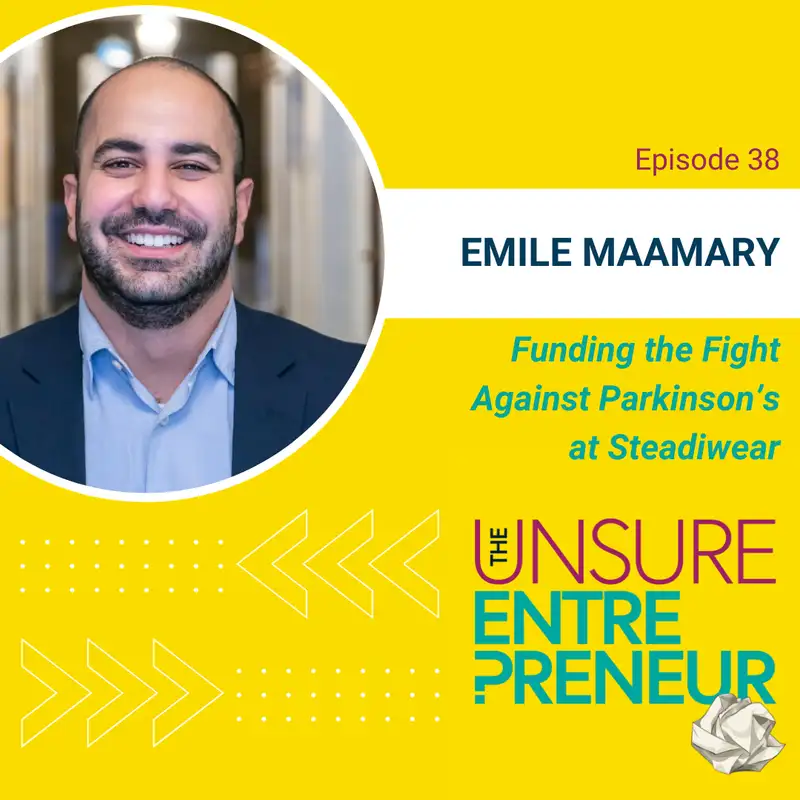
How a Health Tech Startup Raised $5 Million (w/Emile Maamary)
Emile Maamary
The Unsure Entrepreneur Podcast Ep38
SUMMARY KEYWORDS
Entrepreneurship, Steadiwear Wear, Parkinson's disease, essential tremor, non-invasive technology, tuned mass damping, grant funding, angel investors, product development, market demand, healthcare innovation, customer feedback, business growth, small business grants, Zensurance, insurance.
SPEAKERS
Roger Pierce, Emile Maamary
Emile Maamary 00:00
Whatever you think it's going to take to build multiply that number by three. That's how long it actually takes.
Intro 00:06
You're listening to the Unsure Entrepreneur Podcast with Roger Pierce, whether you're scribbling business ideas on a napkin or wrestling with the should I shouldn't I question. Get ready to explore the realities, the risks and the rewards of entrepreneurship as we share the stories, scars and successes of small business owners.
Roger Pierce 00:27
Hello and welcome to another episode of The Unsure Entrepreneur. I'm your host, Roger Pierce. Now today I'm going to introduce you to a founder who built his business out of love for his family and a desire to restore independence for people living with tremors, I always appreciate entrepreneurs who step forward because they see someone they care about struggling. Reminds us of why so many of us start business in the first place. My guest today is Emily Maamary, co-founder and chief marketing officer at Steadiwear, a Canadian health tech company creating non invasive stabilization solutions for people with Parkinson's disease and essential tremor now. Emile has over 10 years of experience in marketing, operations and strategy, along with an executive MBA from Cornell and Queen's University, impressive, he has helped Steadiwear raise more than 3 million and generate 1 million in revenue. Wow, that's great. The company's flagship device is called the Steadiwear three it's a wearable glove that instantly reduces hand tremors for over 75% of users. The device has helped more than 5000 individuals to date, and that impact speaks for itself on people living with essential tremor disorder or Parkinson's related tremors. I've got a relative suffering from Parkinson's. So this is very, very good news. You're developing this stuff. And recently, Emile won the third annual $10,000 Zensurance small business grant for 2025 Zensurance created this annual grant to help early stage Canadian founders access capital gain national exposure and learn how to reduce risks through smart insurance and business planning. It's a meaningful program that offers the kind of support every early stage entrepreneur needs. Welcome to the podcast, Emile. Thank you so much for having us, Roger. You know what? We're going to have a lot of fun because your story sounds fascinating and you won this prize. We're going to talk about that. We're going to talk about what you're what you're going to do with it. But first of all, did I miss anything there in the introduction? Can you add more context to what you guys
Emile Maamary 02:33
are doing? Yeah, absolutely. You know, just to give you a little bit of background, our mission is to restore independence for those living with hand tremors through elegant, non invasive technology and a little bit of our personal story. So both Mark and I, Mark is our CEO, Mark Elias, we both have tremors in our families. Both our grandmothers suffer of essential tremor. That's really what led us to starting this company and how it came to existence. We were seeking out solutions for them, and realized that there was a gap in the market somewhere between medication and surgery. And thought, you know what Mark's background is in structural engineering, and he wanted to approach it from that perspective. So he decided to build out a device that worked with a very similar technology that you've seen an earthquake design. Maybe it's, maybe you've seen those buildings that shake with an earthquake. It's called tuned mass damping. And that's, that's really what's implemented in our device. It's a it's a magnetized tune mass damper, which acts like a counter acting force, similar to like a seesaw. And once you wear the device, it instantly reduces your tremors, has no side effects, no batteries, and we try to keep it as lightweight and powerful as possible.
Roger Pierce 03:51
Wow. Now, for those of you go to his website, you can check it out at state was a Steadiwear wear. Doc, yes, yeah, calm, that's right. There's a picture of it there and describe what I'm seeing. It's kind of like a little almost like a hockey puck size thing with a strap…
Emile Maamary 04:07
Absolutely, yeah, that's a great way to describe it looks like a hockey puck on the back of your hand. We are working on the newer version of our device, but for now, this one was launched a couple of months ago. We've seen some great results. It's working for essential tremor and Parkinson's disease. We have launched it to 2000 customers to date, across United States, Canada and a couple in Australia and Hong Kong too. We've seen it work for three out of four people. It's working successfully and reducing the shakes, allowing them to feed themselves, drink a glass of water, dress themselves. We've heard it all. There are people using it to apply makeup on their faces, again for the first time in over multiple decades. There are people using it for simple activities at home, like DIY stuff. There are people playing the clarinet with this device on so it's. Great to hear all the different activities our non invasive technology is allowing people to perform again.
Roger Pierce 05:06
That's impressive. Very impressive. Let me go back to the beginning. And you know, most founders can point to the exact moment the idea took hold. Now, in your case, the spark came from your own family's struggle with tumors. As I understand, but I want to listeners to hear how a deeply personal challenge became the foundation for this life changing product. Can you dig a little bit deeper into the family experience that led to this creation?
Emile Maamary 05:32
When you're sitting with a family member, you typically have a cup of coffee together. If you have a tremor, holding that cup of coffee or grasping it is a real challenge. You're spilling everywhere. You're not able to control it very well, and as a result, you really don't want to grab that cup of coffee anymore. You put it down. You're frustrated. That was exact experience that Mark had with his grandmother almost a decade ago now, where he was sitting having a casual cup of coffee with her and realized that her tremors were flaring up every time she intended to take a sip out of that glass. And that resonated with me, because I've seen that happen with my grandmother too. It really is a debilitating problem. The simplest daily activities like drinking become a real challenge, which cause frustration, and, you know, reduce your quality of life. Can even lead to social isolation in some cases.
Roger Pierce 06:24
Wow, those are life altering challenges. So what makes the product unique? And what did you learn from like the first couple of prototypes?
Emile Maamary 06:32
Oh, my goodness, we learned so much. First of all, whatever you think it's going to take to build, multiply that number by three times and that that's how long it actually takes, and that's how much, how much more money you need to build it. So manufacturing is a really something that takes a long period of time, sourcing parts, takes a long period of time, building out the supply chain, takes a longer period of time than you're expecting to especially if you're not based in a country that is really well known for manufacturing. So we had to source a lot of components from different countries. We had to head out to their facilities, build out relationships. It was definitely a challenge, language barriers, timelines were stretched, resources were thin. That's on the manufacturing side, the feedback that we've gotten from customers over the years, they're typically saying, you know, we want something lighter. We want something more effective. We want something that's working for both of our hands. So they want a bilateral solution. They want something with no batteries so they can use it for as long as they want. And they want something affordable. So the intersection of all these things with the least amount of side effects, is why it took us almost five years to build out the first product, and then for the first product, we were able to miniaturize to the second product, and then further miniaturize to the third product, and hopefully more miniaturization is coming or the fourth product.
Roger Pierce 07:57
And so are you on Steadiwear three or four right now?
Emile Maamary 08:00
That's right, we're on Steadiwear Three. We're expecting Steadiwear Four in around a year and a half or so.
Roger Pierce 08:05
And is this thing? Do people pay for it under their own pockets? Is it covered by, like, OHIP?
Emile Maamary 08:10
Yeah that's a great question. It's out of pocket for everybody. Unless you're a veteran in the United States where our device has been covered, kind of distributor, yeah.
Roger Pierce 08:19
Okay, so it all depends on your situation, I guess.
Emile Maamary 08:23
That's right. And Canada, unfortunately, there isn't really a streamlined path for reimbursement for a device like ours,
Roger Pierce 08:29
but it's worth it because it's life changing, right?
Emile Maamary 08:32
Yeah, it's, it's, it's definitely making a big imprint on people that use it every day in the positive fashion. It's something that the feedback speaks for itself. The reviews online are speaking for itself too. And our video testimonials, if you ever have a chance to take a look at them, you'll see just how much frustration is alleviated with the device on for these people.
Roger Pierce 08:55
I did poke around on the website, there's some impressive testimonials and images and explains it all so well. I love it.
Emile Maamary 09:01
I appreciate that. Thank you. I'll relay that feedback to our website team. It's a
Roger Pierce 09:05
complicated business. You're in building a medical tech business demands, I'm sure, a lot of patients discipline and an Iron Stomach, because you're navigating regulation, Health Canada, safety testing, long development, like I said, long development cycles, five years so, you know, that's a lot of stuff to help entrepreneurs who are looking at getting into this process. So can you talk? We'll talk a little bit more about what that actually looks like in the early years, because most new founders have no idea what they're in for until they're already in. It a couple of questions here. I'll just throw them at you, like, how did you move from an idea to a working prototype?
Emile Maamary 09:44
What's that process like? We were very fortunate to be mentored along the way by an incubator out of the University of Toronto called the Impact center. That program has been, has been shut down, but they, they really gave us a lot of the blueprints of you know how to. How to build out your own product. They gave us access to machining. They gave us access to product developers. They brought in other inventors that helped helped us, you know, really visualize how we would achieve our end goal and develop the product. And, of course, along the way, we met some very influential advisors that really helped us move the needle.
Roger Pierce 10:22
Tell me more with these advisors or mentors, who are these people?
Emile Maamary 10:26
There are all sorts of advisors that we've been working with along the way. Some of them have med tech experience. Some of them are really just people with a financial background that have helped us build out better models. But really it has to all come together, right? Sometimes, when you're building a product, even if it works, it doesn't mean it'll get adopted, because when you're building in healthcare, you really need to be in sync with the payer, too, because a lot of these devices, if they're not covered, there's a financial gap, and people are used to getting insured or getting covered, or, you know, having having these things paid for them by the government, especially in Canada. So when you are building strictly for the patients, you have to always think about who's going to pay for this thing. That's something that we we struggled with. In the beginning, we were we were building strictly for for the customer, and over the years, we better understood the healthcare model, and now we're also building for the payer to actually achieve better outcomes for everybody involved, with a primary focus on the patient, of course.
Roger Pierce 11:25
Boy, that's a whole bunch of stuff to unpack, because as an entrepreneur, I always say, you know, market demand, you got to ask the customer first, build for them, but you got to build for a couple parties here, you got to make sure that it's working for the Customer, the patient, but also the government, or whoever else is going to fund this thing, right?
Emile Maamary 11:44
Absolutely, and every government thinks differently. Like it was easy to get customer feedback in the beginning, because we would like go out to, you know, essential tremor support groups, Parkinson's support groups, engage with the foundations, like the International essential Trevor Foundation, where we could survey their population, and they would be able to give us a lot of positive feedback on what the features we need to build are for the device, but when you're engaging with the government body, you're not always going to get the same level of feedback. You're not going to get the same turnaround either. And unfortunately, if you're living in Ontario there, there really isn't a way to get an orthotic device covered through the assistive device program. Despite our device being an assistive device, it doesn't fit into the requirements of that program.
Roger Pierce 12:28
Is that something you're trying to change, or is that just something you got to live with?
Emile Maamary 12:33
I think we're at the live with point right now. We we've tried to engage with that body multiple times, and we haven't seen too much flexibility. So it's definitely something that's challenging to navigate, but somehow we find ways around it. Like, for example, we recently implemented a program on the website where you could pay for the device and tranches, monthly tranches over a year, that you know relieves the customer or the payer in this point at this in this case, a lot, and that way, we also allow them to feel like it's not such a big sticker price. And we've also implemented an option where they can, they have a 30 day money back guarantee. So if they try it, they don't like it, they can always return it. So you got to find ways to de risk it that will allow for a higher adoption.
Roger Pierce 13:22
You are definitely an entrepreneur. You are a patient, persistent. You find solutions.
Emile Maamary 13:28
Yes, something we're really excited about rolling out in the next year is is a demonstration program where we're going to be rolling out devices to different clinicians that we've been engaged with across the United States and Canada, so patients can actually try this device from their physician's office. That's something that we see an interest in. Over the past six months, we've been attending different conferences in the USA and Canada, where we've garnered interest from over 300 clinicians. So once we're done building out this next batch, we'll definitely be shipping them out to these clinicians so that they can try it with their patients on site, then hand them a brochure, and then the patient can decide whether they want to buy it from the comfort their home after having tried the device. Big difference for us.
Roger Pierce 14:13
So one of the burning questions I got to ask is you raised $3 million to get your business going in this expensive proposition, you're building a medical medical device for goodness sake. So share some insights, if you can, on how you got that money, where you got that money, how you're making it last.
Emile Maamary 14:31
Oh, my God, honestly, none of this would be possible without the grant systems that exist in Canada. Because to get to the point where we were able to raise money, we had to leverage over $1.5 million in different grants from organizations like age well, Ontario Brain Institute, Ontario Bioscience Innovation organization, the Center for Aging and Brain Health Innovation out of Baycrest hospital. Those are some of the early supporters that gave us that first stamp of approval through different pitch competitions. There. For government grants that allowed us to build out our first prototype. The last organization that also supported us was the Ontario centers of innovation. Back then, it was called OCE, Ontario centers of excellence. Those are really the organizations that gave us that first level of trust, which allowed us to build out a prototype, which then allowed us to go back to investors and say, hey, you know what? We've actually built something that we know works. We validated it in a small setting, and we were looking to commercialize it. Can you help us with some funding for commercialization?
Then we would go out to in our case, we went out to more angel investors and venture capitalists because we were raising a smaller amount of money at a smaller valuation. So it wasn't really on the radar of some of the VCs, and we kind of liked it that though, that way, the terms were a little bit more flexible, and we really found individuals that were passionate about what we were building. A lot of our existing investors, they understand what we're building, because they've seen the problem firsthand, whether it's in friends or family. And so that's something that we really appreciate. We've been very fortunate to have, you know, supportive individuals that are mainly angel investors along the way help us raise the funds. It took a little bit longer, but we're very grateful to have gone down that path.
Roger Pierce 16:17
Wow. I want to dig into some of that there, not to give away any trade secrets, secrets or specific amounts. But of that three, roughly how much was government grants versus, say, angels.
Emile Maamary 16:27
The three was mainly angels. There was probably around two or two and a half government grants, tax credits, aside from the three. So the total is five. But when you ask how much you've raised, you refer to how much was diluted in your business. So that's why I answered with three. So three from angel investors, yeah, three from investors, and then two from government, maybe two and a half.
Roger Pierce 16:50
Now, why do I have 3 million here? Okay, so it's more like 5 million.
Emile Maamary 16:54
Yeah. Total Amount secured would be 3 million. Of it was raised through investors, and the rest is non diluted funding.
Roger Pierce 17:00
That's fantastic. The song and dancing you had to do get a little bit of money from one party, show the other party that you're getting the money go back, back and forth. It's a momentum thing. It's a bundling thing. Congratulations. That's not an easy feat, my friend.
Emile Maamary 17:15
I sincerely appreciate that. Thank you.
Roger Pierce 17:17
But it raises a point I often like to raise with new entrepreneurs, there is a lot of money out there with government grants, subsidies and programs. There's billions of dollars in the States. It's hundreds of billions of dollars for small businesses. For entrepreneurs, you got to dig you got to go to canada.ca, and fared through all the pyramid the hierarchy of different government grants and programs. There's money out there for what you're doing. There's money to hire people and pay them back some of their salaries. There's tax credits, there's all kinds of stuff out there. If entrepreneurs look right,
Emile Maamary 17:51
absolutely, some of the places to look really are. What I've found is following or connecting with program managers from different organizations on LinkedIn is a great way to start. Sometimes you'll find these resources through university programs too. I think every single Incubator has representatives from the government that come to incubators to share the programs names and details. So that's another way to find them. So that's really valuable information. If you're looking for it, you'll also find that there are also a lot of pitch competitions that are listed, not necessarily on government websites, but through maybe corporate companies that are interested in investing in the space or have an interest in bringing on innovation. So for example, like St Elizabeth health, se health, they have the chrysalis innovation chess showcase or challenge that we want not too long ago. But it's a great place to connect with other home health or other healthcare employees or team members that can really move the needle. Help you set up a pilot. Aside from the money, you know, the contacts, there can be very valuable.
Roger Pierce 19:04
Any bank financing in the mix, or was that kind of a third level?
Emile Maamary 19:08
You know, what? We recently took on some debt through BDC Business Development Canada. We tried our best to avoid that. You know, along the way, when you're in hardware, working capital as a loan is not something to shy away from, because, at the end of the day, if you're using it strictly for strictly for inventory, it will come back as long as you can sell the product.
Roger Pierce 19:26
Good advice. I love it. Boy. You could give a lesson on how to raise money for your business.
Emile Maamary 19:31
Perfect. You know, it's been almost a decade now.
Roger Pierce 19:36
Speaking of money. What brought us together was our friend Liam Lahey at Zensurance. He told me about your big win at a conference a couple of weeks ago, and I said, Oh, I got to talk to that guy. Get his story. We're talking about the Zensurance Small Business Grant. I've always encouraged people to look at that. I think, like you said, it's a great source of potential money for the winner. So every year, one Canadian small business. Receives $10,000 along with a media spotlight, insurance guidance and real momentum at a critical stage. But there's also five $1,000 winners, I believe. So let's talk a little bit about your experience with that, Emile, when did you decide to apply? What was the process like?
Emile Maamary 20:19
You know, I stumbled upon this competition actually through an ad on Instagram. I've pre programmed my Instagram ads to highlight on different competitions as ads, because I always click on click on these different things and discuss competitions with friends and maybe Instagram is listening. In a nutshell, we came across the program through an Instagram ads. The application process was super easy. The prize money was was appealing. We hadn't really engaged with Zensurance in the past, so it was a pleasant surprise, because sometimes these kind of competitions are linked to existing customers only, and these organizations shy away from opening it to the public. Let's say it was a great coincidence, and we were very fortunate to have won the prize, we were able to garner over 400 votes to get us into first place. We're probably going to use that money towards our next hire, probably going to be somebody in operations to help us with the except, you know, the more demand that we're getting.
Roger Pierce 21:15
So that's perfect. So you're going to use the money to expand to hire some help?
Emile Maamary 21:18
Absolutely, God knows, we need it.
Roger Pierce 21:21
Any advice along this lines? I mean, you said one for these things, but any advice for someone looking for this kind of contest and funding?
Emile Maamary 21:27
There's a website called f 6s F as in Frank, the number six and then S as in Sam, where you'll be able to identify all the global pitch competitions that are listed. Obviously these, like local ones that have a smaller footprint, they won't be listed up there, but it's a great place to kind of look for new programs, new accelerators, new pitch competitions on a global scale. You'll also find a lot of these things listed on LinkedIn too, through the grapevine, you'll a lot of people will share them. And yeah, it goes back to that community feel of engaging with government organizations or semi government organizations that will amplify the voices of some of these funders.
Roger Pierce 22:09
I love to see corporations like Zensurance step up and put some money on the table to help small business owners. There's, there's more that is needed by companies. Definitely, you know,
Emile Maamary 22:20
Definitely more small business grants and competitions and prizes for small businesses. Because, as you know, small businesses are the backbone of Canada.
Roger Pierce 22:28
Absolutely. 98% of businesses are small businesses — go entrepreneurs. That's what we're all about. Yes, sir. So thank you for sharing your Zensurance experience. That's a lot of information to mine there, as we look at the clock, I want to get into some of your guidance for unsure entrepreneurs, some of your lessons. You know, I know your journey hasn't been quick or easy. 10 years you've been at this You've obviously got a mission. You're doing well. You got momentum. I'm happy for you, but I want listeners to what are some of the mistakes they can avoid. You're willing to share.
Emile Maamary 23:01
Try to build something as simple and needed as possible. Try to validate it as much as you can beforehand. If you're able to test it with a small population, get as much feedback as possible before launching it. It's it'll really, really improve the chances of it catching some scale. In the case of hardware, I would encourage you to be as close to your manufacturer as possible, if not physically, then at least build a strong relationship. You want to make sure that there's a market for what you're building, and some great ways to do that is through serving a population. It doesn't have to be you can try to garner some of the existing frameworks that will help with product market fit. In the age of AI, you're able to do this all very, very quickly. So I'd encourage you to leverage that, try to go back and forth with a different person who working with you on the product, you know, your engineer, or anything of that sort. And you can always use things like chat, GPT to drive you in the right direction when you're in the ideation stage, try to make it challenge you, and then that'll maybe save you some time when you go back to the engineer to describe the product you're building. When it comes to commercialization, I would say, you know, trade shows are really, really valuable. Getting that first hand experience, those relationships that you're building with potential distributors, they don't go unnoticed. That's really where you're going to find your first customer, if you're going if you're building in the B to B space, and if you're in the B to C space, you know, I always encourage people to garner feedback from their local communities. And if you're building an application, you know, maybe a good place to start is to garner some feedback from some students in the local universities try to see if you can better understand how they think that's a really affordable way to do that.
Roger Pierce 24:40
All good advice, product, market fit. I love the way you said that really important in your case, you're building an expensive operation. But you know, this is where most small businesses fail. They run out of money too, but they run out of money a lot of times because they didn't check the market to make sure that it's something that people are going to buy. You clearly have done that, and you keep it a. Great. And you keep adding a new product coming out. You got a number four coming out. That's fantastic.
Emile Maamary 25:06
Thank you so much. Yeah, it's been an uphill battle, for sure. It's a work in progress. Every version requires a different level of intricate detail, and we've been we've been constantly serving and testing out every single iteration that we make with our beta testers. Big shout out to them. A lot of these people are not they're not doing this for any financial reward. They're doing this for the for the benefit of the greater community,
Roger Pierce 25:29
giving back to others in the same situation. Absolutely good for them. Absolutely Okay. Looking ahead, let's look forward a little bit of a picture without giving any trade secrets. What's ahead for you? I know you got plans beyond the current product lineup. Can you share what the future looks like?
Emile Maamary 25:46
Yeah, trying to get this device reimbursed, trying to expand it to different markets outside of North America, I would say those are the two main things. And then once the rollout for version four is ready, we'll be looking for another product, a different line, that we can expand on to also help people in healthcare. So I'll leave it at that. Let your mind imagine.
Roger Pierce 26:10
For sure, because you've got, obviously, brand recognition. Now people know the product and the name and they trust it. So now, naturally, you can offer more solutions. That's exactly right. Love it, building a brand and rolling out around the world. Okay, I know you got a business to get back to you, so we'll lean towards the final couple comments and questions. What's one question you wish aspiring founders would ask themselves before they start a business?
Emile Maamary 26:37
Who's going to pay for this? That's the first question that always is on everyone's mind, especially in healthcare, and I think it's applicable to a lot of other businesses, business models too. You know, you really think, who's the payer and how much are they willing to pay?
Roger Pierce 26:51
Who's gonna pay for this? This is the problem. A lot of entrepreneurs get so excited. I've been guilty of this about their idea or their service, they jump right in, they build it, and they go, no one's gonna buy this? Yeah, it's true. That's great advice. Great advice. It's time to wrap it up. A shout out of thanks again to Liam and the Zensurance gang for putting Emile and me together here today. I really enjoyed this conversation, but here's my quick recap. What we learned from Emil that meaningful businesses often start with a personal mission, that Steadiwear progress beats quick wins. He's taken a long time to build this business, and that grants like Zensurance Small Business Grant, can give a founder the lift they need at the right moment. So Emile, thank you for taking the time to share your story and insights.
Emile Maamary 27:38
I really appreciate it. Roger, thank you so much, and I'll invite the listeners to visit our website to learn more about our product and any updates that could be announced in the near future. Thank you very much.
Roger Pierce 27:49
Give the website another plug for us. It's www.Steadiwearwear.com
Emile Maamary 27:54
And it's spelled S, T, E, A, D, I, W, E, A, R.com,
Roger Pierce 28:00
Steadiwear wear with an “i”. Great name, great name, fantastic.
Emile Maamary 28:04
It looked better when we were drawing out the logo that why hanging in the middle was complicating it.
Roger Pierce 28:10
It's fantastic. Definitely check out the website and reach out if you want to. So thank you listeners. Thank you all of our unsure entrepreneurs for joining us. Please be sure to check back for more episodes, and don't forget to check on UnsureEntrepreneur.com or we've got tools, resources, stories, lots of good stuff for people on their journey. That's it for now.
Intro 28:32
That's it for this episode of The Unsure Entrepreneur Podcast. Thanks for listening. Be sure to subscribe so you don't miss other candid conversations with small business owners and be sure to check us out at unsureentrepreneur.com.