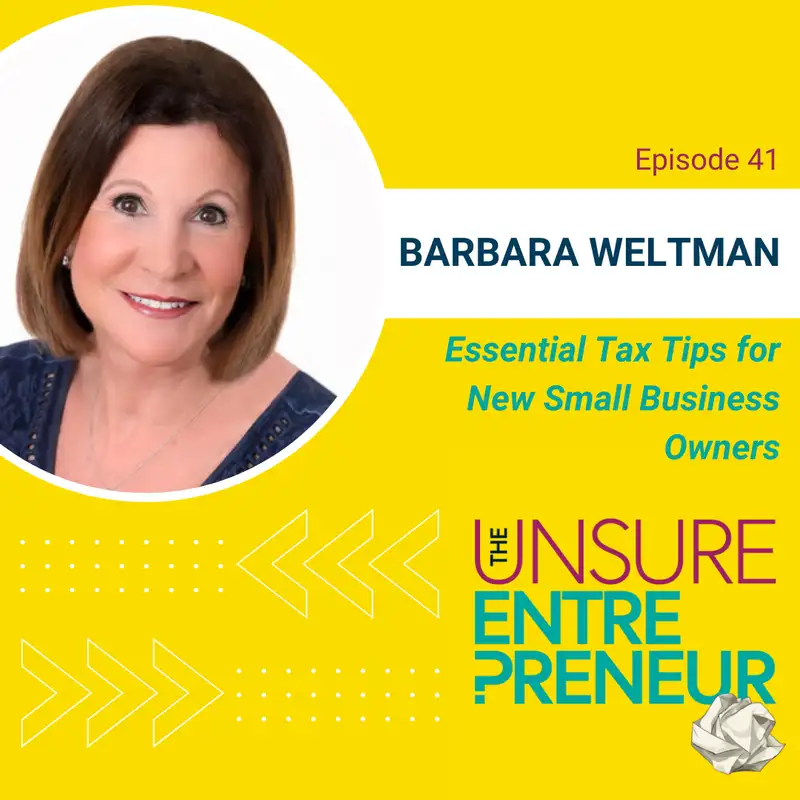
Hard Truths and Tax Tips for New Entrepreneurs (w/Barbara Weltman)
Barbara Weltman Episode 41
Wed, Apr 15, 2026 2:00PM • 32:01
SUMMARY KEYWORDS
Entrepreneurship, taxes, compliance, financial discipline, small business, Barbara Weltman, Big Ideas for Small Business, regulatory burden, cash flow, revenue, home office deduction, business advisors, business risks, business success.
SPEAKERS
Roger Pierce, Barbara Weltman
Barbara Weltman 00:00
Can you tolerate the risk when you're putting it on the line? You're not only putting your money on the line, but you're putting your ego on the line, your hopes and your dreams are on the line there. And are you ready to risk it all?
Speaker 1 00:11
You're listening to the unsure entrepreneur podcast with Roger Pierce, whether you're scribbling business ideas on a napkin or wrestling with the should I shouldn't I question get ready to explore the realities, the risks and the rewards of entrepreneurship as we share the stories, scars and successes of small business owners.
Roger Pierce 00:32
Hey, everyone, welcome back to the Unsure Entrepreneur Podcast.
Today. We're talking about something every entrepreneur must deal with whether they like it or not, taxes, compliance, financial discipline and the real world issues that determine whether a business survives beyond year. One My guest today is Barbara Weltman. Barbara is an attorney and one of the most trusted professional advocates for small businesses and entrepreneurs in the United States. She's the founder of big ideas for small business. That's BigIdeasforSmallBusiness.com which is a comprehensive business resource center built around a simple mission, we make entrepreneurs smarter. And she's been doing exactly that for decades. She is the publisher of a nationally recognized idea of the day, which I've been enjoying, and the free monthly e newsletter Big Ideas for small business, both of which provide practical guidance on the issues that matter most to small business owners. You know, taxes, health insurance, energy costs, regulatory change, employee retention and more. Her blogs win national awards annually, and Barbara is also a best selling author. Her books include JK Lasser's 1001 Deductions and Tax Breaks 2026, Home Based Business Startup Guide, and 500 Plus Big Ideas for Small Business and a book called Smooth Failing. She previously hosted, Build your Business Radio, has served as an Adjunct Professor teaching entrepreneurship, and is currently on the advisory board of the Small Business and Entrepreneurship Council. Her commentary has appeared in The New York Times, Wall Street Journal, Washington Post, Fox News, CNBC, and many, many more.
So in other words, when it comes to understanding the real mechanics of running a small business in America. Barbara has seen it all.
Barbara, welcome.
Well, thank you so much for having me in the great introduction.
I like to give some context, because you know, you've got so much, so much experience in small business and entrepreneurship. I wanted people to know what you've been into and to check out the website and all those good things.
Well, thank you.
I've got a number of kind of themed questions for you. So the first one I want to talk about is kind of like, you know, this show is for new entrepreneurs, people getting going in the early stages, unsure entrepreneurs. So I want to explore Big Ideas for small business, and maybe you could share what entrepreneurs overlook. Barbara, you've built up a huge platform, and it really is a large, robust advice platform around helping entrepreneurs become smarter and more informed. I love that, by the way, and indeed, I'd have to say, many of America's 33 million small businesses operate without formal advisory support or structured planning. So when you look across the small business landscape today. What are a couple of the big ideas entrepreneurs should really be paying attention to?
Barbara Weltman 03:27
When people start their businesses, they're very enthusiastic about what their business is all about, and they want to get started, they want to make sales, they want to connect with their customers, and they want to promote their brand. But what I help small business owners focus on are the unfund things, the things that you have to do to actually survive, meaning, tax, financial and legal matters that if you don't do it, your business is not going to survive. So for example, with tax, I always tell people, taxes are the difference between what you earn and what you keep, so you can be making great sales, but if you're paying all all of that out in taxes, that's not a good thing. If you're not tracking your expenses, you may be in a losing position despite your robust sales. So that's kind of my focus for especially new business owners, but it goes for all business owners.
Roger Pierce 04:23
Fantastic. I'm going to dig deeper into some of your tax tips in just a minute. Maybe you can help me qualify. You know what's a big idea in small business? Or maybe some patterns that you've seen that help businesses thrive versus those that quietly fail?
Barbara Weltman 04:37
You know that old expression, everything old is new again. There are so many things that change. There are so many things that stay the same. So we've seen so many dramatic changes, most recently with AI and what that's doing for businesses, that's a big deal. But over time, you can see that that there are always technology changes. And that we have to continually adapt to. I mean, I remember when I got my first computer and when a fax machine was new, and you had to learn how to do all of that. So businesses have to adapt to changing technology. And then there are economic changes that are always coming about, whether it's interest rates that go up, that go down, and what it means in terms of your capital. Other issues, supply chain issues we remember during covid, that was numero uno of challenges for businesses, but it's still a question for many businesses that rely on that. It's not one big idea. It's that the ideas are just big. AI is big, and you have to kind of wrestle with it, going through what the ideas are. The ideas are continually changing. There's continually things that are new, but you need to be reminded of things that haven't changed, that we still need to focus on in terms of connecting with our customers and maintaining our integrity and all of that.
Roger Pierce 06:05
You raise a couple of really good points there. There's some business basics we have to get right, you know, taxes, accounting, sales, but then we also have to keep learning right, like you're saying, We've got to pay attention to AI and all these trends that are going to impact our business, right?
Barbara Weltman 06:19
Yeah, well, I have little sayings taped to my monitor. So Benjamin Franklin said An investment in knowledge pays the best interest. And Da Vinci said Learning never exhausts the mind. So you have to kind of continually pay attention to changes, and because not only the change is challenging, but they present such great opportunities that you don't want to miss.
Roger Pierce 06:43
I write about this now and then, one of the joys of being an entrepreneur, maybe you can comment, is learning. You get to learn so much. I often tell people you're going to learn more in your first year of business, and you did probably all through university or college, because it is such an accelerated learning experience. You've got to figure out marketing and sales and accounting and taxes and HR, it's a lot, but it's exciting, isn't it?
Barbara Weltman 07:03
Well, definitely. And people say, Well, you know, why are you still doing this? Like you pointed I've been doing a long time, and it's because every day there's something new to find out and discover and read about something, and it takes me down a rabbit hole and to learn about that. And it's so it's continually interesting and rewarding too, because in many cases, you're learning very practical things that you can translate into successes for you.
Roger Pierce 07:28
And you share them so well on your platform, you get the blogs, you get the Business Idea of the Day. How do you stay on top of all that's a lot of output.
Barbara Weltman 07:36
Well, I read a lot, that's all I have to say. I have a lot of resources that I check every day, and they prompt me to know what's going on.
Roger Pierce 07:46
I wan to ask you, too, before we move off this though, red tape burden, regulatory burden. Do you think small business owners pay enough attention to that getting into this game? Is it something that catches a lot of entrepreneurs off guard? How much red tape there is to deal with?
Barbara Weltman 08:00
Well, I saw this statistic, which blew me away, that in during the past four years, the previous administration finalized $1.8 trillion in new regulatory compliance costs and added 356 million hours in paperwork. And the burden falls disproportionately on small businesses. And small businesses, unlike major corporations that have departments to handle legal and accounting and everything, small business owners have to do much of the legwork on their own. They just can't afford to turn to professionals, and they don't even know when they need to ask professionals. New things come up and they don't need they're even unaware of these regulatory changes. So, yeah, I think regulations are a real burden on small business and real challenge, and that's one of the things I like to try to point out, is there's new regs on this, and that, you know, Department of Labor issued that, and I can't stay up on every change in the state, local and everything. So it's a lot. It's a lot.
Roger Pierce 09:04
But, you know, I saw one of your tips today. Was a great little tip. What was it about getting a stamp, a tie, a stamp, when you file your tax return at the post office, that's helpful stuff, right?
Barbara Weltman 09:14
Well, that's what I try to do. I mean, that's kind of how I see my mission, how I'm giving back to the small business community, because I do a lot of this stuff for free, and I'm just sharing this information because I think it's valued. And I get some feedback. I don't get as much feedback as I would like from people. I get questions all the time, and I answer them, and people don't even say thank you. I don't know. Where did we lose that kind of civility? But all right, anyway, I find it rewarding to be helpful.
Roger Pierce 09:46
Well, on behalf of all of those small business owners out there, we thank you for all you do and all of your great advice. I'm going to segue now to tax information, because I know this is an area you know a lot a lot about I'm guilty in. This Barbara, stick my head in the sand when it comes to taxes and the accounting. I'm a marketer. I'm a content guy. I want to talk about tax mistakes that you see new entrepreneurs making, and remembering that the show is for, you know, the earliest of the early entrepreneurs getting into it, where I'm probably going to say most mistakes are made, right? Because we're they're new at the game, and there's a lot of anxiety, I think, around taxes and paying them and being on time, and some people are petrified of the deadlines and don't know what to do. But here's a stat. The IRS estimates the annual tax gap is over 600 billion much of it tied to under reporting among small businesses and sole proprietors. That tells me that tells me that a lot of entrepreneurs either don't understand their obligations or under estimate them. Now, you've written some of the most widely used small business tax guides in the country. What mistakes do you do you see that you can talk about?
Barbara Weltman 10:52
Well, it's a great topic for me, because I'm in the middle of revising for my 2027 edition of JK Lasser small business taxes, which I've been doing for 30 years. So I see the changes all the time. But for newbies, one of the biggest things I see, the biggest mistakes that they being made, is that they don't separate their personal and business finance. They have one credit card. They don't have a separate credit card for business. They have one bank account. They don't have a separate bank account for business, so that's that's the easiest way to get started and be on the right track, so that you don't commingle your activities. And clearly, when it comes to doing your taxes, it will make it a lot simpler to see what expenses are exclusively business. Another problem is record keeping. When it comes to your personal finances, the IRS is not that picky. You want to throw your receipts in a shoe box. Go for it. But the law requires small businesses, all businesses, actually, to keep books and records. You don't have a choice. The good news is you don't have to be a math genius to do it. There's so many, so much software and even mobile solutions to just all you have to do is enter your income and expenses. You don't have to it automatically. Will populate what it needs to automatically. And so it's simple, but you have to do it, and then having that information will enable you to prepare your taxes correctly and not overlook expenses and credit deductions and credits that you may be entitled to. Big Issue is also keeping what's called substantiation. It's not just enough that you have the expense, but for certain particular types of write offs, you need special substantiation. So for example, most small business owners use their personal vehicle for business driver. And if you want to deduct your business use, you have to not only have whether you're using a standard mileage rate that the IRS sets up every year, or you're going to deduct your actual expenses, you also have to keep a log of your odometer reading and the date you went took a trip and why you took that trip. Yes, there are apps that you can use to simplify it that GPS tied and but you still have to put in the GPS doesn't know who you're going to visit. You have to doesn't know you're making a trip to the bank or to Staples or whatever. And you have to put in that information. And I see so many businesses lose out on legitimate deductions because they don't have the right substantiation or other records that are needed to take the write offs.
Roger Pierce 13:32
Yeah. I mean, for entrepreneurs don't understand. I mean, if you're taking your car and driving to a client lunch and then you stop on the way home at Walmart to pick up groceries. There's tax implication to that, in theory, isn't there?
Barbara Weltman 13:44
Look, if you if you're not really going way out of your way, you know, I don't think it's an issue, but you need that record of going to meet with the client.
Roger Pierce 13:53
I love it, because nobody wants to pay more tax, right? Barbara, we want to minimize our taxes. We want to be profitable. We want to give our business as much fuel as we can to succeed like you. I hate it when entrepreneurs miss out on all those deductions. Can you give an example, say, of a home based business deduction that many because most people do start their business at home, might be missing out on?
Barbara Weltman 14:13
Well, if you're self employed and you work from home, you may be able to write off what would otherwise be personal expenses. So you can take what's called a home office deduction if your home is your principal place of business and you use space regularly and exclusively for business, meaning your kitchen is never going to be a home office, because you're never going to use it exclusively for business. But if you have a spare bedroom or even a corner of a room, it doesn't have to be a whole room. It doesn't have to be partitioned. It just has to be exclusively used for business or a place to meet with customers and clients on a regular basis, not just you're making phone calls to your customers or storing inventory. So. There are certain ways that would justify taking a home office deduction. And then, as I mentioned, you could take your actual expenses, which would take a long takes a long time to figure what you paid in your utility bills and your walk and your rent, your mortgage, you know, on and on and on. Or you can take the IRS created kind of what you think like a standard deduction, a per square foot deduction based on the square footage of your home office. So again, there is a way to do it, but you have to be self employed.
Roger Pierce 15:31
…and work with good software. Work with a professional tax preparer.
Barbara Weltman 15:35
That's a great question in and of itself. Do you DIY it yourself? Or do you work with a professional? And there's no single answer. It depends on your situation, how comfortable you are with there are people who love to tackle these things and stay on top of every tax nuance, if you will. But many people don't have the time because they're focused on running their business, and it pays to work with a professional to handle things, but again, just remember, the buck stops with you. You're responsible even if you use some outside assistance that you have to know what's going on. And the other reason why I think it's just this is, I think even more than what you're actually paying when you're preparing your return is that you kind of have to know about taxes to make savvy business decisions, because you have to know about the tax implications of hiring an employee or engaging an independent contract, buying or leasing equipment, buying or leasing your building, those kinds of things. It's challenging to make a good business decision unless you really kind of know the ramifications. Tax wise, you kind of have to educate yourself on what these things are all about. And as you point out, small business owners just don't have the finances to go out and have a CPA on retainer, if you will. So you have to kind of self educate.
Roger Pierce 16:58
Well, that's where your books come in, right?
Barbara Weltman 17:00
They help people, that's my goal.
Roger Pierce 17:02
Yeah, they help people learn. And I'll between things like your books, which are a great resource, accounting software. Shout out to one of my longtime clients, sage, sage accounting software. But there's lots of great solutions out there, QuickBooks and Xero, etc. And you know, when you have the time, reach out to a bookkeeper or an accountant, because while they will cost some money, I guarantee you, they will save you money with their knowledge and their deductions, and they know more about the tax landscape than the small business owner does.
Barbara Weltman 17:30
Well, I agree, 100% I think it's great if somebody wants to prepare their own return, because you can then see where the you see the numbers, you know what's happening, but to have a professional review it, to see that you didn't overlook something, or that you didn't make a mistake, is worth the extra money, not only for your peace of mind, but it may wind up saving you more in taxes.
Roger Pierce 17:53
And when you do engage an accounting professional, you'll probably agree on this. Don't just talk to them a tax time. Involve them in your decision making process throughout the year. Hey, I'm looking at buying or leasing a car. What are the tax benefits of those choices? Right?
Barbara Weltman 18:08
Exactly, I think. And you made an excellent example there, because it does matter when business is involved. It's one thing when it's your personal vehicle, but it's another thing when it's a business vehicle, and deductions come into play.
Roger Pierce 18:20
Good stuff. All right. Well, thank you for that. Your books, I'm sure I've got tons of great information to help people make sure we go to the website. We'll give a plug for that later on. So Barbara, I want to ask you about some advice for people who are starting up a business, some informed decisions maybe you can help them make. Now, according to the US Bureau of Labor Statistics, I quote this a lot, about 20% of new businesses fail in the first year, and roughly 50% fail within five years. Now you've seen entrepreneurs go through, you know, economic cycles, tax reforms, policy changes, as you talked about earlier, but if someone is on the fence today, what would you think they should be thinking about before they take that leap?
Barbara Weltman 19:04
Well, there's so much involved in becoming an entrepreneur and starting a business, and I think you have to really look long and hard at yourself. Are you prepared to put in the time small business owners typically work over 50 hours a week, and many work more. You're really never off the clock. You're thinking about it all the time. It could be Sunday evening, and boy, it's popping into your head. What are you going to do the first thing in the morning? And that's something. Another is the money involved. Are you putting your own money on the line? Do you have access to capital from various resources, and do you have enough to get started under capitalization is a reason that many businesses fail. They think it's going to cost X, but it costs two times x, really, to start, there are always delays. And get it opening up. You're going to open up a retail store, and your town doesn't give you your CEO right away, and so now you've paid rent. Another month and then another month, and it could be four months until you can actually get started. So again, you have to know if you have the finances there to back you up. And then I think there's just like a personal level there. Can you tolerate the risk when you're putting it on the line? You're not only putting your money on the line, but you're putting your ego on the line, your hopes and your dreams are on the line there, and are you ready to risk it all? As you point out, the statistics are not favorable again. Just because you fail is not a big deal in terms of society, because businesses fail all the time, and people start again and they start there may not be the first venture, the second venture, the third venture may be wonderful, but you do take a hit to your ego when things don't work out.
Roger Pierce 20:42
I've had 14 small businesses, and not all of them have succeeded. A couple of them have. I've had I've had a few. I've had some failures too, tanked. You know, they've tagged but it's the picking yourself back up, right?
Barbara Weltman 20:55
It is. That was kind of the reason for my book smooth failing, where I reached out to many well known entrepreneurs who share their experience of failure. Everybody's failed. My favorite example is certainly Abraham Lincoln, who had so many failures in business, and I could go on and on about his failures, but he obviously turned out to be a success. So again, we can learn from other people's mistakes. We don't have to repeat their mistakes if we know what to look for. And that was kind of the thought behind the book. Hopefully there are lessons there that we can all benefit from. But again, everybody fails at some point or another, and it's not fatal. Again, as you point out, pick yourself up and go forward, but before you're starting, make sure that you really understand what this could mean to you.
Roger Pierce 21:46
There's huge emotional risk to entrepreneurship that's often overlooked. Everyone talks about the financial risk, and on the shows like Shark Tank, et cetera, it's all about the numbers, but you're touching upon a really important consideration. Have I got what it takes, personally, emotionally? Am I in a good place? Am I resilient? That's tougher than losing money sometimes, isn't it? If you feel a personal blow.
Barbara Weltman 22:06
And also, do you have family support? I mean, if you have a spouse, a significant other, are they going to be supportive of the demands of the business?
And sometimes that has to take priority. And with kids and raising children, and a lot of people start businesses because they think they're going to gain flexibility and that they can, oh, I can schedule my own time, yeah, theoretically, it works like that, but a customer has an emergency, and you know, that takes priority over maybe going to see the school play of that your child is in. And there are tough decisions that come about, and are you prepared to make those kinds of calls? That was one of my questions.
Roger Pierce 22:44
What's a hard truth about entrepreneurship that really answers it? Well, are you prepared to make those calls? Are you prepared to deal with the emotional ramifications of getting into your own business? It's not all smooth sailing. It's not what we see on TV or on social media. Read stories like your like your book smooth failing. Read failure stories. I think you can learn a lot more from failure stories, sometimes than success stories.
Barbara Weltman 23:06
Well, I'm with you on that.
Roger Pierce 23:09
Before we move off the topic of advice for new entrepreneurs, I want to get your comment on cash flow versus revenue, because a lot of new entrepreneurs don't understand the difference.
Barbara Weltman 23:19
Well, big difference. So you can be making great sales and having revenue, theoretical revenue, but if you're not paid right away, cash flow is really the money coming in and the money going out, and sometimes it doesn't match up with the expenses that you have to pay, and that can really put a crimp in your cash flow, and not having sufficient cash flow is a serious problem for many businesses, unless they create some kind of backstop, like a line of credit where they can tap into funds if they needed to pay a certain bill that comes due because they haven't been paid by customer. And I know one of the problems for many small businesses that do business with large companies, large companies from I hate to generalize, but this is a generalization, that they think that you need them more than they need you, and they don't. They're not eager to pay you as promptly as you would like. You may say, Pay me in 30 days. And you know, 60 days, 90 days comes around and they're, oh, you'll get paid, don't worry, and you will get paid, but they're not in any big hurry, but begins because of that delay. You may not have the funds around to pay your suppliers or to pay your rent, and that that can be a real problem. I think it's important for business owners to use software that will help you track your cash flow so that you don't get yourself into a bad position. In other words, the software will tell you, well, in 12 days you have this expense coming up, and this way you can prepare for it. The other. Other thing to improve on your cash flow is certainly to get paid immediately. And it's so much easier these days with things like square where you can just take credit card payments, or you can pay pal or other electronic payment options so that you can get paid on the spot and not have to wait for payment. And that will greatly improve cash.
Roger Pierce 25:21
That's such a good point to remember, because a lot of new entrepreneurs are timid and B to B sales about asking for money upfront, I think you're right.
Barbara Weltman 25:29
You definitely ask for it. Don't be shy. First of all, when you don't get paid, the likelihood of not getting paid becomes greater over time. I've always said that accounts receivable are not fine wine that don't get better with age, so that you do need to stay up on collections and don't be shy. It's you earned it you should be paid. Squeaky wheel kind of thing. Just ask for repeatedly, absolutely, until they just want, until they just want to pay you and get rid of you.
Roger Pierce 25:59
The money is better in the small business owner's bank account than it is in the customer's bank account. I agree. Great advice, watching our clock here too. But I gotta ask you one question before we get into our wrap up. Question a top issue in your mind, confronting us small businesses. Right now, we're in winter, 2026 I had a recent NFIB study, that's the National Federation of Independent Business showing things like inflation, labor quality, regulatory compliance. These are all top concerns for small business owners and to a lot of us, it feels like complexity is rising, not falling. You stay very close to these things. What are one of the one or two top issues you think we should pay attention to?
Barbara Weltman 26:44
Well, labor quality you mentioned is a big issue. NFIB publishes a monthly report and tracks those various factors that you mentioned. And many small business owners just have a challenge hiring good health. First of all, they're competing in the workplace with big companies that offer a slew of benefits that small businesses can't afford. I mean, if a small business can can help in any way with health coverage, that's a big deal. And major companies will offer health coverage, retirement planning, child care, support and all kinds of other things that, for the most part, small businesses can't offer so you kind of have to, I think, become more creative in how to attract and retain good employees. Or, for example, many big companies are have done away with remote work arrangements, and small businesses may be able to offer that as an incentive and differentiate themselves. And so things like that will be helpful. I think, like I said, if you the report does identify the problem with that, with getting good workers and retaining them. Inflation, inflation is coming down, and I think that I know I have to laugh about it. I don't know if you if, but I remember when we had double digit inflation. For years, my mortgage was 15.3% so and, you know, and I went out and I bought a house, and then as rates came down, I refinanced. So inflation at 3% seems ridiculously low, and interest rates right now seem ridiculously low, but it's all relative. That's another issue. And then I have to repeat the regulatory challenges, the tax changes. We just came off of a major tax legislation last year which had so many favorable tax changes for small business owners, but so much new to learn about and deal with.
Roger Pierce 28:35
One more reason to go to your website and soak all of this stuff in. So Barbara, if you were speaking, wrap up question for you, if you're speaking directly to someone who is unsure, that's our audience, about starting a business and poking around at the fringes, what's one piece of advice you would want them to remember before they make that big decision?
Barbara Weltman 28:54
If you can create a team of experts that you can turn to that will give you a cushion to be able to get started. So you need, for example, as you said, I think a CPA or other tax pro. You need a lawyer who knows business, who could perhaps review you can write your own contracts as templates out there. But you want a lawyer to review it, you need an IT person. I couldn't live without it, without my outside IT person, maybe, maybe an outside bookkeeper. So you don't have to spend your own hours doing that kind of thing, putting together a core of advisors that you can turn to on an as needed basis will give you, you know, a backstop you can move ahead. But when you hit a hit a bump, where to go? You don't have to be hustling at that particular moment. You just check your contact list and go right to the expert.
Roger Pierce 29:48
Surround yourself with a team, a support team of professionals and experts. That's great advice, because entrepreneurship is isolating, isn't it, especially if you're coming from a big corporate job or you're used to hundreds of people around you in the next cubic. Now all of a sudden, ah, I got to do it all. It's overwhelming, you bet. Well, that's excellent advice. So what stands out from our conversation today? Let me see, entrepreneurship is about, you know, rewarding optimism, but it demands preparation. Entrepreneurs who stay informed, as Barbara has said, understand their obligations and respect the financial side business ownership are the ones most likely to see their businesses succeed. So Barbara, I want to thank you for taking your time to share your insight and experience. And where can people find more about you and your work, and subscribe?
Barbara Weltman 30:33
Go to big ideas for small business.com and through there, you can you can see the blogs. You can sign up for idea of the day, just put in your email. That's all that's required. It's free. It's like two sentences a day that'll pop into your inbox. And also there through the website, there's connections to the social media platforms, LinkedIn, X and such, perfect.
Roger Pierce 30:57
I'm going to put that in the show notes, and I am already following you on Twitter. So that's covered for now. Well, this has been fantastic. Thank you again. And before we end the show, for anyone listening, if you're still weighing whether entrepreneurship is right for you, I encourage you to check out my new book called The unsure entrepreneur. It's a practical guide for people who want clarity before they commit. You can find out more at unsure entrepreneur.com so thank you audience for spending time with me and Barbara, and if you're feeling unsure, remember you're in the right place.
Speaker 1 31:29
That's it for this episode of The unsure entrepreneur podcast. Thanks for listening. Be sure to subscribe so you don't miss other candid conversations with small business owners, and be sure to check us out at unsure entrepreneur.com