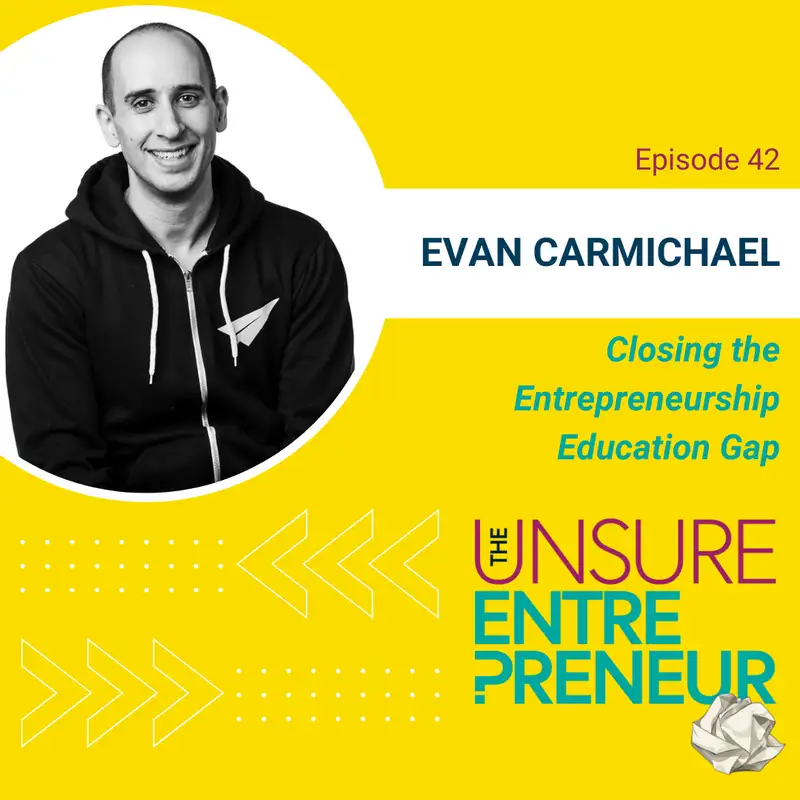
Closing the Entrepreneurship Education Gap (w/Evan Carmichael)
Evan Carmichael
Episode 42
SUMMARY KEYWORDS
Entrepreneurship education, Junior Achievement, YouTube content, mentorship, belief, start small, transferable skills, coaching series, online learning, business skills, young entrepreneurs, midlife entrepreneurs, content creation, personal development, business advice.
SPEAKERS
Evan Carmichael, Roger Pierce
Roger Pierce 00:03
Hey everyone. Welcome to the Unsure Entrepreneur Podcast. Today. We're talking with my friend Evan Carmichael, welcome Evan. Good to see you again.
Evan Carmichael 00:12
Hey man, it's been a while. I'm excited. Let's go!
Roger Pierce 00:15
It has been a while. Now I want to get right into it, because I know your time is precious. We got lots to cover. I want to talk with you about entrepreneurship education and why it matters. I watched one of your YouTube videos called The Secret Schools Won't Teach: Entrepreneurship in 34 minutes (https://youtu.be/pSEcwGYx3aE?si=X2AzZqsKOVjpqet_) and it really got me stirred up, because in the video, you mentioned how two thirds of students say they want to become entrepreneurs, yet over 80% feel they learn nothing about it in school. As a father with a kid going into high school, I wanted University. That upsets me. So today, teens, 60% of them say they'd rather start a business than have a traditional job. So that gap really stood out to me, and it caught my attention because it puts into words something that I've been seeing with entrepreneurs for years. People want this path, Evan, but they're not being shown how to even start thinking about it, not just young people, but aspiring entrepreneurs of every age. So, I wanted to bring you on to explore this more deeply.
Evan Carmichael 01:23
Let's go. I'm excited. I mean, I think, you know, when I was going to school, I'm of the age, well now I'm almost 46 and so the internet was just becoming a thing in high school for me. So how I even learned about entrepreneurship was through a program called Junior Achievement, which I know you're, you know, familiar with, and they have you come in, and we did these little company program high school, after school, kind of create your own little business and try to sell things. Because my parents aren't entrepreneurs. I had no entrepreneurs. My family. I didn't know anything about entrepreneurship. In my high school yearbook, it says, like, where do you want to be? I said, VP at a bank. That's what I thought it was going to be in 10 years. And so, I think it was because of the Junior Achievement experience I had that it just planted the seed for entrepreneurship because it wasn't even in my radar. Now I think, though kids have a lot more options. I mean, YouTube exists, Instagram exists, TikTok exists, it's all great. And so I think there's just a level of, if you talk about the traditional school system, just a level of, this is this is stupid. I have options. I'm gonna go learn about it by myself. And they do where. I think that's why you have your book now you're making YouTube content. A lot of entrepreneurs are getting their message out. I think that's where people are learning. They just go to YouTube, Tiktok, Instagram, they can go learn the skills that they're not learning in school. I don't think that's necessarily right. I mean, I think I would love for school to be more valuable having a 16 year old myself, but I think that's just the reality of what kids are doing now. They just go online and learn. And same thing for adults, yeah, like, same thing. Go, go watch YouTube videos, and you'll learn, because you probably don't have entrepreneurs in your community that you can go and talk to.
Roger Pierce 03:17
You gave a shout out to Junior Achievement. Well I’ll do the same. There's my old ja bumper sticker. I too was in the Company Program, and it really, you know, it taught you through experiences, you started up with a company of teams. You got to work on a product. You got to sell it. You learned how to do your books. You got to be mentored by business advisors from the community. Later on, I went to join the board of ja, so got really involved, but that's one of the points you brought up in the video. If the schools aren't going to teach you, or you don't have a program in your school, take responsibility for going out there and learning some of it on your own, right?
Evan Carmichael 03:54
Yeah, for anybody, I think two different demos here. I think the kids now are actually doing it. I think they've realized that most of the stuff they're learning is not actually that helpful. I think school has actually pretty important place in society. I just think it's not for information spreading. And so I don't think for most programs, not like, if you want to be a doctor or something, you have to go to school, but, you know, you don't want some Yeah, I don't know. I'm gonna be a startup doctor and let me operate on you, right? But for for entrepreneurs, it's just not valuable at all. And so I would love to see changes there, but I think for the most part, the way that I've tried to create change is not from inside the system, but from outside, and that's where most people are going, but I think again, if you're, if you're not in school, you'll you're you're 30, you're 40, you're 60, and you want to start a business. It's never been a better time, never been easier, never been more information, never been more people sharing their wisdom to be able to do it. I mean, the first time I met you, you were running, was it the YES program? I think it was yes, but that was only for youth, right? Yeah, yeah. It's like, you, you are way ahead of your time in terms of supporting entrepreneurs and youth and helping them learn. I think I came in as a speaker or something, but from the start I was like, Man, this guy, Roger, really cares about helping entrepreneurs win, which I loved. And now it doesn't have to just be at you know, these little in person events are programmed, but you can go online to do it. And so whatever you don't know how to do, go to YouTube, search for it. Somebody awesome is sharing how they how they won, and they're giving you the blueprint for how you can do it too.
Roger Pierce 05:39
Fantastic advice. And you raise a good point. It's not just about youth. I want to get back and talk a bit more about schools, but the average start age of a founder is 42 according to Forbes magazine. So you know that's midlife. People are coming at entrepreneurship from different stages. Maybe they worked for a while in a corporate job, and now they're interested in starting their own business. So that's a bit of a challenge to me, Evan, because there's so many people of all ages that are becoming entrepreneurs. And how do we reach them all? And how do we help people with these different stages, and how do we get that education out there, more and more, right?
Evan Carmichael 06:18
Are you talking for the 40 year olds, or who’s now in school?
Roger Pierce 06:23
I mean, we've got to pay attention to both right. Young people are the future. And I think you've raised a good point in the video about entrepreneurship training. Look, it's not just about if you go into entrepreneurship, it's also a life skill. It's a transferable skill you can take to your career path if that's you choose to do. And so therefore we shouldn't be afraid of, you know, telling kids to go start something risky, when really what they're learning is a transferable skill that everything. That's entrepreneurship. But we also have to pay attention to midlife people too, who want to learn these things. They're not in school. How do we reach them? How do we get them exposed to entrepreneurship?
Evan Carmichael 06:59
Yeah, I mean, I think it's something everybody should at least try. You know, I don't know when we stop science in school, grade 10. I don't know. I remember I stopped just before I had to dissect a pig. It's hard to imagine that for like, for you know, North America, learning how to dissect a pig is more valuable than entrepreneurship as a skill to learn, just to see if you should do it or not. I don't know that everybody needs to be an entrepreneur. That's fine. It's not for you. Cool, but how do you know? Until you actually go off and do it again?
I'm a lucky one in that I've discovered Junior Achievement, because otherwise I would have gone down the corporate path of being a banker, but it just came into my awareness. So in terms of the formal process, I think having entrepreneurship, having people come in, I mean the number of entrepreneurs who then say, I'd love to give back. I hate the school system. I wish there was something for me, it would not be that hard to connect with local entrepreneurs. To say, Hey, do you mind coming in, leading a class, or speaking at the assembly or on careers night, having a business owner come in and just share what their journey was, just to inspire some people who care about that, right? Again, it's not gonna be everybody. Some people want to be accountants and doctors and lawyers, and that's all awesome. But having it on the awareness, I think, is is really valuable. How do you reach more people? I think it's just content. I mean, I've done a lot with schools, and it's usually not the school system, but there's some teacher who's really trying to bring more value to their students, and they're like, Hey, can we play your videos in our class? One of the things we don't have is any swearing in any of your videos, too, and that's just because I don't swear. So we always mute swear words. It wasn't really I know that kids are gonna listen to my content. It's just my own personal choice. But because there's no swearing, a lot of teachers end up playing our videos in their classrooms, which is cool. It's like a side effect of wasn't really what I was intending to do, but ended up happening. So we've worked with a lot of individual teachers who are awesome, who's like, deeply care about their students, who want them to learn. They recognize I'm not an entrepreneur. I don't know how to help these kids, but you've got content. Can you Can we play it? Can you come and speak? We've done a lot of that, but it's never at the higher levels. It's always on an individual teacher basis. But I think now, even if you're 40 and you're quitting your job and moving on to something else, what are you doing? You're going to YouTube, or you're going to Google, which, you know, YouTube is owned by Google, or you're going to one of the AI search engines, and YouTube, long form videos show up in 34% of AI credited sources. So regardless, you're going to go learn we're not waiting anymore for permission to do something. So if you have an idea for something, it's like, I'm going to go research this.
And then what's the content that pops up? So I think the how do you reach people? I think you just need to start making more content. And you I mean, I'd love to see Roger Pierce making more content. That's always great. But besides just Roger Pierce, all all you know entrepreneurs sharing your journey, sharing why you do what you do. Because even if video gets, you know, 40 views, maybe for one person that's a life changing video for them, we've all been touched by a video, by a book, by a piece of content that completely changed our lives. So why not you like your story will change at least one person's life by sharing it. And so it may be hard to get around the idea that you're going to have millions of followers and subscribers, and may not even be the ultimate goal, but there are people who can learn from your story, and they'll learn from you in a way that they won't learn from me or Tony Robbins, or, you know, Elon Musk or whoever else like your story and how you started your thing and why you do what you do matters to people, and people will find it, but only if you start actually making it.
Roger Pierce 11:00
Excellent point. And for those who don't know, Evan is one of the biggest creators of entrepreneurship content on YouTube, and he's very well known for his believe philosophy, encouraging people to be the best they possibly can. He's also the author of several business books, a speaker and a prolific content creator to say the least. So I know YouTube is your default. Is it easy for anyone to get started on there?
Evan Carmichael 11:29
Evan, easy is the steps are not challenging. The belief is the harder part. You know, we don't think we can do who's going to want to listen to me? You know my story doesn't matter. What kind of camera do I need to buy? Yada yada yada. The actual steps are not that complicated. You could take out your phone, press record and upload it pretty easily. You have if you have a Gmail account, you automatically have a YouTube account. So the steps are not actually hard. It's the mindset around it that is more challenging, and also just credit to shows like yours, where you're interviewing people who are entrepreneurs, who have a message to share, and some of them are more seasoned than others in terms of doing content. But for some people, that might be the first and only interview they ever do. Might be the only piece of content they ever do, but because you invited them on to talk about it. Now their message is getting out there. And so there's the opportunity as the creator yourself, as the entrepreneur yourself, to make your own content, but also going on shows or hosting people on your show, and having a conversation about what it takes to be an entrepreneur, I think is just really incredibly valuable for people.
Roger Pierce 12:41
Your journey is such an inspiration to people. And, you know, speaking of YouTube, because that's what we're talking about. You talk about how it took years to build up, you know, even a handful of followers and subscribers. And I think that's where a lot of people, you know, shy away from it, because they think, Oh, I can't they give up because they don't see the results right away. But like entrepreneurship, you got to start somewhere, right man, you got to start small. As you said in the video, start with something you can manage, that's that's tangible. Educate yourself. Join clubs and groups. Go speak to entrepreneurs, get them as mentors. Surround yourself with businesspeople. Those things really help introduce us to entrepreneurship, don't they?
Evan Carmichael 13:24
Yeah, I show my journey on my website. If you just go to Evan carmichael.com you can see like, how many subscribers? Not, not a plug, just to go and see if you want, but it's, I think, first, first five years, I had 2000 subscribers, something like that. Five years of making content 2000 subscribers like that looks like a total failure. I just kept going and thought, hey, this might help somebody like I needed. I wish I had this when I was younger. I mean, we all do what we do typically, because we want to help the younger version of ourselves and in terms of getting started. I mean, covid really helped everybody get online. Everybody knows how to use Zoom. You know, everybody is comfortable a little bit being on camera right way more compared to what they used to be. We've all been trained, so now it's just about believing that your message matters, or doing a show to bring on other people, and a show is just a zoom call. Like, I interviewed Tony Robbins on Zoom, I interviewed Matthew McConaughey on Zoom. It's just like a zoom call, wow. We're doing this on Riverside, which is a step above zoom, which is great as well, but you don't need to have a fantastic setup or expensive gear, or like, fly first class somewhere to interview somebody.
And to your point, Roger, I think for entrepreneurs getting started, the easiest way to get a mentor, like, we're always here, like, go get a mentor. Well, the easiest way to get their advice is to start a show and invite them on your show. And a show is really just a zoom call where you're gonna start a new YouTube channel. Like, I'm gonna, here's the outward. Much? Hey, I'm starting a new YouTube channel because I'm building my own business. I don't know what I'm doing. I love to get your advice and will feature you on my new channel. I don't have a million subscribers yet. It's like, it's brand new. You want to come on? People are way more likely to say yes, because one entrepreneurs actually love mentoring. They hate wasting their time, though, that's the thing. Like, most mentees actually waste time they don't do the work. And so, like, that's this filter that we have to work through, is like, Who do we actually spend time mentoring? Because we love mentoring, but we hate spending time with someone who then doesn't go and do the thing, and you're giving them an opportunity to have some content made. And every entrepreneur loves having content made. So if you are starting the business, if you're an unsure entrepreneur, I'd say start a show and have it be a coaching show for you. You basically get to be coached by people who've had a little more success than you, or in some cases, a lot more success. Tell them what you're struggling with, tell them what you're trying to figure out, and they help you. And so you get content, you build a relationship. You also get valuable advice and a personal connection. It's a fantastic way to start building a business.
Roger Pierce 16:10
Great advice, great advice. Get people into your orbit and learn from them, right? One of the things I admire about you is in your early years, you had this formula Modeling the Masters, kind of like what you're talking about here. You dived into the successes of Steve Jobs and Ray Kroc and Elon Musk and all the all the icons. And really, you broke it down. Or, as Gary Vaynerchuk says, You DJ’ed it out for all the audiences to understand. You know, how do they do this? What was the process? And I guess back to tying it back to entrepreneurship education. That's so pivotal. We don't have to reinvent the wheel. We have to look at what other people did. And that's a form, an important form of entrepreneurship education.
Evan Carmichael 16:57
Yeah, I think when you model success, you get two things like, whatever you're trying to figure out, go find someone who's already done it. Who's already done it, and maybe you can talk to them. I mean, I'm never going to talk to Steve Jobs, at least in this lifetime, but you know, I'm not, I'm not going to hang out with Steve but I can still learn from him. And the two things that you can pick from is one, what did they actually do? Like, what? What did they do to get started. And Bill Gates saved my business, my first business that I quit on, and he saved it. And I've never met him, but just his strategies saved my business. So you can learn the actual tactics of what to do. And I think secondly, it gives you extra belief, like when you don't believe in yourself, you can borrow belief from other people. The fact that somebody else made it means that maybe you can too, and you can do it on a grand scale. So if I'm learning from Steve Jobs or whatever, okay, I can learn his ideas. I can learn the belief it makes me a better entrepreneur, awesome.
And you can also learn from people who you have proximity to. So even go back to you with the young entrepreneur program where I met you at you were giving the students both you were giving them ideas, tactics like do this, but they were also borrowing your belief in them, the fact that you told them that, hey, you're encouraging them, making them believe in themselves a little bit more. It's like, well, I may not think I can do it, but Roger thinks I can do it, and so I'll go an extra day, or I'll go an extra week, or I'll give it a try, because somebody else believes in me even when I don't. So it's the it's the strategies, tactics, but it's also borrowing the belief when you don't have that in yourself. And it can be directly from mentors through programs, or people you meet face to face, or it could be from people who you super look up to and aspire who maybe you'll never meet. And I think a combination of those is great, like having both in person people or people you interview for your show, but also the aspirational people who've you know, changed the world that you can learn from too.
Roger Pierce 18:57
Your One Word, right the name of one of your books, I know your word is #Believe. How important is that to “wannabe” entrepreneurs, to future entrepreneurs, to believe?
Evan Carmichael 19:10
I think it's hard to do anything great if you don't believe in yourself. That's why I think it's the world's number one problem, not just for entrepreneurs, but just anybody. We all have dreams, ambitions, things we wish we could do, but if you don't believe in yourself enough to start and then they keep going, nothing great comes. And so there's a level of you believe in yourself, and then again, boring belief from others. If you now go to that 40 year old entrepreneur or 40 year old person who just got laid off and doesn't know what to do next, and they're struggling, and then they see a piece of content, they maybe pick up your book and say, okay, maybe I can do this. And just being exposed to what you created. Even if you never meet them, give them a little bit extra belief to go one more day, and sometimes that's all you need to get your next breakthrough to just keep going.
Roger Pierce 20:08
Fantastic. Okay, a couple more questions, because I know we're on the clock here.
My personal dilemma. You know what I do? Got a book, by the way, thank you for your praise quote. I really appreciate that in my book, The unsure entrepreneur. You know, I've got blog, you know, I train entrepreneurs. I've got some content, not nearly as much as you of course. What else can I be doing? Evan Roger Pierce, what else can I be doing? Because this is my belief, to help more people explore and seriously consider entrepreneurship.
Evan Carmichael 20:44
I would start a coaching series of you helping people you actually like, deeply care, you know, and a lot of people care that's not a you know, but you like, there's watching you with somebody. I'm not trying to gas you up or, you know, fill your head, and I don't get just dish out compliments, but you deeply care about the person in front of you, especially if they, you know, want to be an entrepreneur and helping them figure out their next step, and that's hard to do in an interview show like this. It's hard to do with a presentation style. Like, here are eight things to do to be an entrepreneur. Kind of thing you've presented for decades, right? Like, you're you know how to present. You can speak, you can deliver. I mean, that's that's great too. But I think your your magic is in actually helping people. And I think that comes out when you're actually with somebody. And so I would love to see a series of you coaching entrepreneurs, or want to be entrepreneurs, coaching the unsure entrepreneur. You take from kids to somebody who's looking at transitioning, they're they just got laid off, and they're like, is entrepreneurship for me, I don't know. And you just help them. I think that fun content. I think you, you'd give them a lot of value, give the audience a lot to think about. And I think it shows off your extreme zone of genius around deeply, pouring into people and caring.
Roger Pierce 22:30
Wow, that's very touching. Thank you for those words, and thank you for that advice. I'm going to, I'm going to, I'm going to think about that and see what I can come up with in that vein, thank you, Evan.
Evan Carmichael 22:40
Like you've helped a lot of I'm sure, if we went through the people who've came to your program, you had a disproportionate amount of value for the time that you spent with people. Meaning, like you, you might have spent an hour or five hours or 10 hours with somebody, and the level of impact that you had on them is far greater than anybody else who spent an hour or five hours or 10 hours with them, because you have the ability to meet somebody where they're at and, like, give them the right amount of love, push, guidance, hug, you know, to get them to where they need to go. The challenge is that's all kind of behind the scenes. I don't know how many people you've helped over the I mean, it's got to be you. Yeah, in the 1000s, for sure, people that you've helped over the years, right? And if you count, like, Zoom stuff, then obviously even more. But I'm talking about like, the people you've helped, like you've sat down with and helped and you've had a personal conversation with. I'm sure, if we track some of those people down the amount of love and praise it would have for you would be incredible, because I think that's actually what you're, what you're, what you're best at, right? So now, how do we show that off? How do we scale that? And that's where, like, this kind of show would help, whether it's in person, whether you work better, like have somebody meet you in person in Toronto, and you're you're mentoring and coaching them, whether it's a riverside show like this, where you're helping them. But I think the ability, we call it, demonstrate the process, is like the ability to show your skill set, whatever you're best at. I think for you, your best thing, my subjective opinion, man of one, you know, not the be all, end all, but I think that would be just awesome content that then leads into whatever, your books, your programs, speaking, everything else, and also super fun. Some people hate coaching. Some people really struggle with this, like, I don't want to, I just want to speak. Just give me a whiteboard. But they hate the one on ones. And I think that's where you actually are, like, really killer, wow.
Roger Pierce 24:47
I'm very touched. Thank you, my friend. I'm going to take that to heart. Fantastic. Okay, I know you got to go soon. You got lots to do. If someone's on the fence about entrepreneurship, what would you say to them, Evan?
Evan Carmichael 25:00
Uh, give it a try. Like, what's the easiest way to get started? First talk to Roger Pierce. Pick up the unsure entrepreneur. Yeah, good stuff in there. But what's the easiest way to get started? I just did a podcast with a guy who wants to do in person events for his community. And he's, like, never done an in person event, and he's got this big thing for, like, I don't know, in person events are so big, they're so hard to do, yada yada yada, okay, but dude, don't wait like, four years to have the perfect in person event. Just next month, book something in your city. He's talking about, you know, San Francisco, and just do a coffee shop meetup. Like, just, just start, just find the smallest possible way to get started. Because he, he has a YouTube channel, and he's, he has people kind of commenting, but he's never met them really in person, and he thinks that'd be fun. Okay, cool. So like, just try that and do a meet up and have 20 people meet you in a coffee shop and see if you liked it, and then ask for their advice and help. Like, hey, I'm thinking about doing this on a bigger scale. What do you think? And then they'll they'll support you and cheer you on and give you ideas and make some connections. Like, we have all this momentum now building, or you might start it and discover, I hate this. I don't want to meet people This is terrible. Either one is great, but like, we don't know until we start actually creating and so you want to be an entrepreneur. Awesome, go research, pick up pick up the books. But what's the fastest way to take the smallest thing, the smallest first step, and do it? You want to start a YouTube channel? Awesome, pull out your phone, press record, and say, I want to start a YouTube channel. I don't know what I'm gonna talk about, but you know, I've had this idea for three years, and I haven't done anything. So this is me starting. I hope you support me post right? It's just like, Get get something up, and that first step creates a lot more momentum. Like, the first thing is gonna suck, it's fine. Like, your first anything sucks, great. Expect it to suck. And then, like, the first step of that was the hardest, and that builds momentum to keep going. And keep going and doing more. So if somebody's on the fence, yeah, surround yourself with content that helps you believe yourself a little bit more, and then whatever that first step is, time to take it.
Roger Pierce 27:12
Take that very first small step. That's it for today. Evan, thank you for doing this, man. It really means a lot to me. It was really good to see you, and I appreciate your time here. Tell us before you go — how do people find you online?
Evan Carmichael 27:24
Evan Carmichael, wherever you go, or on one of the first few pages of the Unsure Entrepreneur book…
Roger Pierce 27:33
Both of those are some of my favorite sources! So thank you for that plug.
And that's it for this episode. If you want to learn more about becoming an entrepreneur. Head over to Unsureentrepreneur.com you can also grab a copy of my new book there. Thanks for spending time with me today, and if you're feeling unsure, like Evan says, You're in the right place, thanks for listening.