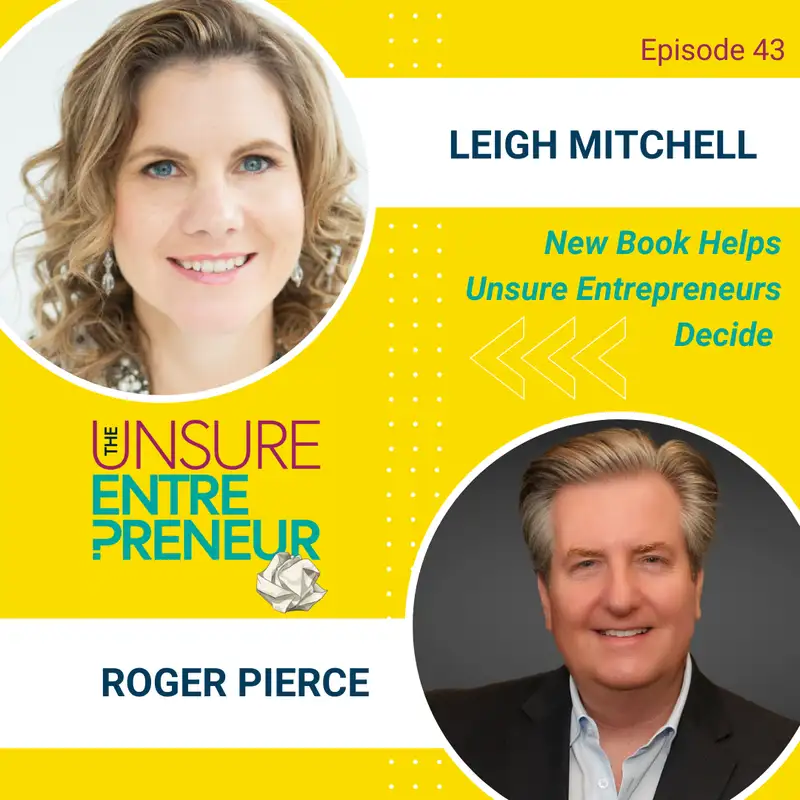
Roger Pierce and Leigh Mitchell discuss risk, freedom, and The Unsure Entrepreneur book
Episode 43
Leigh Mitchell interviews Roger Pierce
SUMMARY KEYWORDS
Entrepreneurship, The Unsure Entrepreneur, Roger Pierce, Leigh Mitchell, business ideas, small business owners, emotional risk, financial risk, burnout, personal brand, podcast, self-employment, business challenges, support team.
SPEAKERS
Leigh Mitchell, Speaker 1, Roger Pierce
Roger Pierce 00:00
So I wrote the book for people who are on the fence, unsure as the name implies, thinking about it, considering exploring entrepreneurship, had a dream, and surprisingly, maybe unsurprisingly, most people have had a dream of entrepreneurship.
Leigh Mitchell 00:37
Hi, I'm Lee Mitchell, and today's episode is a little bit different. We're turning the mic around. I'm stepping in as host, and Roger Pierce is joining me as the guest to talk about his book, The Unsure Entrepreneur, a decision guide for people who are thinking about starting a business but aren't sure if they're on the right path. Roger is an entrepreneur, content producer and educator who has launched 14 businesses over a 30 year career. He worked with 1000s of entrepreneurs through his training programs, seminars and content partnership with banks and major organizations. Before I go further, Roger and I go way back. We've been good friends for years, and we started working together extensively to help entrepreneurs start and grow their businesses. For those of you who don't know me, I'm the founder of Women in biz network, the host of the change maker leader podcast, and I teach entrepreneurship at York University and the University of Guelph Humber, as well as digital marketing, so I spend a lot of time with people who are right at this decision point. Roger, welcome to your podcast.
Yay. I'm not used to being on this side of the table.
Kind of fun, isn't it?
Roger Pierce 02:02
Oh, it is fun. And thank you for doing this. I wanted to talk a bit about the book, and I can't think of anyone better than you, Lee to lead us through that. So thank you for doing this.
Leigh Mitchell
Oh, well, I'm thrilled and honored. I have read your book, and I have been an entrepreneur for over 15 years, and it has gotten me going back to the drawing board and really thinking about some of the reasons why I got into business and what is keeping me there, and also some of the challenges that I still have to this day. So it's a timely discussion, because entrepreneurship is one of the leading titles in 2026 for people that are looking at new employment choice. So it's one of those things that we should be talking about, because in this uncertain world, maybe entrepreneurship is where we should be headed. Who knows? We're going to dive into this topic today, and I'm really excited to be here. So
Roger, your book, The Unsure Entrepreneur, isn't a typical business book. You describe it as a bit of a reality check, and I think it's important, because people who are thinking about starting a business aren't necessarily understanding what it really takes. So let's start there. Why did you write this book? And who's it for?
Roger Pierce
Great question.
Thank you for asking it. So I wrote the book for people who are on the fence, unsure, as the name implies, thinking about it, considering exploring entrepreneurship. Had a dream, and surprisingly, maybe unsurprisingly, most people have had a dream of entrepreneurship, something like 70% of Americans have thought about starting a business, but only 6% do so. It's written for those people who are interested in entrepreneurship but are hesitant, are worried about what they're getting into. Want a little more information, you know. They want to understand the complexities of it, the challenges, the rewards, The Good, the Bad and the Ugly, as I like to say, of entrepreneurship. And really, you know, a friend who's been there before explaining what to expect, so that the reader can make an informed decision about entrepreneurship. Because, as we'll talk about, I'm sure, you know, there's lots of pitfalls. And I really wrote the book to help people go in with their eyes wide open, Leigh, to understand what they're getting into. I think entrepreneurship is kind of sold in the media quite a bit as a glamorous life. You and I both know that's not always the case, and I wanted to provide some real insights into that and help people go in with their eyes open and knowing what to expect as best as you can expect.
Leigh Mitchell 04:59
Yeah, and I love how you launched the podcast before the book was even out. So you know, you've been doing research now for what is this? Your second year with the podcast. Congratulations on this milestone anniversary. That is incredible. I'm I've been really admiring the work that you're doing with a podcast, and I've met some incredible people through your podcast that I wouldn't have met had it not before the fact that you're doing this new venture. So kudos on that milestone.
Roger Pierce 05:16
Thank you. Yeah, it's been two years. Yeah, two years now.
Leigh Mitchell 05:20
Yeah, wow. It's amazing.
Roger Pierce 05:22
I love the podcast because it gives me a chance to talk to people like you. You were on the podcast. Please look it up. We'll put the link in the show notes, the Leigh Mitchell interview. And just love talking to founders. So I really explore their journey again, so people who are considering entrepreneurship can find out from people like you, who have been there what it's all about, and again, go into it with their eyes wide open. On the podcast, we also explore resource providers. You know, I've had people from like the Competition Bureau of Canada or the Business Development Bank or financing experts, people that can also provide their information and their insights to entrepreneurs who are considering this leap. We've had authors, we've had body language experts, we've had YouTube celebrities, all kinds of people providing different takes on what it means to be an entrepreneur and how to get going. So I love every minute of it.
Leigh Mitchell 06:10
Yeah, as a fellow podcaster, I think it's a great way to not only get to know people who are in your ecosystem, but it's a great way to leverage building a client base through, you know, you can almost use your podcast as a funnel. So I think there's lots of different ways that entrepreneurs can build their businesses without doing maybe what some people might consider salesy or slimy or make people feel uncomfortable like, hey, you know, let me tell you about my business. You know, that can be a bit uncomfortable for people.
And I think more and more people are using entrepreneurship as a way to be able to sort of think about their personal brands. And that's something that I really like to focus on. The fact that no matter where you work, you are always going to be you, and so we should all be developing our own personal brands, and really that is essentially what we stand for and how we put ourselves out into the world. So I think podcasting is a great way to do that, as well as writing a book, which Unsure Entrepreneur, is a great way for someone to explore why they might want to start a business, and maybe it's a side hustle, maybe it's building a brand outside of the company they work for. There's so many different ways that you can approach entrepreneurship at different levels, but one of the things that we know is that when you start a business, it's all on you. Roger, why? Why is it all on us? Yeah, what does that actually look like?
Roger Pierce 07:45
I think that's the biggest shock for people coming into entrepreneurship.
Look. The typical path is someone working in a job, right? Who had a corporate job or an office job, and there were a lot of other people in cubicles around them, doing different roles, someone else handling accounts payable, someone else handling the books, someone else doing the computer repairs, making sure their printer works, someone else staffing the cafeteria, someone else sweeping the floors. In a big company, all those different roles are covered. But as you said, in a company one, it's all on you, and that's a real shock for people coming from like I said, that bigger, bigger environment.
You are multitasking. You are doing marketing, HR, you're doing production, you're doing sales. We'll come back to that maybe in a minute. You're sweeping the floors, you're running to the bank, you're going to Staples or whatever to get an ink for your printer because it just ran out. You're trying to print a proposal to get it to a meeting by five o'clock. You're doing all those things and more. And some people love that. Some people thrive on the multitasking and the multiple hats. Others get, you know, exhausted by it. I'm not going to judge. I just want people to know that that's the reality, one of the realities of entrepreneurship right there.
Leigh Mitchell 08:56
Yes, it's really quite common for entrepreneurs to get burnt out. It could be burnout. Can be something that happens in the early stages. It could be at a scaling stage, and honestly, it could also be at an exiting stage or a new transition. We're never at a stage where we aren't really on and achieving. And achieving can be a good thing, but it can also feel overwhelming.
Roger Pierce 09:27
Let's talk about that, because you and I have talked about that off mic, about burnout and stress, and in the book, holding up a copy of it now.
Leigh Mitchell 09:35
Thank you.
Roger Pierce 09:36
My big yellow book. In the book, there's a chapter on emotional and financial risk. Financial Risk, I think people understand that conceptually, there's some details in the book about what what that actually entails, like putting your entire life savings on the line. But anyway, the emotional risk part of running a business, I think, is often under discussed Leigh, and underestimated, because look on. Entrepreneurs have one of the highest suicide rates of any profession. Entrepreneurs have an exceptionally high rate of mental health challenges because of what you just mentioned — stress, fear, worry, anxiety.
My God, how many times have we been through that where you've got payroll on Friday and maybe two or three employees and you got no money, and the bank's not going to give you any more, and you're like, oh my god, how am I going to pay these employees on Friday? That's stress, man, that's real stress, because you're responsible. It's okay not to pay yourself, but you can't not pay your employees, right? There's a legal obligation and a moral obligation there, and they're going to quit, they're going to walk, and your business is going to crumble without the staff. So I'm exhausting myself, but all these things cause stress, cause anxiety, and can lead to burnout. And I think, like I said, that's an often under discussed area of entrepreneurship, is the emotional risk.
And the question in the book is, are you ready? Are you built for that? Can you handle that? Have you got a support team? You're very good at surrounding yourself with people and advisors, and I know you coach and you teach, you provide that to other people. That's one of the coping mechanisms that are very, very important for even an early stage entrepreneur, make sure you've got folks around you that can listen to you vent, that can help you solve problems, maybe provide paths forward. But I really want people to take away from the book that emotional risk that is inherent with starting and running a business.
Leigh Mitchell 11:26
Yeah, I love that you bring that up. I mean, you included the story about my family in the book as well, and about how, unfortunately, my father had a lot of challenges when it came to running a resort that you know was way beyond his expectations of you know how much emotional and financial responsibility that was going to risk everything that that was going to rip up his life. And that's one of the reasons why I started my business, a Women in Business Network, was because I've seen the highs and the lows of entrepreneurship. I think everybody has a story of someone close to them who maybe lost everything, and there's very seldom situation where someone is an overnight star. That's often a bit of a fallacy, isn't it? When it comes to entrepreneurship,
Roger Pierce 12:19
it is. I'm glad you brought that up because your story and thank you, by the way, for sharing your journey in the book, Lee, it's woven throughout the book. You gave so many insights to me that I've used them in multiple chapters on multiple topics. So thank you for for contributing that. But that story you mentioned is so I know it's sensitive, but we can learn from it. Because of what your family went through, because of some of the history of entrepreneurship in your family, you've approached it differently, haven't you, in your business? Maybe you can share, because I know you're very adverse to financial risk. You want to be safe, don't you?
Leigh Mitchell 12:51
Yeah, yeah. Unfortunately, I lost everything. My parents lost everything, and I was very lucky, because I was very young. I was like my early 20s, when and was able to rebuild my financial security. My father, not so much. And so, yeah, I made a very conscious decision when I started my business that I would be more on the
Leigh Mitchell 13:16
conservative side around how I wanted to spend the money and how much I was willing to invest up front so services businesses can be a good entry point for those that are a little more risk adverse. And so you you talk about the different types of businesses in the book, and you know what the risk level is involved? Obviously, if you have a bricks and mortar location like my father, that is a huge risk. Yeah, in you know yourself from your family history, I I got to read about your father and your grandfather and their entrepreneurship journey as well. Oftentimes, we hear about family stories when it comes to entrepreneurship and businesses that get passed on through the generations. There's lots of risk.
Roger Pierce
Yeah, it's true, and that's there's a lot of risk. And you talk about, you know, the path into entrepreneurship, a lot of people are influenced by their family. Obviously, you're you came from an entrepreneurial family, and that weighed heavily into your career choice. Other people might see it on the news and go, Hey, I want to be like that successful female entrepreneur or that leader, other people might go, I've been laid off from my job. I gotta go start a business to make some money. It could be a young person graduating from college or university or high school saying, Ah, you know what? Rather than get a job, I'm gonna go start my own business. So I'm fascinated by the different influences and paths into entrepreneurship. Everyone's got their own there's never a right path, but there are multiple paths, and that's just fascinating to me. Me to see. But I want to segue to something else you said in the book which is kind of related to your family's story. You said in the book you consider a Job to be the riskier choice you thought entrepreneurship was actually a more sure path for you. Maybe you can explain to the audience what that meant.
Leigh Mitchell 15:10
Yeah, I don't want to say that I attributed this thought to something that I originally came up with when I first started the business journey, I didn't have a choice like I want to start that segue to say that I did. I never would have become an entrepreneur by choice. What happened was, I was raising my children, had a full time job, and on my second pregnancy, I had complications. Started sort of gathering ideas around social media and maybe creating my own social media business back when this was early days of before anyone really knew what LinkedIn was or what Twitter was, now called X. Then I had a milestone, pivotal moment, which some people talk about, and that is that my son was left at home alone with a nanny, and I took a leave of absence and stayed home and decided that, okay, now I have no choice. I can do this business because I have to be at home anyways. So let's figure this out. And that's how I met you, because I'm like, Okay, let's figure this out with other people that can help me figure this out, mentors.
And so, you know, I had you as a mentor. So in terms of the risk, I was interviewing many successful entrepreneurs, Erica M from Much Music, VJ days, Julie Cole from Mabel's Labels, who since sold her company to Avery Labels then and is still the face of Mabel’s Labels. When I was speaking specifically to Erica, I asked her, I'm like, don't you think this is risky, you know, starting your own business? And she said, Well, actually, I think that those that are employed by someone, they don't know when they're going to be on the chopping block, whereas the reverse is the truth with entrepreneurship, because you're in charge. You know what's going on, you know the health and well being of your company. You also know the way you want to direct your life. And for me, one of my values was that I wanted to have a close relationship with my children, because unfortunately, my parents running the resort, I was kind of left to my own devices, to a certain set to, you know, figure things out. And I'm very independent because of that reason. So certainly benefits to that.
So, yeah, I just realized that there was a lot of advantages to being the one that was in control of my destiny, and with the layoff rate the way it is right now, I like the idea of being in charge. There is a big gap. Something like 70% of people say they want to be self employed, but only 6% actually are. So you know, there's a lot of us out there that want to be entrepreneurs, want to be in charge of our own destiny and have flexibility in our whatever that might look like to you. I'd like to bring it back to the book so because this is what stands out to me, why do people take the leap? I think we might be because we have no choice. It might be because we want to leave a legacy. Maybe we are close to retiring, but we're not quite ready to throw in the towels. So what do you think is the right reason to go into entrepreneurship?
Roger Pierce 18:44
Well, great question, and you touch upon a bunch of interesting things there. I mean, there's no one reason. It's very personal to other people. I mean, the most common is pursuing a passion. A lot of people get into it for that. There's a caveat there, though we talked about that in the book, I don't believe you should just follow your passion blindly. It's got to be well researched. It's got to be at the intersection of market opportunity and your skills. So you want to have passion, you want to have skills.
You want to have someone who's going to pay you for those things. That's a good marker of getting into business. I think people get into business like you said too, to be in control BYOB, not bring your own booze. Be your own boss. We're not going to the pub yet BYOB being in charge. And that is Lee, such a underestimated. Again, joy of entrepreneurship. Here you are. You're up away from home, up at your cottage. You've got flexibility to do things up there. That's great. You're as an entrepreneur. You're in charge of everything that comes with a lot of responsibility, but it comes with a lot of freedom. Set your own schedule, work with who you want to work with, clients and employees in a job you're forced to do that. You don't get a choice of who the customers are or who the. Co workers are that decision is taken away from you. As an entrepreneur, you get to make those decisions, and some of my some of my best suppliers, are my best friends, right? Look at you.
Other benefits include freedom and flexibility. I mean being able to go and watch your kid play baseball if you need to knock off early or take your kids, the swimming lessons to weave in your family life to your small business life, that is a true benefit. Now it comes at a bit of a cost. The old joke is, you know, I love being my own boss and being an entrepreneur — “I can choose to work any 12 hours of the day I want.” You can relate, but that kind of speaks to the ebb and flow. I mean, we might work a few hours in the morning, go do something we have to do personally. In the afternoon, come back to the work around three or four, have some dinner, spend some time with the family, get the homework looked after, and then go back to back to work, right? So it kind of flows and interweaves with our our personal life, and that, to me, is a great privilege. But the flip side of that is, there's a cautionary tale. Do you like that? Or would you rather be a nine to five? I'm done. I'm out of here at five o'clock. Kind of person? These are some of the questions we raised in the book, for sure.
Leigh Mitchell 21:17
Yeah, you asked some really compelling questions that requires you to do an honest inventory of what it is that you want. But you know, with the with many employers wanting to get people into the office downtown four days a week, now, you know, I think that people are again, whether they're potentially getting laid off, or they just don't feel that they can be the parent or the leisure life that they want, whatever is running their decision process. The fact that more and more flexibility is being taken away, I think, is, is another good reason to sort of take an honest look at inventory of your life and be like, okay, is this what I want, or am I staying where I'm at because I don't know what else to do? And that can also be an interesting you know, fear can help keep us from moving forward.
But, like, I want to wrap up, because I know we're getting close to time. It's been a great conversation. If someone reads the book and decides not to start a business, do you still feel that that's a win?
Roger Pierce 22:30
Absolutely, absolutely. Look, at the end of the day, I'm in favor of entrepreneurship. Obviously, I want more people to be entrepreneurs. This is what I call the “Era of the Entrepreneur.” There's never been a better time to look at, look at self-employment, the tools, the resources, the money, the support, the societal acceptance, it's all working in your favor. High youth unemployment, all these things are driving to entrepreneurship. But are you ready? And do you have what it takes? As it says on the website, these are fundamental questions. And hey, if it turns out you're you're better suited for a job situation, that's fine, then I've saved you years of struggle,
Leigh Mitchell 23:09
money,
Roger Pierce 23:11
a lot of money,
Leigh Mitchell 23:12
a lot of money.
Roger Pierce 23:13
So I do consider that a win. That's a great question. You know, the end of the day, it's not for everybody. And like the book says, Know if you've got what it takes before you go in.
Leigh Mitchell 23:23
Exactly, pop that book up again, Roger, so that everybody can take a look. So entrepreneurship is a great path, but it is not a casual decision. The reality is that many businesses don't make it, and people do underestimate what is required. But for those who are prepared, it can be incredibly rewarding. This book is about clarity, helping you to make the right call before you commit. So, Roger, thanks for allowing me to step into the guest host chair today. It's been wonderful.
Roger Pierce 23:56
Leigh, I can't thank you enough for doing this for me. It's been great to talk to you, and of course, talk a bit more about entrepreneurship and what people can expect out of the book. I really, really appreciate it. So thank you very much.
Leigh Mitchell 24:07
Thank you. So for those of you who would like to connect with myself or Roger, people can find me at LeighMitchell.ca, or Womeninbiznetwork.com, for Roger, why don't you tell us where to find you?
Roger Pierce 24:24
Absolutely I encourage you to check out the website and the book. By the way, the website's got a bunch of resources for entrepreneurs, you know, tools, calculators, templates, links to financial loans, that kind of thing. But check it all out at UnsureEntrepreneur.com
Leigh Mitchell 24:38
It's a catchy title. I love it. Thanks again.
Roger Pierce 24:43
Thanks, Leigh.