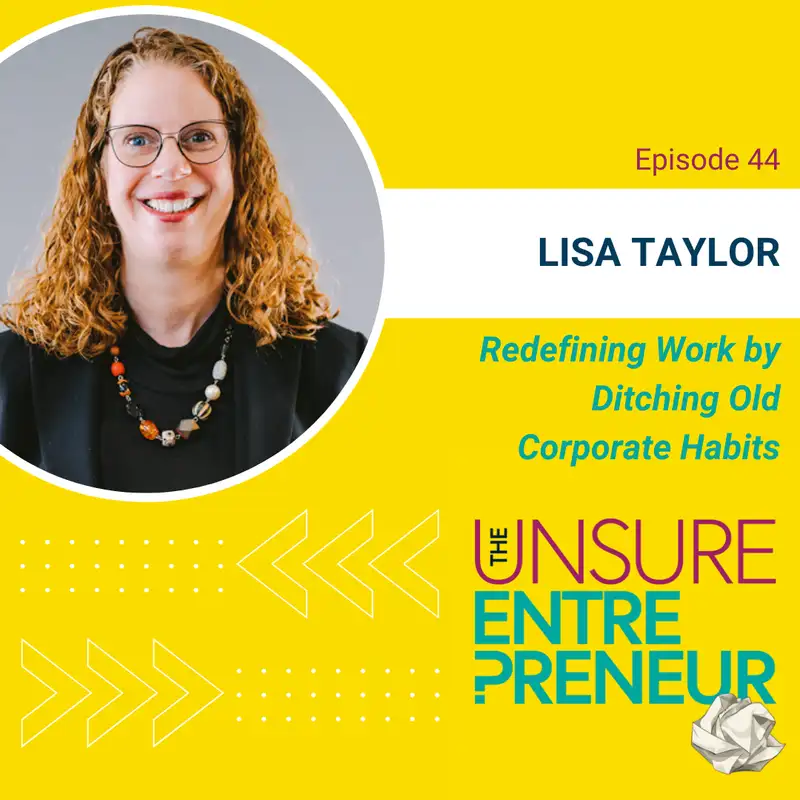
What Entrepreneurs Get Wrong About Growth (w/Lisa Taylor)
Lisa Taylor
Episode 44
SUMMARY KEYWORDS
Entrepreneurship, leadership, career development, talent escalators, AI impact, B Corp certification, workforce innovation, nonlinear careers, business growth, career infrastructure, workforce engagement, lifelong learning, emotional well-being, business strategy, workforce adaptability.
SPEAKERS
Lisa Taylor, Roger Pierce
Lisa Taylor 00:00
Most entrepreneurs don't realize that you actually can build a business that you resent, and that your own career and the intersection of your own needs and agency, and what you want, and where there's labor market opportunities, even if you are the business owner, still continues to be important for you. You continue to be a human being who's growing.
Roger Pierce 00:42
Hey everyone, welcome back to the Unsure Entrepreneur podcast. I'm Roger Pierce. Now, today's conversation is about leadership, careers, and work, and why so many of the systems we still rely on no longer match the reality people are living and working in today. My guest is Lisa Taylor. Now, Lisa is the founder and CEO of Challenge Factory, where she helps leaders redesign workforce and career systems for a world shaped by AI, longer working lives, and constant change. Lisa is the co-author of The Talent Revolution: Longevity and the Future of Work and The Canadian Guide to hiring veterans and the author of Career Development and the Future of Work, a conversation guide. She's obviously been very, very busy now. Her work sits at the intersection of research, policy, and real-world leadership. Lisa has advised national governments, worked with large multinational organizations, and her insights, no surprise, have been featured in the Globe and Mail, Forbes, The Wall Street Journal, CBC, TVO, and the OECD Future of Work reports. She's also a sought-after keynote speaker for leaders trying to make sense of uncertainty and change. What I really wanted to explore today with Lisa is how her work applies not just to big institutions, but to entrepreneurs and leaders building businesses right now, often without clear rules, templates, or much certainty. Welcome, Lisa.
Lisa Taylor 02:12
Thanks, Roger. It's great to be here.
Roger Pierce 02:14
It is so good to see you. It's been far too long.
Lisa Taylor 02:16
It has. We used to see each other all the time, and now it's a rare treat.
Roger Pierce 02:21
Well, busy lives and all that, running a business, it takes up a lot more time than we anticipate, doesn't it?
Lisa Taylor 02:28
It does.
Roger Pierce 02:29
Well, you've been so busy, and I want to get right into it, because I've got so many questions for you, and I really appreciate you taking the time to be here today.
Lisa Taylor 02:37
My pleasure.
Roger Pierce 02:38
Before we continue, though, can you explain in your own words, beyond what I just read, what Challenge Factory does, who you serve, the kinds of organizations you help, and maybe tell us a bit about that amazing center for career innovation.
Lisa Taylor 02:52
Sure, so Challenge Factory is a research and insights firm. We're based in Toronto, that's where I founded the company, and we have impact around the world, so we have clients in the Middle East and Europe. I'm spending time later today, it's their morning, it's my evening with our clients in Singapore, and so our work really does export Canadian thought leadership and insights all around the world for how we can think differently and act differently in a changing world of work, and at its core, what Challenge Factory does is we basically, we do one thing, we fix broken talent escalators, so the systems and structures that exist for our workforces and our workplaces have infrastructure that were built in an era that we no longer live in, and we do this work inside of companies to help them create new career infrastructure that is relevant for today, and we also do this at the systems level, so that's the work that we do with national governments or provinces or industries that know that they have broken talent escalators within their jurisdiction, and they need to approach it from a policy perspective, as opposed to from a corporate perspective. So that's really what Challenge Factory does. It's a simple statement to say, but it's a quite a complex set of services that we, we work with our clients.
Roger Pierce 04:21
You have grown so quickly and so impressively. It's just fantastic to see. I am so happy for you, and I know all the work you're doing is making a tremendous impact. That should feel really good.
Lisa Taylor 04:33
It does. Impact is important to both Challenge Factory and the people that work there, and maybe we can get into that a little bit later. Challenge Factory is a certified B corporation, which means actually that word impact has even more meaning and importance in the way that we think about what we do, the way that I think about my role as founder and the entrepreneur that started the company. It really is an important word for us.
Roger Pierce 04:57
I saw that on the website. Now let’s talk about it now, if you don't mind, because this is all part of educating new entrepreneurs. So, explain what a B Corp is, and how it's different from, say, a regular corporation.
Lisa Taylor 05:07
So, certified B Corporation is a global brand, it's a global standard. It's like imagine an ISO standard for impact, so externally provided by an organization called B Labs, they're based in Europe. We're audited every three years on the impact that our work actually has on our clients, the communities that we are a part of, the workers that engage within our own workforce, as well as the extended workforce that we interact with, the environment, and good governance, and so we need to demonstrate each time we go through certification. There's over 800 pieces of documentation that we need to provide. It is hard, so that's one of the things I usually lead with when I talk about our B Corp certification. We're incredibly proud of it, in part because it is hard and rigorous, and the process they take us through to be recertified is a very valid process. Sometimes they ask us to provide documentation on a clock, so they may say, you know, within the next number of hours, provide this, because you either have it or you don't have it, and so it is a real and valid certification, and it means that we need to put at the core of what we do a different approach to how we make decisions. It's a separate legal structure. We had to change our letters of incorporation, so that, unlike regular companies and corporations, we do not just have a fiduciary duty to stakeholders and to shareholders, instead we have a fiduciary duty to shareholders and a duty to consider the broader implications on all related stakeholders, and that puts an extra layer of decision making in things like where, who we have in our supply chain, who we do business with, what type of work we do. How do we engage with broader communities? How do we engage with really tough topics, and it's something that we make decisions about collectively as a team.
Roger Pierce 07:10
That's a great primer on B Corp. I mean, did an interview earlier today, and that came up, you know, sole proprietorship, corporation, federal corporation, nonprofit status. B Corp is a different beast completely.
Lisa Taylor 07:21
It is. In other jurisdictions it has different tax status. In Canada, unfortunately, we do not get that benefit, but people always think that we pursue the B Corp certification for the marketing benefit to be able to put it on the email and brand it and have you be able to see it on the website. But to be really honest, for me the biggest benefit for us being a business B Corp is in how it's changed how I lead the company and how the company operates. It's led to enormous growth within our employees, engagement as a company that's focused on the future of work and career development. It really is a really great mechanism for us to continue to grow both the company and our people in a way that aligns with the values that we want to be expressing.
Roger Pierce 08:10
I was gonna say, yeah, it fits you, your values, it fits you well.
Lisa Taylor 08:14
Yeah, it definitely does.
Roger Pierce 08:16
Now, let's go back. I want to talk a bit about people feel their work and their careers don't operate the way they were, maybe promised, and they can't always understand or articulate why. Can you explain more what you said earlier about broken talent escalators?
Lisa Taylor 08:30
Sure, a broken talent escalator just highlights the fact that most of the structural components for how careers and talent works was built based on assumptions that were true in the 1930s or the 1950s it actually hasn't changed in more than half a century, and in every other part of our business we wouldn't say from a financial instrument perspective, from an operations management perspective, from a technology perspective that operating as if it's still the 1930s or the 1950s is acceptable, and yet when it comes to our people, we do that, that is exactly how we are operating, and so then there's these pieces that come that feel novel or new or out of place, work from home, return to office policies, the ability to have flexibility, integration of AI, all of these things start to become anomalies or things that cause friction within the system, as opposed to having the infrastructure that just allows us to continually adapt to the actual conditions that people are living and working in today, and maybe I'll just give the most profound kind of example of where the talent escalator is broken, so Challenge Factory started based on the understanding that longer lifespans were not translating into longer work spans, and that that was causing an enormous issue in product. City and engagement and social cohesion, and that's because of the broken talent escalator. So, when the retirement age was set at 65 something that we all readily kind of just accept as if it's like a fact, like something that will always be true. It was the 1930s and life expectancy was only 62 so retirement was set at 65 as a way to provide care and support, social support, social security to people that were past life expectancy because they were working themselves to death. So today we have an 82 year life expectancy, but our work life expectancy is still frozen, as if it's the 1930s and all of our talent structures start to give cues and signals that when you hit your late 40s, early 50s, definitely by your early 60s, you know you're not being nominated for the high potential programs anymore, you're not being given the training, you're not on the leading edge of receiving generative AI training skills, like all of these kinds of things that actually you are in the prime of when you should be receiving all of those things, because we no longer live to 62 and there is no reason for us not to continue to grow, we don't have to keep doing exactly what we've been doing, but there's no reason for us not to continue to grow well past 60 or 65 or even 70 in a lot of cases, so the talent escalator assumes that everyone's going to step off when they're in their 60, then people aren't doing that. What they're doing instead is instead of stepping off the escalator, they're stepping back and using the top step as if it's a treadmill, they're just riding the same thing over and over and over again, because they have nowhere to go, and it's super boring, and it causes disengagement for them, that then gets cast as something else, that you know, as if everyone that's older is disengaged, they disengage because they're on a treadmill, and it causes cultural issues all the way, and career issues all the way down the rest of the escalator, so that's one example. There's many others, but just from a demographic lens, the talent escalator is broken, and it impacts everyone of all ages that are within our worlds.
Roger Pierce 12:11
Because someone on the top step, circling top step again and again, is holding back people below them?
Lisa Taylor 12:18
Because they're not moving into something that actually uses their skills well, they're paused, and it isn't even necessarily that they're holding someone back from moving into their job, although internal mobility is impacted. It's more likely that they're assigned as the mentors for the newer staff. They've been there the longest, they're the culture keepers, and they're the leaders, whether it's formal or informal, that people look to for how do we do things around here and what do we tolerate, and people that are coming to work every day feeling like they're on a treadmill is not a good foundation for any culture, so fixing it is less about moving in order to be able to be replaced, there's actually a ton of data that shows that older workers remaining engaged reduces youth unemployment, like it's actually a cure for productivity to keep older workers in the workforce longer, but that's not actually even the point that we need to focus on culturally, it's a culture pillar, and then we take a look at how are we going to support our culture and increase engagement and all of these kinds of things, and we look to programs and initiatives for younger workers. When actually, if we were to address this one issue and provide legacy career paths where people can move to the escalator, would start to flow again.
Roger Pierce 13:34
I remember when we first met years ago, this was a big focus for you, the legacy careers, right, and the mature workforce, and what they bring.
Lisa Taylor 13:44
When I think that you know, especially here, where we're talking from an entrepreneur perspective, or from a company growth perspective, the one thing that has surprised me, although it shouldn't, maybe over time, is Challenge Factor. I started Challenge Factory in 2010 it was incorporated. In 2012 in those early days, it was very focused on a very specific population, very specific set of services. Today, we've grown to be a leading voice and a global authority on labor markets and talent mobility around the world, and the core of what we do is still grounded in those early days, like we have not necessarily changed. We've just grown from what we have learned, and had the chance to be now, for multiple decades, experts within this particular field, and that is something that I wouldn't have necessarily predicted, that our work individually with Canadian older workers would eventually one day lead us to transform workforces in Saudi Arabia, or in Singapore, or in Europe.
Roger Pierce 14:46
Aren't you also in the Middle East, doing something over there?
Lisa Taylor 14:49
Yeah, in Saudi Arabia.
Roger Pierce 14:50
That's amazing. Well, obviously, the word about your good work has spread.
Lisa Taylor 14:54
Good work spreads to good people. There's no magic to that.
Roger Pierce 14:59
I love it. I love to hear it. I love to hear about success. So, I want to pivot a bit to talk about entrepreneurs and what they often understand, or, sorry, misunderstand about work. If I could ask you a couple questions here. Many entrepreneurs kind of come into this, and the show is for existing entrepreneurs and emerging entrepreneurs. They come into it with their preconceptions about their old job or the role they had in the past. Most entrepreneurs, midlife, coming into it, come from a corporate background, but they might be bringing with them a lot of assumptions that could be outdated, as you just touched upon. Can you share some of the common misconceptions that new entrepreneurs may be bringing in to this new life from their corporate life?
Lisa Taylor 15:38
There's a few. I mean, I think the first is that entrepreneurs don't have careers, that their job is now business owner, and that the focus on their own growth and development, their own engagement. I think most entrepreneurs don't realize that you actually can build a business that you resent and that your own career and the intersection of your own needs and agency and what you want and where there's labor market opportunities, even if you are the business owner, still continues to be important for you. You continue to be a human being who's growing. I see two things with entrepreneurs: either they ignore their own growth and development, and focus exclusively on the business growth and development, as if they're the same thing, or sometimes some entrepreneurs pursue growth and development as an avoidance strategy for building their careers, that they continually take more courses, more learning, more programs, especially coaching-related programs, many entrepreneurs will spend a lot of money continuing in their own personal development, where it's not actually aligned to their own personal development or the development of the business, it's an avoidance strategy to actually take the scary step and take, go one step bigger to actually move into action, so I'm always cautious about those things, but I think that idea that we are individuals that have our own interests and growth opportunities, I think that's really important for entrepreneurs to recognize when they're no longer in a corporate structure with training plans and courses available and a manager that's asking them how they're developing, or that's giving them a review of where they need to develop next, that we need to develop that for ourselves.
Roger Pierce 17:28
That's so many good things there to unpack. You're right, there's nobody giving us a review as an entrepreneur, because there is no boss. So, how do you do that? How do you performance review yourself? Like you said about training and education, obviously you're a big fan of continuing an investment. That's what the joys of entrepreneurship is, lifelong learning. I often say, you learn more in the first six months in the business than you will in most of your time at school. So, what can entrepreneurs do, Lisa, to stay ahead of the curve there?
Lisa Taylor 18:00
I think putting together personal growth plans that mirror the business growth plans, treating yourself as if you are your most valued employee, and what would you put in place so that that most valued employee continues to grow in ways that serve both the business as well as yourself, so that you do get that sense of satisfaction, especially if you're someone who's motivated by growth opportunities, so making sure that you're planning for that, and that it's not just kind of left, because, as you said before, running a business, it's very time consuming, and it's really easy for the stuff that matters actually most to you to go by the wayside as you're tending to all of the things that matter most to the business. I really love in family enterprise certification programs. They often provide guidance for advisors who help family-run businesses to think about the relationships that exist, where there's you as the business owner, there's the business as a separate entity, and then there's your partner or your spouse or whoever else is significant in your life, and it's like a triangle, you have a relationship to your business, you also have a relationship to your partner or your spouse, but that partner and spouse also has a relationship to your business, and making sure that you're thinking about how all of those things continue to grow is really foundational for making sure that your business has the support, and you personally have the support that you need.
Roger Pierce 19:25
Absolutely, it's in my book that I'll mention earlier, emotional well-being, the emotional side of entrepreneurship. Everyone focuses on the financial, but there's a whole emotional component, and having the involvement of your life partner, your significant other in the business is critical, right, and that's the reason a lot of businesses can fail without that kind of cooperation and insight and collaboration from the people that matter most to you.
Lisa Taylor 19:51
I think when we're talking about growth and development, I think in Canada, when it comes to entrepreneurship, for the most part, not 100% of the time. But for the most part we think pretty small, we're pretty provincial in the way that we think about things, you know, if companies grow to do business in more than one or two provinces, that's seen as an enormous growth pattern and footprint, and it's not like that in other countries, and I often wonder, why is it that we don't grow our businesses as frequently, or to the size that other countries that their entrepreneurs grow their businesses to, and of course this isn't true, you know, we have very large businesses that have started as single founders, so it's it's not that we don't have any examples, but the majority of our founder-led one person, two person, you know, up to the micro business size, 10 person firm, which is the majority of small and medium sized businesses that we have in Canada, really do stay at a smaller scale, and even if we've come from large enterprise companies, we know what big business can be, our companies still don't grow to that size, and I always find that really fascinating, that there's this kind of tone to entrepreneurship in Canada sometimes, but it's, it's an alternate path, it's kind of what you do when your corporate career hasn't worked out for you, and that is not true. It colors or it kind of taints the way that we think about who we are within the economy. We actually are really important within the economy and critical to our growth engine. When we hear our Prime Minister talking about making it easier to do business across our country and bringing more Canada to the world, we have so many supports that are available to us, for us to be as big as we aspire to be, and whether that means as big, you know, from a geographic footprint or from a team size or revenue size. I'm not even prescribing what you know what big needs to look like. I find that most conversations with most business owners, the biggest they can imagine is still quite small. I think we can have larger impact than that.
Roger Pierce 22:05
Isn't that interesting? Go entrepreneurs go, think big, dream big, do big. Just to pause there for a minute. You are so right about the resources. There are billions and billions of dollars of resources, funding, financing available to entrepreneurs, Canada, the US, and in most modern countries, but we just got to tap into it. There is money out there for training, there is money for hiring employees, there's financing for your business, there's support, there's resources, there's all kinds of stuff out there. In Canada, of course, the best way to start on that journey is to look at canada.ca the federal government's website. Start to dig into some of the resources available for entrepreneurs, nonprofit organizations, some of the work you're doing, it's a great time to be an entrepreneur. There's no reason not to be big, because we've got all these resources.
Lisa Taylor 22:46
Yeah, and they're very helpful, and they're really high quality. I mean, we certainly Challenge Factory’s growth. We talked a little bit about our global footprint a couple of minutes ago, that was entirely because of the support and training and funding that is made available, and just knowing how to access it, and know that I have the backing of lots of really smart people behind me when we're doing things in parts of the world that we haven't had experience in before.
Roger Pierce 23:14
Again, talking about entrepreneurship, and how does it fit into a modern nonlinear career path?
Lisa Taylor 23:20
So nonlinear careers are actually more the norm than the exception, and just so that, like, let's take a step back, and maybe I'll just define it. Nonlinear career just means that it's a career that looks like a little bit like a string that kind of goes all over the pace on the page, instead of the straight line arrow that moves you from step to step. I like to go back to kind of the underlying assumptions about structure and infrastructure, so a nonlinear career would follow a defined career path. Before the 1970s there was no such thing as a career path, like some super smart consultant came up with this idea that we should have career paths and implemented it in some of the largest corporations, and it just became the norm that every industry and every profession now has this very clear best practice for companies to have clear career paths for their employees. But it's not like career paths were reformed in nature and can't be undone, and so actually what we're seeing these days is most people are making different kinds of choices, where they may start in one direction, but then head in a different direction, and then maybe go back for some education, and then find that they take some time off and travel somewhere, and that awareness, or something happens in their family, that new level of insight and awareness puts them on a path where they're interested in something else, and within career development, there's many different theories that describe the way that careers occur. One of them is happenstance theory, which says that things happen to you as you're on your way in life, and that causes you to make different choices and gain different skills that you could never plan. So, entrepreneurs that find themselves in this non-linear path are in very good company, and it means that just the same way I mentioned that I love that Challenge Factory is still true to its original origins, but is almost unrecognizable to the company it was when I first started it. There is a through line, there is a common set of values or a common set of purpose of why the company exists that continues to be part of the story. That's true for entrepreneurs that are experiencing nonlinear careers too. There is a through line to your career. There is something that, if you look at it, has always been true, whether that's being focused on relationships or a skill set you've always consistently used, even if you've applied it in many different ways. So, I think it's important for entrepreneurs to recognize that staying adaptable and recognizing again they have a career, but knowing what this through line is, it actually helps them to identify what's their superpower, what is always going to be true. And then, if they do need to make shifts and changes, they want to grow, they want to shrink, they need to step back from entrepreneurship, they want to step back into it, like there is lots of movement that takes place. You are still always you, and you're continuing to grow and move forward, regardless of what step you're taking.
Roger Pierce 26:18
That's a really good point. I know entrepreneurs who shift back into the work force, come back into their business, like they go back and forth over the years, and that's okay, isn't it?
Lisa Taylor 26:28
Of course, there's no reason, I mean, it's not like if you step into a particular sector, we say you can only work in that sector for the rest of your life. Choosing to be an entrepreneur is the same, you'll learn and grow, and maybe you'll decide there's another opportunity you need to pursue, and maybe you'll come back to it again. I like to always think about the difference between being an entrepreneur, which is a role that builds businesses that employ - this is my definition - builds businesses that employ other people that add to the GDP of the country and productivity of the country by providing employment for others to being entrepreneurial. I think even the entrepreneurs that may at some point decide to step back from their own individual businesses and step into corporate or step into a partnership or something else, they most likely are still being entrepreneurial. That through line still exists, they're just not in the role of being responsible for building the company, the profits, and the employment of other people.
Roger Pierce 27:33
We used to call them intrapreneurs, being entrepreneurial within a larger organizational context. That's so refreshing to hear. A lot of entrepreneurs I know step back into a job, they feel like they failed. Oh, I didn't succeed in my business, but as you just pointed out, you're still you, you're plowing ahead, there's a common line going forward. It might just be a bit squiggly at times, right?
Lisa Taylor 27:56
Yeah, I mean, there's so many people that the quote is attributed to, I know that it's attributed to Steve Jobs as well, but basically, careers - your career only makes sense when you look at it in reverse. The story that you are on becomes clear when you look at it from where you are now backwards. You can see where that through line comes, but as you're living it and taking the steps, sometimes it's really hard to see where the connection is for you to be moving forward on a consistent path. I know that's true for me. I mean, my early days in my career was, you know, very random in the way that it navigated, and now that I look back on it, I couldn't do what I'm doing now if I hadn't had all of those combinations of experiences. It all makes sense now, at the time it didn't necessarily seem like it was making sense.
Roger Pierce 28:44
That's interesting. So, looking at it from an employer leader point of view, a manager's point of view, what should they understand about people coming in and out of these roles, or coming in and out of a job and entrepreneurship? What would you say to them?
Lisa Taylor 28:56
Yeah, I think there's a couple of foundational pieces. The first is we are in an era now, and this is where career infrastructure becomes, or thinking about career work as infrastructure work is so important. We're in an era now where every single person in the workforce has questions, uncertainty, and a need to do something different than the way that they've been doing it. There isn't a single worker anywhere in our workforce that doesn't need upskilling and reskilling as generative AI comes in and changes the way that we could be working, or that some of the other forces that are impacting within our economy are shifting who our clients are, or how we talk with our clients, or who we might partner with. There's so many dimensions that is actually shifting and changing work at the moment, that everyone needs a little bit of career attention and career love right now, because nobody can continue to do what they've been doing as if they've been doing it over the last 10 years without some kind of change, and that includes opening up new opportunity, there's a lot of discussion. About the disappearance of entry-level jobs, or jobs that are going to be completely upended, and as someone who studies this all day, every day, in lots of places, I continue to look forward with both hope and with optimism. Those two things are not the same. To see how we navigate forward, but it only happens if we're paying attention to what's happening within labor markets and careers, and so for a manager or for a leader, recognizing that your team needs career development at the moment, they need to understand how their work engages with your business strategy and what they need to be doing in order to stay at the leading edge of how they can be helping the business the best, they need some help to be able to understand where you think the company is going. All of this transparency, something that is baked into a part of being a B corporation. For example, there are lots of things that I have to share with my staff, even though I am the sole owner, I'm the only director. It's a private company. There are certain things that I'm obligated to share with the team, and to have a conversation with them. And at this moment in time, that kind of transparency is really helpful. And if it causes anxiety on the part of the business owner or the manager, because you don't know either, I think that's fair to give yourself a little bit of grace, too. You are also navigating through change and don't have all of the answers, but there are good answers out there, and there are good ways that we can support each other. So, what I don't know about certain aspects of my business I might be able to learn from you, and what you don't know about what's coming next for workforces and careers and employment, I might be able to share.
Roger Pierce 31:42
So well put, and give ourselves a break too, because we're all trying to figure this stuff out, aren't we?
Lisa Taylor 31:47
And we're just people. I say that to my team all the time, when something happens, and like what I did wasn't the right thing, like just a reminder, like I'm just a human being going to work doing the best that I can, the same way that everyone else is going to work doing the best that they can.
Roger Pierce 32:00
Don't be afraid to show our imperfections and vulnerabilities and admit our mistakes, and that we're all learning too. We're in this together, right?
Lisa Taylor 32:07
Right.
Roger Pierce 32:07
Well, that's so cool. Well, I'm watching the clock here. I know you're busy, but I've got lean into the question for you. The final question here for you, Lisa. Maybe you touched upon to use it to touch upon AI if you want, because I didn't get to ask you about the impact of AI on careers, but for someone who's listening, and they're early in their entrepreneurial journey, and trying to build a business that works for people, as well as, of course, make a few bucks. What's the most important thing they should rethink right now, or think about?
Lisa Taylor 32:35
I always come back to when I'm working with early stage entrepreneurs or meeting with them casually, I always want to know what they think they're building. I think it's really important for entrepreneurs in the early days to know whether they are they building a global company, are they building a service-based business, are they building a sole practitioner-led, maybe with some associates, like at this moment in time, what's the biggest level of Zoom that you can imagine for your own business, and what is it that you think that you're building, because so often where there becomes disconnects, or where development, our own growth and development doesn't happen in the ways that we need it to, or we become disengaged, we, we build businesses that we resent. It's because we didn't, we weren't really clear from the beginning what we wanted to build, and if you don't know what you're trying to get to, it's really hard to get there. And entrepreneurship is hard enough without working against yourself. So, that would be what I would say to be really clear, and think about, you know, what is it that you want to build? What do you want your the legacy of your business to be? And then work your way backwards, and there's a million ways you could get there. Challenge Factory has actually grown quite slowly compared to some of the tech companies that, you know, in three years time, in five years time, have hit multiples of what we have done, and that's okay too, but you have to know what you're trying to build.
Roger Pierce 34:06
Are you talking about vision?
Lisa Taylor 34:08
It is vision, but I think it's also, do you have a team? Are you are you hiring, like, are you managing lots of people, and is your job to manage them, or are you in the craft and trade or service area? Are you delivering the services that you want to be a part of, and someone else is managing the business? Do you have clients beyond your borders? Do you take clients, anyone who wants your services? That's a good client. Kind of relationships do you want to build? So, I think vision is sometimes.. it's funny. I mean, my background is as a strategic consultant, so I've led many visioning workshops. I think vision is sometimes hard for people to kind of say, “this is my vision,” and then to be able to make it happen. When you say, like, "tell me the story of what a day in your life is like five years from now, who are you with? What are you doing? What's hard about it? What's easy about it? What. You like, what do you hate? Like, I think if we lean into how we tell our story in the future, and then use that to back cast how do we get there. I think that's, I think that's an easier way for, especially entrepreneurs who often are doing this kind of thinking all on their own.
Roger Pierce 35:14
And very much ad hoc sometimes. I like that. Think about your story, how you're going to tell your story? Fantastic advice. Well, listen, I hate to, but I'm going to have to let you go, Lisa. Thank you for joining me today. And where can people find more about your work and Challenge Factory?
Lisa Taylor 35:32
Sure, so our website is challengefactory.ca and I'm on LinkedIn as author Lisa Taylor.
Roger Pierce 35:39
The website is fantastic. I encourage you to check it out, lots of great blog articles and useful information on there. So, I'll put the website in the show notes, so people can get to it easily as well. And before we wrap, if you're listening to this and still weighing whether entrepreneurship is the right path for you, I'll remind you about my new book, The Unsure Entrepreneur. It's a practical decision guide for people who want a clear picture of what business ownership really involves. You can find it at Unsure entrepreneur.com. So, thanks everyone for spending time with me here. If you're feeling unsure, trust me, you're in the right place. Bye for now.