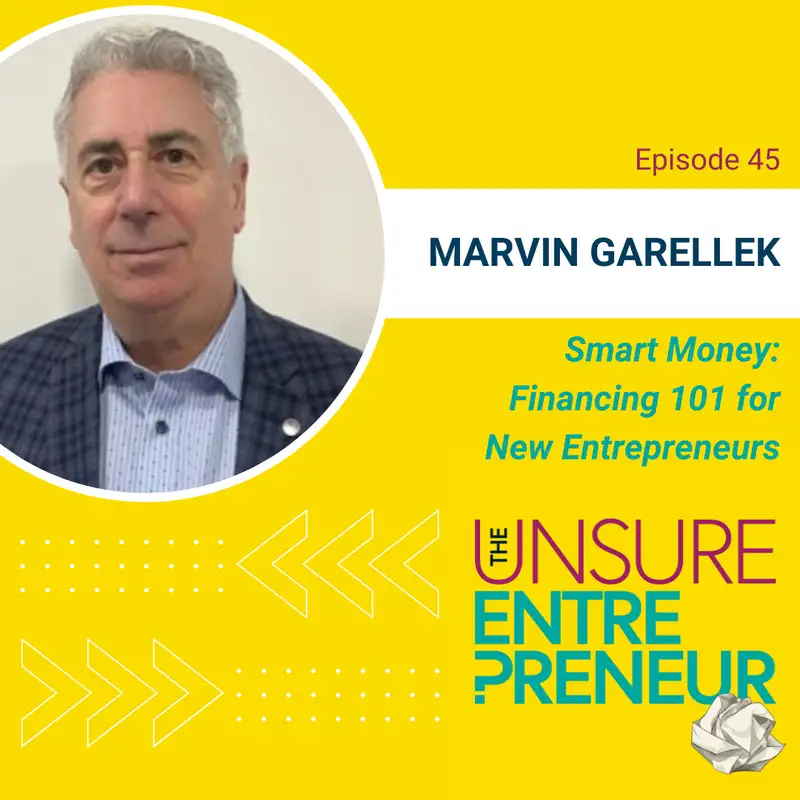
The Funding Mistakes Most Entrepreneurs Don't See Coming (w/Marvin Garellek)
Marvin Garellek 00:00
One of the misconceptions of banks, they are not investors, they're lenders, and they're looking for a return on their money.
Roger Pierce 00:29
Today, we're talking about one of the biggest barriers and opportunities in business financing. Whether you're just starting out or trying to grow, access to capital often determines what's possible and what stalls out. My guest today is Marvin Garelik. Marvin is known as the Montreal finance guy, and he specializes in helping small business owners access funding, structure financing, and understand the real options available to them. So, through his advisory work, he helps entrepreneurs do things like navigate loans, credit, government programs, and alternate funding sources, often translating complex financial systems into practical steps that business owners can actually use. So, I've known Marvin for many years, and we've worked together trading entrepreneurs and helping them understand the financial side of starting and growing a business. I've seen firsthand the kind of clarity he brings to a topic that often confuses a lot of people. So, if you've ever wondered how to fund your business properly, and who hasn't, whether you're making the right financial decisions, this conversation is definitely going to be for you. Marvin, welcome.
Marvin Garellek 01:39
Thank you very much. Thanks for having me, and it's great to see you, Roger, again.
Roger Pierce 01:42
Great to see you. And you know, there's so much to talk about. Just before we hit record, we were talking about some actual clients you're working with on finance and helping them out, and the trends you're seeing right now in finance. This is such an important topic for entrepreneurs, as you know, the people who are listening are new entrepreneurs maybe a few existing entrepreneurs, but there's one commonality: no matter what stage of business you're in, you're always going to need money of some sort, and I know you're the guy that can help us sleep better at night, knowing there are some solutions there. So, can you elaborate a bit more beyond what I said in the intro about what you do and the kind of entrepreneurs you work with?
Marvin Garellek 02:18
Sure, sure. So, it's very interesting, because in school we don't learn about money, we don't learn about marriage, we don't learn about relationships, so right off the bat we're out of the game. So when it comes to money, it's very fearful. People get fearful of money. A lot of people, like myself, who grew up without any money, have fear of money, and fear of money causes you to not to attract money. When it comes to starting a business, you need to understand there's three - what I break it down into three areas is management, marketing, and money. So, what I do is I'm an entrepreneur. I had a business plan software that was very successful, and the internet killed my business, so I had to reinvent myself. So I had loans from the banks, I had loans from the government, I had loans and grants, I had private money, I had raised a lot of money and done it successfully, and decided to pivot and become the business plan and finance guy based on my experience and the fact that I had the software with all the tools, so I set about helping people with their business plan, because without a plan you can't get to where you're going. I don't know anybody who says they're going to go on vacation and they're going to Nantucket and just get in the car and drive they actually have a map, they use Waze or they use Google Maps or something, but in business you need a roadmap to how you're going to get to success, which is happy customers, cash flow, profits, money in the bank, so information is money, and if you understand that information is money, then you got to go out and get the information. So what I do is I help entrepreneurs of all kinds, whether they're startups, they're manufacturers, distributors, roofers, garage people, people who want to buy a building, they want to buy a business, they want to sell a business, whatever it is, it's all common in terms of what they need to get the money to do what they want to do, so start with a plan, and then we can get into the money side, right? Let's say you're a startup, a lot of your unsure entrepreneurs are saying, How do I start up? Where would I get the money? Well, you have to know how much money you actually need, so that's the other thing. It's like, oh, I want to open up a Pilates studio. You know, I love Pilates. I'm going to open a studio. An entrepreneur came to me and said, I've got this great idea. Everybody's taking Pilates. I'm an instructor. I'd like to open my own place, so I have an idea of how I'm going to do that and get customers. So I said, well, do you know how much that’s going to cost? So she was like, well, I'm not sure. I said, well, do you know that these machines, the reformers, they cost 10s of 1000s of dollars. You're going to need, you know, at least 10 of them, or seven of them, and then you need a space, and then you need leasehold improvements, and then you're, you know, once you open, you've spent $300,000 and the entrepreneur goes 300,000 Well, if you set out your plan and you work your numbers, you're going to find out exactly how much money you're going to need, and then you need a buffer. So, what happens is when you go to the bank with your beautiful business plan and your projections, the bank says, well, okay, you want to borrow, let's say the entrepreneur is going to put in 25% One of the misconceptions of banks, I just want to interject, is that they are not investors, they're lenders. So, a lot of entrepreneurs say, "Well, why won't the bank give me the money? I don't understand, don't they, that's what they do. So, I have to explain to them that they're not investors, they're lenders, and they're looking for a return on their money, and if you could show them you can pay the interest and the principal on the loan, they'll never bother you. You won't hear from them. They'll be collecting their interest, they'll be, you'll be paying back the loan, and everything's beautiful.
Marvin Garellek 06:13
As soon as you stop paying the interest or stop paying the principal, well, then you know your friendly banker is going to call you up. So they say, well, if you want to borrow 250 on the 300 what happens if the business doesn't go exactly like you planned, and you need some more cash flow? Do you have the ability to put another 50,000 in? So the entrepreneur usually goes, no, that's all I got. So they go, well, in life and in business doesn't always go to plan, and we're not investors, so we need to know that you have the ability to re-inject some capital, because things, you know, the customer, you might have a snowstorm, you might have some power failure, you might have customers, COVID, yeah, people who travel another studio could open up down the street. So they always take into account their risk level. That's something that the, you know, startup entrepreneurs don't understand, and they also don't understand that they have to prepare a lot of documents for the bank. And in that process they learn more about the business, because, like I said at the beginning, management, marketing, and money, so all entrepreneurs are good at one of those, for sure. A lot of entrepreneurs are good at two, but it's very rare you get an entrepreneur who's good at managing a business, marketing, and sales, and money, finance.
Roger Pierce 07:35
Let's dig a bit more into that. You raised so many good points there, and just to unpack a bit of it, and I've got some questions for you. The bank will not buy into your dream. I think that's a very insightful comment. A lot of entrepreneurs get mad at the bank. I've gotten mad at the bank. What do you mean you don't see my brilliant idea? What do you mean you're not going to back my business 100%. That's not the game they're in. They're there to make money off your loan or your product, and they want to see some skin in the game. We'll talk more about that in a minute, but I want to sort of frame this as a larger conversation, Marvin, about what entrepreneurs get wrong, how you can help. Interestingly, stat here, I've got 50%, 49.3% of Canadian small to medium sized enterprises requested external financing in 2023. So this isn't a small issue or a niche issue, it's something that half of all small business owners deal with at some point, but there's a lot of misconceptions out there. You've touched upon a couple, maybe I can prompt you with a couple, couple more questions. Can you talk about the difference between needing money and qualifying for money, because there's a disconnect there? I've got this great business idea, but I may not have the credit history or the resources or the collateral to satisfy my desires, will I?
Marvin Garellek 08:45
So, a lot of times it's a question of how your personal net worth. So, the bank looks at your personal financial statement. Your personal financial statement just shows your assets minus your liabilities, which gives you your net worth. So, you might have a car, you might have some savings, you might have some investments. If you own a home, you have a mortgage, but if you're renting, then you have that obligation plus credit card debt. Did you know that in 2025 TransUnion reported that the average credit card balance per Canadian was $4,681 which was up from $4,076 in 2023 so on average every Canadian is carrying a balance of almost $4,700 at 20% interest. So right away you can see that the average entrepreneur, because the engine of the Canadian economy is entrepreneurship, is carrying credit card debt at 20% so that's a lack of an understanding of how money is should be used, because you should be paying that off before you even tell me that you have an RRSP or a TSFA, or you went to $150 dinner, you should be paying that off. So, there's a disconnect in the thinking of I can use this piece of plastic to buy anything I want, but I don't really have to pay it off in full. And a lot of women entrepreneurs specifically, use their credit cards to start their business. They don't go to the bank, 50% don't go to the bank first, they start the business off of their credit card. So I run into women entrepreneurs who come to me with 50, 75, $100,000 on their credit cards and say, you know what, I'm ready for a bank loan. So it's a little backwards, and that's because of a lack of education on the part of the school system and the banks and parents on saying, hey, that's the wrong way to go. Don't use your credit cards to fund it. So then that's already too late. But if you're already, for the listeners out there that are considering starting a business, the best thing they can do is write a business plan. If they can't do it themselves, then they need to get a consultant like myself or any other consultant out there to help them, and there are free programs, like in Montreal. There's the YES Youth Entrepreneurship Service that offers free services, and I know across Canada there are lots of free service in terms of pay a pro Montreal entrepreneurs, where they offer free consulting, they offer grants, they offer loans. So, there's a lot of access to information and capital that's available, but once again, you got to look for it.
Roger Pierce 11:30
And someone like you can help. Now, you touched upon a bunch of stuff there, but one in particular entrepreneurs get upset about is why is the bank asking for my personal credit information and personal collateral? I'm trying to borrow money for my business, and they get kind of upset because the bank doesn't, you know, automatically fund the business as a separate entity, but there are reasons for that. Maybe you can explain.
Marvin Garellek 11:50
Sure, I have a case right now - it's a plumbing distributor. They have been in business over 25 years. Let's say that the owner is worth 10 million plus on his personal financial statement, and his business is profitable. And we went for two loans, one is to increase his line of credit because his clients are paying slower, and he still has to pay his rent to himself, because he owns the building, but he has to pay rent, he has to pay for his employees, he has to pay for his inventory, so he needs a bigger line of credit, because there's a slowdown in the economy. And we got him an increased line of credit, and then we got him a new mortgage on the building, and he had to sign personally. And he was going, like, I have a big net worth, the company is valuable, why would I have to sign personally? And all banks, it's 100% requirement, because they don't know what's going to happen with the business, they don't know you can empty your bank account, you could sell it to someone, you could close it, you could do whatever you want, but when you're signed personally, they know that you can't give that up. So it's about the risk, and it took a lot of convincing to tell this gentleman that he had to put his signature personally against the loans, and everybody's going to be like that, and most entrepreneurs don't understand, because they think it's just for the business, but you have to understand that a business, when you register it in law, an incorporated business is considered a person. So, that's a separate person to yourself.
Roger Pierce 13:26
Separate legal and accounting entity, as I like to say. So, you touched upon a couple of the mistakes or misconceptions. Any other mistakes when it, when it talks about you, talk about bank financing? I'm going to get you to talk about alternate financing next, but specifically about bank financing. Any other mistakes that you see entrepreneurs making when they approach?
Marvin Garellek 13:43
The most common mistake is not taking the money when you don't need it. So, a lot of times entrepreneurs wait till they're in a jam, and then they go, "Hey, I need the money, and it takes two to four months to get a loan, and they think that, you know, we're going to get it in two weeks, but the process is very lengthy due to the risk and all the paperwork. So, I always recommend to my clients and to entrepreneurs that go and get the money when you don't need it. Business is going well, increase your line of credit, don't use it, but have it accessible for when hard times come. Increase your credit card, even though you don't use it when they offer you an increase, take it, because there are some times you may get a deal on inventory, and you may get a deal on marketing and advertising, and you say, you know what, I'll put it on my credit card, and then I'll pay it off right away, because I have the access to the capital to make that happen.
Roger Pierce 14:40
So, you just confirmed, and you probably agree with the old adage, the bank will lend you money when you don't need it.
Marvin Garellek 14:46
Oh, 100%, 100% when you need it, they're not your friend, they're very difficult. And there's a new sheriff in town, it's called the Risk Department. The Risk Department sits up in some high level access room that you don't have access to, so you deal with your banker. And if you notice, all the banks advertise, we're here to help you, we're here to lend, we're here to promote business, and every banker will tell you, yeah, I could do that deal. But then they bring it to the risk department, and that's where they get the bad news, it's a good guy, bad guy type of thing.
Roger Pierce 15:22
And that's an important point you bring. It's not the frontline banker, it's not the person you see in the branch that's making the decision, it's the risk assessors behind the scenes, isn't it?
Marvin Garellek 15:30
Right. Up in a corporate office somewhere, I never meet them, I'm not allowed to meet them, I'm considered what they call a COI, a center of influence, so they consider us like a center of influence that brings business that brings that influences the way they work. They love working with us because they don't have to pay us, number one, and we bring them files and we prepare the files and help them make the loans, but that person that I'm dealing with at the front level, whether it's a VP, a director, or even a researcher, they don't make the decision.
Roger Pierce 16:06
Yeah, the bank should like you, because you're making their life easier by hopefully preparing the client for a successful application. Now, on that note, maybe you can briefly tell me some of the things that entrepreneurs should be prepared to submit, because I think it's often a shock, especially for new entrepreneurs. Tax returns, CRA assessments. Give me a bit of a laundry list there, if you would.
Marvin Garellek 16:25
So, business plan with financial projections. Historical financial statements of the business. If you are in business, interim financial statements right away, personal financial statement, credit score, tax returns. In some cases, your mortgage, your credit card statement, some cases your bank statements. They want to see the money going in and out, so they can get really, really detailed. And I've had bank, you know, show me like the last two years of bank statements. One of the things is the fin track, right, of a, you know, like fraud. And something that people don't discuss, but it's going to be uncovered right here on the Unsure Entrepreneur, is there's a lot of entrepreneurs that create fake businesses or fake paperwork for their business in order to get a loan. I see it, and the banks see it, and the banks catch it. And a lot of entrepreneurs say they won't notice, you know, I'll fix my numbers, I'll adjust my sales, I'll increase my profits, I'll make my business look better, I'll submit it. So, what they do is they say, "Okay, show me your, your bank statements,” and then they can go and see the ins and outs, and it doesn't match, or they can say, "Show me your CRA filing.” So, what happens is, they get caught. Now, as an entrepreneur, okay, you get caught, but if I bring the file, then they can say to me, “We won't do business with you anymore.” And one of the things I want to say as an entrepreneur is that you know you have your integrity, and it's taken me 25 years to build my integrity, but it could take five minutes to ruin it. So, for those of you listening, you know, think about how you use your integrity, because that's a currency of itself when you go to borrow.
Roger Pierce 18:06
Good point. So, let's talk beyond traditional banking, because I know you're an expert in all sorts of different financing. Can you tell me a bit about traditional bank financing versus alternate lenders, and maybe the pros and cons of those options?
Marvin Garellek 18:18
Okay, so there's a few alternatives. You know, there's venture capitalists, right? So you're starting a business, and you might want to go to a venture capitalist, or what they call an angel. There are angel groups, there's angels out there who've made money and invest in, you know, startups. You type in the internet, angel network in my city, and you'll find one. So, you can go and find an angel, but you'll need a business plan, you'll need some, you know, proof of your history, and so on and so forth, and you'll make a pitch.
Roger Pierce 18:46
Could you help people find an angel, Marvin?
Marvin Garellek 18:48
Absolutely, absolutely, I have access to the angel networks, a venture capitalist. I have an AI tech company that's in the wellness and skin care business that came to me to raise $4 million for their business through a VC. It's not bankable, they can't get bank financing. However, there are venture capitalists or angels who may see the business as a good platform to make money, and will do that. The other thing is alternative lenders, so there's a lot of you out there on Facebook will see ads, for you know, “we can give you money tomorrow, 24 hours. All you have to do is apply. You don't sign personally, blah blah blah. We'll get you, you know, up to 200,000 right away.” But the catch is, is that the interest rates are very, very high. Anywhere from 24% to 48%, and the payback period is like seven months. So I had one case where a gentleman was buying out his partner, and he needed 100k and the bank wouldn't give it to him. We made this application, he got approved for the application, and he'd have to pay back 148k within seven months.
Roger Pierce 20:02
Wow.
Marvin Garellek 20:03
So, that's almost $20,000 a month, and his business couldn't afford that.
Roger Pierce 20:06
Yeah.
Marvin Garellek 20:07
Because he had, you know, employees, he had to buy supplies, he had to pay rent, electricity, insurance, taxes, permits, and himself, by the way. So, it looks good. And then there's private lenders, which are groups of successful businessmen who pool their money, and they lend it out against real estate. So, they'll lend you money against your house, let's say, or if you have a real estate investment. So, if your business needs money, they'll lend it out between 14 and 18%, but then there's a catch. There's a 2% startup fee, they call it ‘open the file fee.’ So all of us, oh, there's a 2% file fee. And then if you use somebody like myself, then I got a fee. It becomes very expensive, and the way they say, look, we'll give you the money, and you sign over your house, you got to go to a notary, where they become, you know, a second mortgage on your house or your property, so you pay that $1,500 notary fee. And then, as long as you keep paying your interest and principal, you don't hear from them. As soon as you stop, you know, the next call is, well, put your house up for sale. I don't want to take your house, I have the right to take it, but I don't want to take it. Just put up for sale, take the proceeds, pay me back, and keep the rest.
Roger Pierce 21:24
Easy peasy.
Marvin Garellek 21:25
Yeah, so this is what happens.
Roger Pierce 21:27
That's scary stuff. So, you know, be careful of what the, what you're reciting on the dotted line. Talk to an expert, talk to someone who can give you the pros and cons. But I want to ask you about government grants and loans, because a lot of entrepreneurs wonder about that, and I'm a big fan of checking into that option. There are billions and billions of dollars of funding, subsidies, grants, bursaries, tax credits, all kinds of forms of government support Canada and the US, but entrepreneurs don't know how to tap into it. Maybe you can shed some light.
Marvin Garellek 21:58
So, I'll give you an example. There's a program that will allow in Quebec. We have a program to market outside of Quebec, market your business outside of Quebec. So, if I want to market in Toronto or in the United States, up to 250,000 the government will give me free money to go to trade shows, buy PPC ads, make brochures, whatever it is that I'm doing outside of Quebec. However, the catch is you have to spend the money first, and then they give you back 50% up to 250 (thousand) and you got to fill in all the paperwork first. So, what happens is, most entrepreneurs don't have the time, and I see it with business plans, they don't have the time or the knowledge on how to write it up, R and D tax credits, it's very time consuming. There are less and less grants today, by the way, of free money, it's matching money, or it's the federal government just came out with $13 billion for housing. Now, how do you get that? Well, you know the only people are going to be able to access that are really the developers or people are buying land and things of that nature. So, it's not for the average entrepreneur, but it's a trickle-down effect, because if the developer gets a piece of that money, and then they might come and buy your service, whether you're a marketing agency or you're a plumber, whatever it is, they'll be able to, you know, buy your service. So, the hard part is there's lots of programs out there, and what happens is people throw up their hands and go, "I don't know, I don't know what to do.”
Roger Pierce 23:31
They get frustrated.
Marvin Garellek 23:32
You need a professional. So, you need what I always recommend to entrepreneurs is surround yourself with professionals, surround yourself with people that know more about areas of expertise that you don't know, and it might cost a little money, but it's going to pay back. I tell my clients all the time, whatever you're paying me, I'm going to give you a multiple of value back.
Roger Pierce 23:58
It's true. Invest in professionals.
Marvin Garellek 24:00
Yeah, you know, an example. I got a mortgage negotiation with the bank. The current mortgage that this company has, they were paying whatever they were paying, and I was able to negotiate a blended rate. They were paying principal plus a moving average on interest, so their rate every month was always different, and it was high. I negotiated with the new bank a blended rate with a constant monthly payment, so he was going to save $7,000 a month in cash flow.
Roger Pierce 24:30
Wow.
Marvin Garellek 24:30
And he had predictable, predictable cash flow that his payment was always the same. So just that little piece of information that I was able to negotiate on his behalf, all of a sudden changed the whole picture.
Roger Pierce 24:43
Yeah, no, you're right.
Marvin Garellek 24:44
So, so that entrepreneur went back to his current bank and said, "Hey, Mark negotiated this, what can you do?” So they go, "Oh, well, we don't want to lose your business, so we'll do a blended rate,” but they only saved them 3000 on the seven, so he was only going to get, you know, now he's at four, which was still better than where he was at.
Roger Pierce 25:04
I love it. Another great point. Shop around. Once you're approved by one institution, chances are the others want to bid, right?
Marvin Garellek 25:11
Yeah, and you know the other thing is, when you have a letter of intent, when you have an agreement, take it seriously, because a month from now they could turn around and you wait and you know you hedge and all that, they go, you know what, we're not going to do that deal anymore. Our metrics change, the economy changed, you know, you got to be careful of not taking the money when it's available. I've seen that happen.
Roger Pierce 25:34
Waiting too long.
Marvin Garellek 25:35
Yeah, and it happens with investors, if you're trying to sell your business or you're trying to get a new partner and you keep negotiating, keep negotiating, and then the person says, "You know what, forget it,” and they go, "Whoa, whoa, okay, let's go back.” No, too late.
Roger Pierce 25:48
Wow, so much to, so much to explore there. I’m going to have to have your back. So, let's talk about how people use the money. Most people use it for, you know, operating costs and working capital. What's some advice you give about the best ways to use the money once you do get some.
Marvin Garellek 26:03
so there's different types of loans that the bank will lend on, and you have to know which one you've got to apply for. So, let's say a line of credit. So, a lot of people say, well, I want a line of credit of 250,000 or $200,000 So, a line of credit is typically used as a revolving line of credit. So you buy inventory, you pay staff, you pay rent, because you're collecting money, so it's revolving and it's moving all the time. You don't take a line of credit because you want to buy a piece of equipment.
Roger Pierce 26:32
A car.
Marvin Garellek 26:33
If you want to buy it, or like, you know, a lift truck, or some shelving, or you know, you need some equipment for your business, a 3D printer. You take a loan on the equipment, because equipment loans are easy to get. And then there's leasing, so if you have a 3D printer, a car, a truck, whatever it is, you could look at leasing. And then there's leasehold improvements, like if you have to renovate or move things around, you're taking a new space, you don't take a line of credit for that, you take a leasehold improvement loan, which is guaranteed by the government 90%. So the banks are easier to get, so equipment and leasehold improvements are easier to get loans because the federal government guarantees it to the bank 90%. And that's up to $500,000 by the way, so right away it's much easier, because the bank goes, huh, something happens, I just got to get 10% from the entrepreneur. So entrepreneurs make the mistake of not understanding which loan to apply for.
Roger Pierce 27:33
And doing their homework. I mean, reminded for our American listeners, you know, the Small Business Administration, the SBA loan, that's a very common channel for entrepreneurs to apply for funding, which is guaranteed by the government. The bank lends the money, like you're saying, but the government - government is the ultimate guarantor. So, by knowing what you're going after, what you're going to use it for, that's really an important first step, isn't it, Marvin?
Marvin Garellek 27:55
Yes, and that's part of the plan. Are you using it for it to buy inventory? Are you using it to acquire a business? Are you using it just for cash flow? Are you using it to increase your marketing spend? They want to know. I have a case in Texas right now where it's a startup. I started to ask questions as a startup. They want to create a new product. They hired me to do a business plan, and you know, I looked into grants and the SBA, and what's available. So, I ask questions. I say, okay, are you a veteran? No. Are you indigenous? No. Are you woman-owned? Oh, we're partly woman-owned. Okay, partly woman owned, that they have programs for that. Are you disabled? Oh, yes, we're disabled. Okay, so I looked into it, and I found next to nothing, if you're a veteran, yes, but if you're just disabled, no. So we couldn't find any free money, but there are free services that the SBA and other local, like in Nevada, they have programs for entrepreneurship where they'll walk you through the business plan, they'll coach you that you know you have a mentor, but they don't give you any money. So they're like, we don't need that service, you, we're going to use you for the business plan, and then we got to go get the finance. So everybody's different, you know what they, how they want to go about it, but there's not a lot of free money, the governments have clamped down on that because of Covid, they gave out so much free money.
Roger Pierce 29:17
As you say, success is a good plan, it raises a good point. A lot of entrepreneurs think, "Oh, I'm going to start a business, I'm going to go to the bank or the government, they're going to give me some free money.” It's not, it's attached to something, there's conditions, maybe you're a certain minority group or certain conditions in your life that apply for a certain pot of money, or maybe you're starting a business in a regional area of the country that's got some some extra funding allocated to it, or maybe you're starting a category of a business like fisheries or wildlife preservation, where there is some extra government money. There's always some kind of condition attached to it, but it's out there, isn't it?
Marvin Garellek 29:53
It is out there. They're hard to get, they're hard to find, and you do have to do all the paperwork. I do work with the Nunavut Investment Corporation in Northern Canada. They hire me to do business plans for entrepreneurs to promote entrepreneurship in Nunavut, so they pay my service, and then I coach the entrepreneur. Then they loan them. So one guy came to me, an example, he wanted to rent out Ski-Doos and four by fours because there's no car rental places up there, and people want to go fishing, they want to go touring, they want to go snowmobiling. So he had an idea to buy a couple of snowmobiles and a couple of four by fours and then create a rental company. So I wrote the business plan, then they presented it to the investment corporation, who gives out the loans, and then he gets the loan, and then he starts his business.
Roger Pierce 30:48
Wow, that's a great example. You need people like you on your side, you need a good, good accountant, you need a good financial expert, you need a lawyer, you need a good insurance agent. These are your partners, right, in your business.
Marvin Garellek 31:00
Surround yourself with professionals, that's what I say. Surround yourself with people who know their vertical, and that way you're going to get information. Like I had an architect come to me, he wanted to buy a business, and he didn't know anything about business, he knew about architecture, but he didn't know how to run a business, and I had to explain to him through the acquisition process, the financing, how he's going to pay for it, like all these details, and really it was like talking to someone who didn't know anything about, let's say, math, you know, where you had to teach them what the math is, because they didn't have the experience, and this is a professional. Lawyers who run their business, they have a business to run, and if they're not businessmen, they don't do very well.
Roger Pierce 31:48
Surround yourself with people smarter than you, that's the secret.
Marvin Garellek 31:52
Well, yeah, and professionals, I mean, you don't go and buy your own insurance online unless you know you might want to use a broker, because they might be able to tell you what you really need. It's like with everything you really want good information.
Roger Pierce 32:05
Absolutely, absolutely.
Marvin Garellek 32:06
And today information is so readily available, and people like me and you are available to talk to. We don't charge for our first meetings. We always want to share the information and help and see what we can do.
Roger Pierce 32:20
There you go, Montreal Finance guy.com. We'll get you to plug that at the end too. So, watching the clock here, but I want to ask you a couple more questions. For really early stage entrepreneurs, people who are just getting into this, Marvin, for the first time, maybe you can talk about the importance of building credit early. Sometimes that's a first step before you even get into a business, right?
Marvin Garellek 32:40
I think, yeah, having good credit is very important, because your credit score - the banks used to be at 650 now they're at 720. So, if you have a low credit score, they're not going to lend you any money, means you're not paying your bills on time, and so on. It's a thermometer, it's a barometer of where you are financially, so it's very important to pay down your credit card. I always tell everybody, oh, why are you saving in an RRSP, or why are you going on a trip when you could pay down your credit card? The sooner you pay down your credit card, you'll have more financial freedom than you can believe. Also, don't buy a new car. Never buy a new car. I've buy, been buying used cars for 25 years, because the moment you drive it off the lot, it's worth 30% less. That's a bad investment. You could buy a one year old car, even if you buy a new car, as soon as you start driving it, it's like a used car, right? It's already used, so don't buy a new car, it's your second biggest purchase next to a home. Think of that. These are all like tricks that the wealthy use. The wealthy, they get wealthy because they put their money to work for them, so they don't spend it on themselves. They spend it by investing and having that money work for them. I say money is like my children, I like to keep it close to me,
Roger Pierce 34:00
Just like Warren Buffett, legendarily, I think, always drives a used car, lives in a modest house, right?
Marvin Garellek 34:07
Well, he lives in the same house that he always lived in, but maybe that's a little too extreme, you know? He can afford to buy a new house. He also drives a way too old car, but I drove for free for 14 years when my kids were going to school, because I didn't want to have a car payment, so I bought used cars, and I would buy them, and I'd shine them up, use them for a year, and then sell them for more than I paid for them, and I gradually ended up with convertible for the summer, and a nice fancy sports car, all starting on a $700 car. It was an experiment I did that my wife didn't like at the beginning, but certainly liked it at the end. So, for 14 years, drove for free, and I ended up with two beautiful cars.
Roger Pierce 34:48
Drove for free. For a new entrepreneur, is there advice, a situation, Marvin, when you would say don't take the financing?
Marvin Garellek 34:56
Yes, and I've had that. I've had that several times. Because, we do the business plan, and we find out that we're not going to make money. It happened to me. So, for two years, I had a social media agency with a partner, and we had this great idea to open a storefront, and we wanted to get an office, but an office is a cost. So, I said, "Oh, why don't we put a coffee shop in front of the office, and then we'll have a retail frontage with a coffee shop, and in the back will be our office, and that would promote our business, and surely coffee is a money maker, right?” So I did the business plan, and I found out that I was going to lose money at the coffee shop, and the reason was the cost of the help, the cost of the people that I would need to run it.
Roger Pierce 35:42
Labor.
Marvin Garellek 35:42
Labor, and on a gut decision I was all in. Had I not written the business plan, I would have lost a lot of money. So, I think when you need to run the numbers realistically. And one more thing I'll say about starting a business, or thinking about starting a business, a lot of people talk about passion. Start a business you're passionate about. I look at it differently. I say, “What are you good at? What are you good at?” That's the thing you should start a business in. Be passionate about your customers and be passionate about the quality of the work you do, but do something you're good at. If you're passionate at, let's say, you love cooking. Oh, I'm going to start a cooking business. Well, you're passionate about it, but you might not make money. But if you're good at, let's say, building something - a woodworking or building or plumbing or welding - like, do that as a business, because business is there to make money. It's not there to be your side, you know, like, like your passion. The passion comes from customers, the quality of the work, the people you surround yourself with, the lifestyle that you generate. That should be your passion.
Roger Pierce 36:54
Gotcha. It's not a hobby, it's not a hobby, it's a business.
Marvin Garellek 36:58
The other thing is, you're going to spend way more time in your business than you spend with your family, so you have to realize it's a big commitment that you're going to be spending time away from your family, you're going to be maybe weekends, maybe nights, you're going to be committed to it. And so that's something you have to take into account too, because there's always the unknowns, it's happened to me hundreds of times. The other thing is failure. Most businesses fail. I've failed hundreds of times. Yeah, and people don't talk about failure, but you know, Caleb wrote this book called The Anti-Fragile. So, when you fail, it's sort of like lifting weights. When you lift weights, you break down the muscle, but then it grows back stronger. So you have to get out of your fragility, out of your comfort zone, break it down, and then you come back stronger. And that's what entrepreneurship is all about, because you fail all the time. And then, how do you get back up and start? Like, I had a successful software business, and then it went to zero. It's like, oh boy, what do I do now? Covid. I'll give you an example. Covid, a friend of mine's a distributor, and he said, "Oh, why don't we get in when Covid hit? Everybody's going to be shipping goods from Amazon, and they need the shipping bags,” and he had shipping bags. So I set up a website, and anyways, we only got two customers, and I thought it was a slam dunk, so it was a failure. And then you move on, you do something else, right? And that's what entrepreneurship is about. It's like, okay, how do I go back tomorrow and make it better?
Roger Pierce 38:35
Learn from our mistakes, that's the game. Get stronger, build that muscle. I love it. I'm gonna head to our wrap here, Marvin. At the end, of course, we'll get you to mention how people can reach you. But if you were speaking to someone who is unsure about starting a business, is there one thing - a big ask, I boil it all down - but is there one thing you'd want them to understand about money and financing before they get into this life.
Marvin Garellek 39:02
So, the two questions are, is why are you getting into the business, and the second question is, how are you going to fund it, and where is the money going to come from, and what happens if your plan, you know, doesn't go exactly to plan, and you need more money, what's next? And it can't be well, figure it out then. You sort of got to have a game plan of how it's going to work. Now, that might be digging into your credit card, it might be calling your dad or your mom or your cousin, you might get family and friends. You might have to sell a few of your assets in your apartment, you know, I've seen that they sell some furniture, you know, raise the money. So, you have to be prepared to to think of all of the obligations that you have and how you're going to be able to meet those obligations and where the money is going to come from. It's hard because most entrepreneurs, the money is in. They're the focus of their business. It's more they developed a product or a service, and they're passionate about it. That's all about them, but the money is they don't look at it like a real serious issue. It's sort of like getting your credit card envelope from the Visa company in the mail, and you don't open it. People sort of don't want to know. They don't look at their bank account. They don't strategically plan their financial success.
Roger Pierce 40:29
Blinders, yeah.
Marvin Garellek 40:30
If that's your weakness in your personal life, then it will carry over into your business life, and you really gotta like look at that, and that's looking at yourself in the mirror and saying, I've got to change. I've got to open my, I got to see my, my outstanding balance. It's real, and I got to confront it. And that's part of being anti-fragile, is to say, okay, I'm taking the pain and I'm building on it, because I'm going to put $100 a week away, or $50 a week, or I'm going to stop going to Starbucks and spending seven bucks on a coffee. I only go out for coffee if it's a business thing; otherwise, I make my own. It doesn't make any sense that you spend $1000s of dollars a year on coffee. Makes no sense to me.
Roger Pierce 41:14
Exactly, that's a good point. I think the little costs they add up, don't they?
Marvin Garellek 41:20
They certainly do. All your subscriptions, you know, you have your Peacock, and you have Bell, and you have Five, and you got Rogers, and you know, and then you have your storage, and then you have your AI, and the next thing you know, you have hundreds of dollars per month going out on all these things, because you thought $7 plus $3 plus $20 plus $40, it all adds up, but you have to look at it. And I think, as an entrepreneur, or somebody starting out, you have to say, I'm going to look at everything in my business, even though I'm good at marketing, or I'm good at product development, or I'm good at customer service, I'm going to look at my accounting, I'm going to look at my bookkeeping, I'm going to look at my expenses. I'm going to pay my suppliers on time. I'm going to collect. Another problem is collections. People are afraid to call their customers and ask them for the collections, and that affects your cash flow, like they feel uncomfortable. So, you want to say, 'Hey, I provided the service, I shipped the goods, or I did the service, please pay me. Call them up.
Roger Pierce 42:22
There have been times, Marvin, where I've gone out and stopped by a client's office to pick up a check.
Marvin Garellek 42:27
Absolutely, we all do. I was just, I have a client, I have a new client. I never met him up until last week. He'd been a client for three months, it was a referral, and I did a whole bunch of work for him, and then he said he put the check in the mail, and unfortunately he didn't. And then we added more and more, and then I called him up. I said, "I'm coming by,” and he, I said, "Can you e-transfer me?” He doesn't e-transfer, he only writes checks. And his rule is, he only pays 30 days. And then I found out by meeting him, he gets up early in the morning at 5 o'clock You know what his first thing over a coffee he does? he goes into his bank statement, and he checks all his transactions in his bank to understand where the money in his business is coming in and where it's going out. Every morning he does it every morning. So that is an extreme, but if you can move to that and understand your ins and outs and understand your banking, you'll be a way better entrepreneur.
Roger Pierce 43:23
That's great advice. And do it, do it often, not just at the beginning. Do it every three months. Take a deep dive into your finances and your expenses, right?
Marvin Garellek 43:30
Yeah, even every month, you know. You now, with the online QuickBooks or whatever, you can produce a report in two seconds, and you can look at your income statement right away and say, hey, am I making money? Am I losing money? Oh, what's my receivables? Oh, geez, my receivables are more than 90 days. Like, people owe me money. What are my payables? Just simple KPIs like that keep the business running. You know, you have your car, you always top up your fluids, or you talk, you know, you want to run out of gas, money is your gas, but you don't want to run out of oil either, and you don't want to run out of windshield washer fluid when you're on the highway and it's snowing, so you want to top up your fluids. You want to know what everything is at. You do the same thing for your business, you know. Why should it be different?
Roger Pierce 44:15
Yeah, stay on top of it. Well, we're going to have to head into the wrap. Unfortunately, it's all the time we have. But Marvin, what stands out from today's conversation is that financing isn't just about getting money, it's about being prepared, having a plan as you promote, and understanding your options, and using capital with discipline and purpose, right, knowing exactly what you're going to use that money for. So I want to thank you, Marvin, for sharing your insight. Can you tell us where people can learn more about you and your work?
Marvin Garellek 44:45
Absolutely. So I'm on TikTok, Instagram, LinkedIn at Business Plan Guy and Montreal Finance guy.com and I'm known as the Business Plan and Finance Guy.
Roger Pierce 44:56
I enjoy your TikToks a lot. I've followed you, and I. Help other people do the same. You'll offer these great little tips and pieces of advice in a short little video. It's fantastic.
Marvin Garellek 45:05
Thank you so much. The same ones are on Instagram and LinkedIn, so wherever you find me, give me a call, I'll help you out.
Roger Pierce 45:12
That's great. Excellent. Please do. And before we wrap, if you're still weighing whether entrepreneurship is right for you, I encourage you to check out my new book, called The Unsure Entrepreneur. It's a decision guide for people who want clarity before they commit. That's it for now. Thanks for spending time with me. And if you're feeling unsure, you're in the right place. Bye for now.