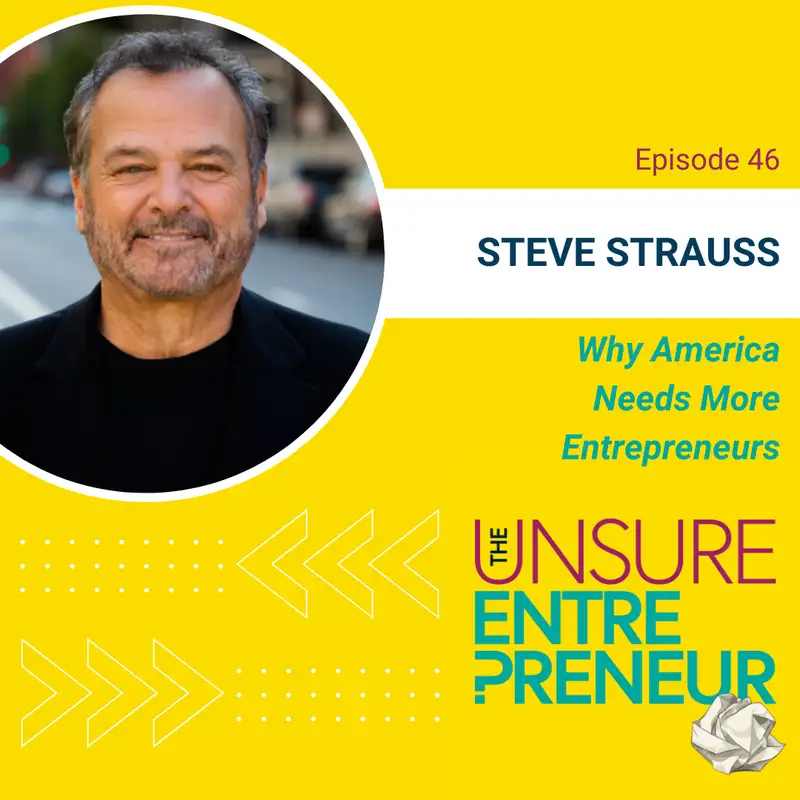
Steve Strauss on Why America Needs More Small Business Owners
Steve Strauss
Episode 46
SUMMARY KEYWORDS
Entrepreneurship, small business, risk, marketing, failure, mentorship, side hustle, technology, resilience, business growth, independent contractor, business resources, business strategy, business success, business challenges.
SPEAKERS
Roger Pierce, Steve Strauss
Steve Strauss 00:00
I understand that people are scared of starting a business, makes them nervous, but you should also just flip that and use that to get excited.
Roger Pierce 00:30
Hey there, Unsure Entrepreneurs. Welcome to the show today. I'm joined by Steve Strauss, one of America's best-known small business voices.
Steve is the best-selling author of the Small Business Bible, as well as 17 other business books, he was the senior small business columnist for USA Today for more than 20 years, and now writes about entrepreneurship and small business for Inc. The very well-respected and well-known national organization Score Mentors has named him the country's leading champion of small business, and we'll talk about Score a little bit later on. Steve's also an attorney, entrepreneur, speaker, and prolific content creator, to say the least. Through his company, the Straus Group, Steve has worked with major brands, including Visa, Yahoo, PayPal, Bank of America, and Microsoft, to produce things like blogs, videos, podcasts, ebooks, webinars, and other digital content. I can relate to that. There are many great examples of his work at the website mr. allbiz.com but to help small business owners directly, Steve created another website called Planet Small biz.com where visitors can learn how to start, run, and grow a small business doesn't stop there. In 2025 he created the excellent newsletter, Notes to an Entrepreneur, and grew it to over 22,000 subscribers. And I'm a big fan of this publication. Bottom line, Steve has spent decades studying entrepreneurs, writing about entrepreneurs, and helping entrepreneurs, so he clearly has his finger on the pulse of the small business movement in America. So, naturally, I wanted to have him on the show to talk about a question that feels bigger than any one business. Does America need more entrepreneurs? And if the answer is yes, what can we do about it? Welcome, Steve.
Steve Strauss 02:18
Thank you for that generous intro, Roger, and happy to be on your show. Finally, I love your show, and great to be here. Thank you.
Roger Pierce 02:26
Delighted to have you. I've been looking forward to this for a while. You and I have a lot in common. I think we're going to have a lot of fun together, and we've got a really important topic to cover. So, let's dive in.
Steve Strauss 02:37
Let me tell you why I love entrepreneurship. To start with, when I was a little kid, I grew up in Southern California, and my dad had taken one little carpet store, which was his business, and turned it into what became the biggest carpet chain in California at the time, back in the 70s, and I was about eight or nine years old, and I had to do a story in school about what my dad did for a living, doctor, I could have said, lawyer, retail carpet store owner, does not roll off the tongue of an eight year old, so I asked him, like, oh, Dad, what do I say, what do you do, and you think this is like 72 maybe 70, you know, he goes, well, Stevie, I'm an entrepreneur, people did not banter that word around back then, you know, like you're an entrepreneur, what he said, I'm a person. An entrepreneur is a person who takes a risk with money to make money. I've heard lots of definitions over the years, but you know, maybe because that was my dear old dad gave me that one. I like that one a lot. You know, person who takes a risk with money to make money, clearly it rang a bell with me, because this idea of taking a risk and making money and having fun, and I loved, you know, watching my dad grow his business. That's what we would talk about over the dinner table at my house. It was growing a business. So, entrepreneurship, as you said, it's in my blood. It's been part of me for a long time, and it took me a while to get to be able to do it on my own, but when I did it, I did love it.
Roger Pierce 03:57
I'm sure your dad would be proud of you today for caring. Thank you, right, and helping so many other entrepreneurs. That's right. Did you get to work in the business at all as a kid, or
Steve Strauss 04:07
You know, it's a funny thing. My very, my very first job was in his carpet warehouse. I was about 15 years old. It lasted until this one day, it was a summer job where I was driving the forklift, and a carpet forklift has this long pole going out of the front of it, so it can pick up the carpet rolls, and I drove that pole. It was up high, I'm driving, and it went right into my dad's wall, right through his wall into his office. That was my last day working at the carpet store. Wow, but later on my dad ended up growing this big business, and you know what, he was an entrepreneur, and he became kind of a manager, and he didn't like it. It was not, it was not a fun experience to run 20 different stores, so he sold out to his partner, and at the end of his career, he had one giant carpet warehouse again, my. Dad sadly passed away early, unexpectedly, and he left it to me, my three siblings, and the carpet store manager, who ran the store, because we were all underage, so five of us owned this carpet store, but she, and she ran it, she thought he came up with this genius plan, but it was a horrible plan, because one, none of us really wanted to go into the carpet business, you know. I was at UCLA at the time, and she was this poor woman running the store, did all the work, and she only got 1/5 of the money. This didn't work, so we sold - we sold out to her. So, long story, I didn't ever get a chance to go into the carpet business, but I think it worked out.
Roger Pierce 05:36
Your entrepreneurial roots run deep. I love it, and I guess this is a better path for you than forklift driver.
Steve Strauss 05:43
Anything's a better path for me than forklift driver. Can you tell me what was your first business?
Roger Pierce 05:49
Oh gosh, I, I've had businesses since I was in high school, I got involved in Junior Achievement.
Steve Strauss 05:54
Oh, good for you,
Roger Pierce 05:56
That's opened my eyes, and my grandfather, who's mentioned in my book, owned a survey firm, really successful survey firm, you know, land surveying back in the 40s, 50s, and 60s. They grew up like 20 people and had lots of government contracts, so I always admired him. And I would drive by his office window as a kid, I remember looking up with the name, you know, Pierce on the windows and being very impressed by that. Let's talk about small businesses in America. As you know, small businesses sit at the heart of the American economy. Now, according to the US Small Business Administration, there were 36 million - can believe it - 36 million small businesses in the US in 2025 and they make up 99% of all American businesses. That's an important fact. Lot of people don't know about now. These small businesses employed 62 million people, which is like 46% of the private sector workforce.
Steve Strauss 06:55
And how many of those are one person businesses?
Roger Pierce 06:58
That's right, micro businesses.
Steve Strauss 07:00
I think it's 78% I think you know of those 30 million, the vast majority are one person businesses, which people don't realize.
Roger Pierce 07:10
So true. A lot of people, you look at business, they think of companies like Apple and Microsoft and Tesla, but the landscape is micro.
Steve Strauss 07:18
Yes,
Roger Pierce 07:19
Very small.
Steve Strauss 07:20
Yeah, those big companies employ roughly half of all workers in the US, and small businesses employ roughly the other half. So, half of everybody works for a small business, you know, or knows somebody who does.
Roger Pierce 07:35
People should remember, if you just walk around your neighborhood, you'll see the small businesses that you often probably don't pay attention to the, you know, the dry cleaner and the bakery and the sandwich stop, the pub, that's America, isn't it? It's small businesses.
Steve Strauss 07:49
Yeah. And I love, I love that analogy, because I tell people something similar all the time. What is your book about, The Unsure Entrepreneur? It's about people who aren't sure whether they can do it. Should I do it? If I, how do I do it? Should I take the risk, and I get this question similarly a lot from people. And what I say is, drive down the road, that car shop, and that little market, and the nail salon, and the tanning place. Those are people who had a dream, too, just like you, just like me. They figured out how to do it. There's their shop, and they get to go there every day, and that's just the physical businesses.
So, if they did it, you can do it. Yeah, is it going to take some risk? Well, that is, as I said at the top, that's part of the game. Risk is part of the game, but the best entrepreneurs are the ones who reduce the risk to the extent possible, and then go forward, and it's kind of the juice, I think. Roger, I'd love to hear your take. Taking the risk is like, okay, no one's going to tell me how to do it. I'm going to find some good podcasts and books that are going to help me, but I'm not gonna have a boss telling me what to do. And that's the fun of the thing
Roger Pierce 08:56
I think it is an exciting and intimidating prospect of opening a business, and that's what my book, thanks for the shout out, The Unsure Entrepreneur, is all about. It's to kind of demystify what entrepreneurship is all about and provide people some real insights. Doesn't sugarcoat it, it talks about a lot of the bad things of entrepreneurship, like emotional risk and the toll it can take on mental health for entrepreneurs. I know you've written about those subjects in the past, but at the end of the day, we want people to start businesses, we want them to try it, and hopefully by listening to what we're saying here today, they might consider that. So, let me ask you, do you think Americans understand how important small businesses are to the economy and the culture?
Steve Strauss 09:37
I think they do, for the most part. When I started writing about small business back around 2000 or so, not to date myself or anything. All the business was was big business and.com and my lone little voice about small business and little entrepreneurs was kind of drowned out, and I used to say, hey, pay attention, this is a big deal, and I think since. Then things have shifted, yeah, of course, big business always gets a lot of attention, but what do you hear every four years when, when the different politicians come out? Well, they talk about small business and how small business is the backbone of the American economy, and we need to support small business, and then they go away and they trot it out again four years later, but it does come out, and I do think just now this idea of side hustles and this challenging economy we're in, and AI is making people think about what can I do, how can I do something else? Maybe I can't, maybe I shouldn't just have my main job at my job and have a side business that's a small business, or maybe I'm ready to go off on my own, so I just think that the culture and the context and the ability to create a small business to become an entrepreneur is easier than ever, and that's the good news. Technology has made it easier and cheaper than ever to start a business, so the risk that way, at least, is less, and you're right, there are other risks, reputational risk and emotional risk, and those are real. But I do think the idea that small business is important, and it might even be important to me as a person, is getting through.
Roger Pierce 11:14
And I think it's important that people remember all these big businesses that we may see out in the news and dominate the news, they started off small.
Steve Strauss 11:20
Every one of them
Steve Strauss 11:22
Right? Yeah, I mean, Apple started in a garage, and HP started in a garage, and Microsoft started, you know, in Albuquerque when Bill Gates and Paul Allen dropped out of college, and they started a little company called (this is so funny) Traff O Data. You heard of this before? Microsoft, they were doing, they're analyzing traffic patterns with computers, and so their company was called Traff O Data. Not surprisingly, maybe it didn't do very well. You start out small. I tell my kids, I got three daughters, and I say everything is hard before it's easy, and the same thing is true in business. Everything is little before it's big, and you don't have to get big. Lots of small businesses. Most I would suggest like being small. That's part of the fun of it. You get to run it, you get to control it. It's not too much overhead, you know. You make what you make, and the bigger you get, it might get more complicated. So it's just fun to start small and stay small. I was looking through some of your articles, and you reminded me now, oh yeah, on Ink, you talked about Hershey, founder of Hershey, going broke and now turning it into what, a $50 million brand at the time.
So Milton Hershey went bankrupt, not once, not twice, three different times, and he still went forward and ended up becoming successful. I mean, now that's an entrepreneur or dummy, I'm not sure, but you know what, he looked at it like I had a 10 year run of the best entrepreneurial training you could have, and he started one company in Lancaster, Pennsylvania, and then he started another one in New York, and and finally he figured out a way to make Carmel last, Carmel at the time would go bad in a day or two. He had this process that would allow you to create caramel, let it keep, and it turned into a million dollar caramel company. And at the height of his caramel business, he was still an entrepreneur. He decided chocolate is amazing, and everyone deserves chocolate, and chocolate at that time was kind of meant for upper classes and Europeans, and it wasn't readily available. He sold his caramel company, took his millions, and started Hershey Chocolate, and became a, you know, a $50 million at that time chocolate entrepreneur. So it's an amazing story, because the resilience is really impressive. And that, what did he do right, though? He kept learning from his mistakes, which I think is the key to a great entrepreneur. The ones that I write about in my newsletter and notes to an entrepreneur, everyone's making mistakes and making mistakes along the way, but then they figure something out, and all of a sudden that thing they figure out is like, oh, that's what I needed to get to the next level.
Roger Pierce 13:59
It's so true, and you touched upon so many points there, like persistence, never giving up, right?
Steve Strauss 14:04
Right,
Roger Pierce 14:04
Trying again and again. I mean, I'm glad we're having this conversation, because I think part of my thing is there's all this discussion about all the big businesses, we pay more attention to the small businesses and help them. What would you say? What's one of your main reasons you like to see people start up a small business?
Steve Strauss 14:21
You know, it's always personal. It could be that boss you hate, which was true for me, or it could be you wanted more freedom, that was true for me, or it could be you wanted more creativity, or it could be positive things that come with this risk that we were talking about. Those are great things to be your own boss is fantastic to take your own ideas and run with them. That's really interesting to be able to be creative and come up with a marketing idea, and then implement that marketing idea, and then make a profit with that marketing idea.
That's super exciting, the chance to make a difference in your community and hire people and give people jobs that. Very intoxicating, so I think there's so many bad things that go are going on in this world today. There are lots of people who like to destroy things, who love to talk negatively about things, because it gets clicks and it gets attention. What I love about entrepreneurs, what I love about small business is it's positive, you are making, and it's not so easy to build something. Hey, tearing something down, blowing up a mosque, blowing up a synagogue. We're not gonna say it's easy, but it's boom, boom, boom. Creating a business that takes work, that takes creativity, and vision, and persistence, and lots of positive things. And then, when you do it, you're making money for yourself and for your family, and you're adding to the tax base. Maybe you're creating jobs and giving someone hope, and so, so many positive things come from, you know, waxing poetic here, but that's how I am. I really admire people who do it, and I really think it's in this world it's more important than ever, and there's more opportunity in it than ever. There's so many ways to start a business now that weren't true when my dad started his carpet store.
Roger Pierce 16:10
I call them entrepreneurship enablers, and I call this the Era of the Entrepreneur. There's never been a better time,
Steve Strauss 16:16
yes
Roger Pierce 16:17
…to start a small business, because, like you said, 30, 40, 50 years ago, yeah, you needed a couple 100 grand and an office, and maybe a staff, another factory, or whatever, but today I can open a Shopify store this afternoon if I wanted to. There's so many things, and there's government money out there, we'll maybe touch upon that later. There's grants, there's banks, there's business competitions, there's people like you and I, hopefully helping entrepreneurs. This is, I think, a glorious time to start a small business,
Steve Strauss 16:41
You know. I'm reminded the story of why, and I told this with one of the news of Tommy Hilfiger, the designer.
Before he was Tommy Hilfiger, he was a designer in some shop, and he was in the middle of his career, and he wanted to become a designer. And what am I going to do? I just.. I don't want to work for this guy forever. Is make what he tells me to make and design, what he tells me to design. I really have my own ideas. Like, sounds like an entrepreneur, right? So, he went to a PR agent. He was working in New York, and the PR guy came up with this audacious plan. He said, 'Tommy, here's what I think you should do. I think you should get some backers and go buy yourself a billboard in Times Square, and on that billboard, we are going to compare you to the great designers of the day. We're going to compare you to Calvin Klein and to Ralph Lauren and to Perry Ellis and all the great designers. And then there is Tommy Hilfiger, and he's like, that's crazy, I love it. And so he did it, he found some backers, he got a couple $100,000 they put up this billboard across from the Polo Ralph Lauren Polo store in Times Square, comparing him to all these great designers, and he became overnight the talk of the fashion industry. And then the next week he ended up on The Tonight Show with Johnny Carson interviewing him, and he became around, he became Tommy Hilfiger. So that's entrepreneurship, right? And it one big bold bet, and he did it. He began, became this, you know, this thing. So I don't know, I love these, these guys who do this, these women who do this, because they're risk takers and they make a difference in the world.
Roger Pierce 18:17
There's also the chance of maybe one day selling your business absolutely like you did. I'm gonna pull up a fun fact here. You know what's coming. You sold one of your businesses to one of the sharks on the Sharks tank. Can you tell us about that?
Steve Strauss 18:32
I did. So I've started four businesses. Three have been very successful. The fourth one we don't have to talk about, or I'm happy. I'm happy to. I'm happy to talk about, right? Because I learned a lot in that one as well, but one of them came about about a decade ago. It was before Obamacare, and it was a company called eHealth Insurance, and eHealth insurance helped people navigate their health insurance options, and they thought their next big channel was going to be the micro entrepreneur who we'd been talking about, that one person business, so they found me. They said, "Steve, what can we do together? We want to do something for to attract the micro, you know, freelancer, independent contractor business, and let them know about e-health insurance. Really bandied around some ideas, and I said, "Why don't we come up with a website? Let's come up with a website, and I've got the content. I'll run the content, you run the finances, and together we'll build a great website design specifically for the self-employed. I went out, I found the URL, “TheSelfEmployed”. It turned out it was already owned by a band in Sweden. Okay, the band named the Self-Employed, so I spent $5,000 I bought the URL from them, because it's such a perfect URL for a website for the self-employed, right? Obviously, so we created this website called the Self Employed, and then I kept adding content to it, and content, and then I got other partners. I found Bank of America wanted to run the money part of the website. In that section, and score, who you had mentioned, wanted to do the startup section, and LegalZoom wanted to sponsor the legal part, so I found I got all these different sponsors, they added content, I added content, it grew to be a really fantastic website, and about four or three years ago, Mark Cuban and Mark Cuban company came to me and said, we really love your content, we love the SEO, you know, historical nature of your content, and we want to buy the website lock, stock, and barrel, and so I'm like, okay, you know, I never built it with the expectation that I was going to have that kind of exit, but it was turned out to be a great exit.
Roger Pierce 20:40
You got to expect the unexpected and pivot in entrepreneurship. Now, tell listeners what he turned that into.
Steve Strauss 20:46
So, he had a site at that time called Zen Business, and Zen Business is a company that it'll incorporate for you, it'll do anything you need for your small business. I love Zen Business, it'll incorporate for you, it'll help you create content, it'll help you create your website, you know, does everything, and so their plan was he didn't create Zen Business, but he became the majority stakeholders in Zen Business, and Zen Business went around at that time and bought every little small business-oriented website. So Riva had a site, our friend Rieva Lesonsky (Episode 35 on The Unsure Entrepreneur Podcast), that was sold to Zen Business, a couple other people that I know, Zen Business bought all these different sites for the content for the SEO. So, when you Google anything these days, you're gonna often end up on Zen Business, because our content now is the content of Zen Business. It was a very smart, not surprising business strategy to kind of own that space.
Roger Pierce 21:39
Did you get any tickets to go see the Mavericks at the time?
Steve Strauss 21:41
Damn it. No.
Roger Pierce 21:43
Put that in the agreement, right? That's a great story. Thanks for sharing it. Okay, we've talked about, you know, why we need more entrepreneurs, but let's talk about what we can do to, you know, get people more interested in entrepreneurship, and that's one of the reasons behind the podcast and the book, is there's lots of people who are interested in entrepreneurship, but they are hesitant. They don't know where to begin. They don't know much about the money side of the business. They worry about failure - that's a big one. Maybe we'll talk about that, and they wonder if they've got what it takes. So, a couple quick stats to frame our talk. The Global Entrepreneurship Monitor, one of the one of the most respected reports and surveys on small business, says the fear of failure still deters about two in five, two in five adults from starting a business, that's a lot, that's 40% and yet on the other side, Kaufman, the Kauffman Foundation, another well-respected think tank on entrepreneurship, they have a report that's encouraging, they say the opportunity share of new entrepreneurs rose to 83% in 2025 which means most new entrepreneurs are starting by choice rather than out of necessity. So, we kind of have both things happening at once, Steve. We have fear and opportunity.
So, I want to talk to you about this. In your opinion, what do you think holds people back from starting a business today?
Steve Strauss 22:59
I think fear is a big one, for sure. This idea of risk, and it's a little bit of an old-fashioned idea, because, as you mentioned, there's never been a better time to start a business. There's never been an easier time, or a more affordable time, or more opportunity. I mean, this really is, I think, the golden age of entrepreneurship. For one, entrepreneurs are celebrated. I mean, if you look at who gets the juice in our culture, who gets the media, who gets the attention, it's the entrepreneurs, right? For sure, that's true.
Way beyond that, it's just that technology has made it such that starting a business doesn't need to be a hugely financially risky thing, and you're not on your own like you were a generation ago, right? It used to be like my dad or me when I started my first law firm. You read a book and you cross your fingers and hope you knew enough to do it, but these days there are podcasts, there are websites, there are trainings, there are institutions groups like Score, like the SBA, the Small Business Administration?
There's so much help out there that you're really not on your own, you're on your own doing it, but you're not by yourself. That, for one, makes it much easier. And then, if you were to make an online business, which is what so many people want to do these days, the overhead is just a radically different computation, you're not renting a place or buying a place, you're not paying for labor unless you really need it, you're not paying all heat and utilities, you know, so your overhead is much, much lower. If you run it out of your house, it's almost, almost nil, so that takes the risk down substantially, but there's always going to be some risk, that's just the way it goes. You're going to be risking some capital if you're going to do it right, because I think the worst thing you can do is start a business and not have enough money to market it and get the word out there, that's like a big mistake. So it's going to take some money for sure. Okay, that's the way it goes, and you're going to help. People, you're doing it, you're gonna cost you some reputation. Good. Well, if you succeed, they're gonna think you're a genius. That's the thing about risk - sometimes it pays off.
Roger Pierce 25:09
Without risk, there is no reward, right?
Steve Strauss 25:10
Risk and reward. And then, with all this different help, even AI.. let's talk about AI for a second. The AI help you put the right prompt into the right AI, it kind of can do it for you. I know the agents are out there, but at least you're going to get a plan very specific to you that's going to tell you what you should be doing and what you can do, and how to do it, and it's going to be world class help and information that too is great. So, yeah, I understand that people are scared of starting a business, makes them nervous, but you should also just flip that and use that to get excited about the possibility and the option, and being your own boss, and making a difference, and running with your ideas. I was a terrible employee. I don't know about you, Roger, but I had to be an entrepreneur because I stunk at being an employee, you know, because I just didn't like taking direction, and I didn't quite do what they said, and I always thought my ideas were better, and gee, I got fired. How surprising?
Roger Pierce 26:10
Nobody would hire me again,
Steve Strauss 26:12
is that right? That's true for me.
Roger Pierce 26:15
I'm ruined. I'm ruined for employment, that's for sure.
Steve Strauss 26:19
Yeah, my first job out of law school, got a great big job at a big law firm in the big city, making the big bucks, and I was just big time unhappy. I was not good at it, and also I was kind of a mediocre lawyer. So, turns out I'm a fantastic writer. So, right around that time, my first books got published. I was able to get published after trying for a decade, and then I got fired, and I thought this is my moment. I'm gonna, and my sweet wife supported me, and I got to add a friend who believed in me and lent me a little bit of money. And I opened my first law office, and it was successful, right from day one. I made a profit the first month, that was great, but still I wanted to do more than just practice law, and I liked it. Turned out the idea of getting customers more than I like practicing law, right? I like the business part of it more than I like the legal part of it. So I ended up, you know, creating this content company. I was very fortunate that way. Point is, it never would have happened if I hadn't got taken the risk, and so I think people are scared, or they're scared of spending the money, but it is for sure easier than ever. I know you must be saying the same thing on your podcast and in your book, right?
Roger Pierce 27:24
It is the right time to consider entrepreneurship, all things considered. And you touch upon so many great things there, so we might as well, we might as well talk about support right now. And I'm going to bring up Score Mentors, (Score.org) because I know you are heavily involved with the organization. That's a great example of a resource out there available to help small business owners succeed. Can you explain a bit more what it does?
Steve Strauss 27:44
Yeah, so Score is a, you know, is over 50 years old as part of the Small Business Administration, SBA. The way it was explained to me is like a Peace Corps of entrepreneurs in the United States. There's 11,000 volunteers, people who were entrepreneurs or businesses, they owned a business, whatever it is, and they volunteer their time at their different score offices, so every state will have a score office, usually several score offices. And then score.org is the overall website, and you can go to Score and get a business mentor. Right, people always want to know, where do I get a mentor? Go to Score for free, they'll hook you up with one of these volunteers, and let's say you have a problem with marketing, or you need to know something about how to do a marketing company. They'll find somebody who's marketing is their specialty and hook you up, and you're gonna have your own score counselor, and you can meet in person for coffee, or you could meet over online just via text and DM and email score does lots of great webinars. I'm a Score webinar presenter. You're going to do the one of the webinars, you might have heard me. So it's a fantastic organization. I was on their board of directors, actually last year, and that was, that was cool, exhausting, a lot of work, but it was an honor. And a couple years ago, they named me the champion of small business in all of the, all of America, so that was pretty cool too. But I just love score, because I think small businesses, you know, you can go read something, you know, go find a website, but actually being able to talk to somebody who's done it, who can give you some advice, that's, and it's for free, that's really incredible.
Roger Pierce 29:17
Great organization, and I'll put the website address in the, in the show notes, but you raise a good point, you know. We're not in this alone. There is help out there, whether it's through organizations like Score or whether it's through a small advisory council of your own construction. Bring in some entrepreneurs, you know, bring in some business owners, meet every quarter and ask them, "Hey, guys, help me with my, with my business. We're not alone out there, are we?
Steve Strauss 29:39
Brad, absolutely, we are not alone out there, and you know what? People want to help you. You start a business, you'll find your friends, your family, your colleagues, they'll send you business if you ask. People want to help. We all like small business. Actually, we answered one of your earlier questions, and if you go out there and say, 'Hey, I'm starting a business, and if you know anybody. You do needs this, is what I offer. I, I do ghost writing for people, whatever it is, they'll help. Just need to, and can I mention one more thing? Roger, yeah, please. I did a Score webinar just recently. This week got me thinking about that a couple weeks ago on Booberpreneurship during Small Business Week, and it was very well attended, because there are a big group of people my age, I won't speak for you, maybe your age, I'm not sure. Who are boomers, or at least they're older entrepreneurs, and typically maybe they were never an entrepreneur before, but they're going in to their senior years, or they're wrapping up their first career, and they like this idea of starting a small business or a side hustle. But how do you do it? How do you do it when you're older, because the risk, the risk ratio is different when you're older, right? You want it, you have less tolerance for risk, for good reason. You don't want to risk your 401 k. So, how do you do it? So, I had a fantastic webinar. People could go to score.org if they wanted to see it. They could google my name there, they'd see the boomer entrepreneurship webinar, and I'm actually doing some coaching for people. If they're interested, you can find me on my website, mr. Elvis. Shoot me an email, and I'm helping some older second act people start their own business these days as boomers. So that's another way people can get into this entrepreneurship world in a smart, savvy, you know, less risky way.
Roger Pierce 31:18
Let's talk about that for a quick sec.
Boomers make great entrepreneurs for some of the reasons you just mentioned. They've got hopefully a little more access to capital than younger entrepreneurs. They've got experience, they've got connections, they've got wisdom, patience, all those things that make, make for great entrepreneurs. That's a huge market, because it's people who are, you know, too young to stop working, but looking for their next next adventure. Fair enough.
Steve Strauss 31:39
Yes, exactly. And those skills and assets are really not insignificant. Just the people you know, a young 20 something tech pro wants to know people, you, me, we know people, we have a whole network of people we can tap into. Ideally, we have some resources, and ideally we have a skill set that is very honed, that is very unique and very good, and that people would pay for, right. So you can even just go out as a consultant and take, you know, your list of people and your skills, and you'll get gigs, you know, you can start in a nice second career and doing it on your terms when you want, when they write you the check and not your company, you'll like that a lot. It's a very potentially lucrative and less risky way to make some money and still be productive and useful and feel like you're doing something.
Roger Pierce 32:33
Absolutely, they make great entrepreneurs on all fronts. My typical advice to someone who gets let go, you know, in their late 40s or 50s, from their company, and I, and I often say, you know what, set up a service company, set up a consulting company, and sell yourself right back to them,
Steve Strauss 32:48
very good,
Roger Pierce 32:49
for three times the money,
Steve Strauss 32:50
there you go, that's right,
Roger Pierce 32:51
yeah, and some of them pay it, they actually would always have flexibility, right,
Steve Strauss 32:58
right, because all of a sudden there's a big gap in the company, like, oh, shoot,
Roger Pierce 33:01
yeah, yeah, love it. There's always opportunity there. So, a bit of a connection to me to there to that topic.
Steve, and I know we got to watch the clock, educating entrepreneurs, not just in school, and when they're young. I know that's important. I've got a stat here saying two thirds of students said they were interested in starting a business, but 80% felt they didn't learn enough about it in school. So, again, building on that theme of entrepreneurship awareness and education, which is one of the things you're doing, of course, helping people learn about entrepreneurship. Do we need to be doing more of that across the age spectrum?
Steve Strauss 33:35
Absolutely, but I'm a little different than most people you might talk to. I am not one of these guys who thinks we need to teach entrepreneurship in school, you know, in high school they should do, you know, young entrepreneurs or whatever, you know, it is. I think go to college and get a good, get yourself a good education, go learn how to think, go butt up against adversity, go hit that professor who gives you a hard time. I had a torts professor, right? I practiced law, as you mentioned. You know, I came to my senses. I don't do that anymore. But, boy, Judge Adams taught me how to think, right? He was my torts professor. And my first two weeks, I hated this guy so bad that I actually went to the dean and, like, please transfer me out of this man's class. I do not want to be in Judge Adams' class. I ended up becoming Judge Adams, TA. I fell in love with the man. He taught me so much, and me and my wife - one of our best memories is going with Judge Adams and his wife on his boat down the river when I was a senior. Now, if I just quit and said, 'Oh, it's too hard for me, or 'I want to go start a business, I never would have known how to think like a great lawyer, which is what he taught me how to think like, right. So, those experiences are, I think, to really run a business, you need to be well-rounded. You need to come up against some bumps along the way, and you could be, couldn't you be 20 and move to Palo Alto and try and get some VC money? Yeah, you. Can, but I don't. I think in the real world we mere mortals don't do that kind of thing, right?
So, if you're just a regular person who wants to start, young person who's thinking about starting a business, go work in that business first. You want to start in a restaurant, go work in a restaurant, see how hard it is, see how low the margins are, see what the overhead is like, see what keeping people on staff, how hard it is. Then you go run a restaurant, you want to run some kind of tech business. Go work for Google for a while. My daughter works at Yahoo, and in New York, she's not feeling like she wants to be an entrepreneur right now, at least in the tech world, you know, because you get the inside view. My point is, you need to learn the business first before you go start a business, so instead of just theoretically learning it in school, I think it's a much better experience to go experience life and then go find something you do find interesting, and then go work in that industry. That's the best thing you could do to become an entrepreneur.
Roger Pierce 35:57
Fantastic advice. Get paid to learn.
Steve Strauss 35:59
Really get paid to learn, like the law firm, I went to work at this big law firm for two years. I learned how to be a lawyer, I learned how to draft a brief, I learned how to go to court. They taught me all, and then they fired me. So, but that's when I was able to go off and know how to be a lawyer and start my own practice. So
Roger Pierce 36:17
it's interesting how the path of life is takes us all these twists and turns, but it usually works out just fine.
Steve Strauss 36:23
That's for sure true.
Roger Pierce 36:24
So, before we go to our next segment, I have a fun question for you. I couldn't help but bring this up because I saw it on your bio. Is it true, Steve, that you hate ketchup?
Steve Strauss 36:32
My nemesis, ketchup. Oh, I hate ketchup. I grew up in Southern California, as I said, and there was a Hunts tomato plant about a mile from our house in the hot summer sun. They had these vats of tomatoes sitting outside, and this smell of rotting tomatoes would waft over our house for two months over the summertime. Like that smell, I couldn't take it, and it's damaged me into my adulthood. Ha! you know, my younger brother Spence used to love, like, we'd get hamburgers, and he would love, like, when I'm looking away, he'd sneak ketchup onto my hamburger, and then put the button back on, and I could smell it a mile away, you know, much to my children's dismay, as they grew up saying, well, you like pizza, Dad, and you know, you like spaghetti sauce. Yeah, I do. I don't like ketchup.
Roger Pierce 37:27
I guess I shouldn't send you that bag of ketchup chips.
Damn you, Roger, no.
Watching our time too. I want to talk about your advice for emerging entrepreneurs. So, okay, this show is for people who are obviously on the fence, you know, not sure they want to go down this path, although we've given them lots of good reasons to consider that. One of the things we haven't talked about is earnings and money, because I know that's a big myth, Steve.
Steve Strauss 37:52
yeah,
Roger Pierce 37:53
for entrepreneurs. So I just want to share a stat. The average self-employed worker in America earned about $62,600 in self-employed income at 2024 so that's a respectable number, but it's also a useful reality check. It's not millions. Entrepreneurship is not always about getting rich, as you and I both know, it's about building independence, flexibility, pursuing your passion, controlling your future, but it can be for the right person one of the most rewarding paths there is. So, I'd love to get your take, knowing though that you're not going to get rich out of it, and maybe accepting that reality. Is there a way someone can like test an idea before taking on too much risk?
Steve Strauss 38:31
Absolutely. I think one of the best things you can do, be you know, if you have a job, I don't recommend quitting your job and starting a business. Do you? No, no. Yeah, okay. Right, we're on the same page here. That's too much of a risk. But what I do suggest is come up with an idea for whatever your business is, stay at your job, and then either do it part-time, right, as a kind of a side hustle, as you can, or even better, go interview people who are doing it. Go talk to people who are living the trade. You want to start a carpet cleaning company, which actually can be very lucrative business. I'll just use that, because I know carpets, right? Well, go find some carpet cleaning companies, maybe in a different city, so they don't think of you as the competition. Go 1020, miles away, find a carpet cleaning company, take the owner out to lunch, and that pick their brain. What's good about this business? What's bad about this business? How do you hire? How much money can you make? How do you grow it? What's the best marketing idea? You do that three or four times, and then you really are going to get a fantastic education on how to start that business from people who do it. Then the risk we talked about this whole time, you've reduced it way down, because you know what you're talking about, you know what you're doing, you know what's going to work, what's most likely to work, and what's most likely not going to work. And then I would say, save up a little money, then you can quit or get fired and go start that business.
Roger Pierce 39:51
Great advice. Remind me, I just interviewed someone last week, a 16 year old young lady who is running a. Arguably, very successful jewelry business. She's doing trade shows, she's got billboards, she's got a lot of national presence, and she's doing it in between classes and after class. She's in grade 11.
Steve Strauss 40:10
So impressive.
Roger Pierce 40:12
So, like you said, don't quit school, don't quit the job, start the side hustle, prove to yourself that's a great way to mitigate the risk.
Steve Strauss 40:20
Absolutely,
Roger Pierce 40:22
So I have to ask you about on the flip side, Steve. When should someone not start a business?
Steve Strauss 40:26
Starting business is not for everybody. Being an entrepreneur is not for everybody. Some people are athletes. I'm not an athlete, although I tried. Some people are artists, some people are musicians, some people are employees, and some people are entrepreneurs. We all need great employees. There's nothing wrong with being an employee, boy. If you can go and fit in that organization and make it work and do your job and be a good colleague, that's a super valuable asset. And doesn't mean you have to quit it and go and start your own thing. It's a whole different skill set to do the entrepreneurial thing, so you got to make sure one that you have the skill set, whether you can live with risk, whether you can live with uncertainty, whether you have enough ideas, whether you have the backing of your family or not. Because if you don't, that's a non starter right there. How much competition is there in the area that you want to start? Because there's too much, that's scary too. If there's none, that's maybe a sign too. So, there's lots of things that go into that equation, whether you're going to start a business or not, become an entrepreneur or not. You just got to make sure that it's a lifestyle that fits with your temperament and that your work skills fit with what you can do and go make money at. I mean, being an artist is cool, because you can just go buy a canvas and paint a picture, and you paint your picture, but when you're an entrepreneur, you got to go paint the picture, then you got to sell the picture, that's the difference. So, you got to make sure that you can do the thing, and then there's a market for it, and that you know how to sell it and make money at it. So, you got to make sure that all those things actually fit you before you go and do it.
Roger Pierce 42:01
And there's nothing wrong with saying, you know what, all things considered, it's okay to stay employed. And what if someone does start Steve, and they fail, and that's a big, big concern for people. What do you say to people who are worried about failing if they do venture in?
Steve Strauss 42:17
Well, welcome to the club.
Roger Pierce 42:20
Me too. Right, right,
Steve Strauss 42:21
And we've all been there. I started four. Three were successful. The fourth was I had started a law firm in one city, and as I was going to expand into another city, so I opened another law firm about 90 miles away, and it was pretty much a pre-internet era, so it wasn't so easy to run two offices so far away. I dumped $40,000 into a losing venture, and it was stupid. I didn't know what I was doing. I didn't know how I was going to run it. What worked in one city didn't work in the other city. So, failure is part of it. You read any story about Steve Jobs or Virgin Airlines or Martha Stewart, they all of them have had failures. In fact, in my, in my notion entrepreneur newsletter, I share the story of that someone who'd been failing, and all of a sudden, Milton Hershey - all of them, they figured something out. This, the fun part is when you figure it out, right? That's why my newsletter is successful and popular. And sign up, people, if you don't, what kind of entrepreneur would I be if I didn't say that? But we all fail, then you keep going. I think that's how it's supposed to work.
Roger Pierce 43:23
I think on your newsletter a couple issues ago you talked about the guy who invented the cup of noodles.
Steve Strauss 43:28
Oh, yeah, yeah, yeah,
Roger Pierce 43:29
right.
Steve Strauss 43:31
But he had had failure after failure in his life, and then this idea of freeze-drying noodles, he became, you know, a billionaire. I mentioned Martha Stewart. Martha Stewart was a caterer well into her 40s in Connecticut, and then she went to a party in New York City, and someone offered her a book deal, and she did a book called Entertaining, but even then she wasn't very, very well known. She was a caterer with a book. Then she met a woman who was a business genius, and that combined they created Martha Stewart Living Omnimedia. Martha was able to, and the woman had some money behind her. Martha was able to become this creative genius that she is. The partner did all the nuts and bolts and back-end work, and together they did it. But it was, it took those two people working together, and in her mid 40s, almost into her 50s, before she became Martha Stewart. There's failures along the way, and you find the right teammate often, that's what makes a difference.
Roger Pierce 44:25
Well, I could talk to you forever. Fun. Two last questions. I know we got to go, but I can't help, I can't help but picking your brain on this. Is there one thing you wish more new entrepreneurs, emerging entrepreneurs understood before they begin starting a new business?
Steve Strauss 44:39
I like to say, it’s like being alone in a dark room.
You know you're there, no one else knows you're there, so you have to turn the light on, and the only way you turn a new light on is to market your business, and then market it some more, and then market it some more. That's it. And so marketing and getting the word out has to be the key to your business from the very start. Hurt. When I was in law school, I took a class on how do you start your own law firm, because even then I was thinking about it. The professor said, think of everyone you know, every single person, colleagues, work people, family. He goes, you need 10 different sources. He goes, everyone you know is one source. Now, advertising, there's another source. Podcast, there's another source, that's what I'm saying. You got to think expansively and think big about how you're going to turn that light on from the start. That's a really big key to success, I think.
Roger Pierce 45:31
Because nothing sells itself.
Steve Strauss 45:33
That's for sure.
Roger Pierce 45:34
Good for you, marketing and selling, and that's a scary prospect for a lot of new entrepreneurs, because they think, oh, well, my product is going to be popular. I don't have to worry about marketing itself. No, you gotta get out there, as you said. But there's lots of help and resources for you. Okay, so let's end on a positive note. What do you love most about this thing we call entrepreneurship and small business?
Steve Strauss 45:55
For me, it's not having a boss. For me, it's being the boss, the freedom, you know. I had some terrible, terrible bosses along the way. I had one boss who threatened to put his - he got so mad at me because I did hit my sales figure that he threatened to put his cigarette out in my forehead. Okay. And then I had another boss who came - she was just horrible, really horrible to work for. So I never worked with bosses. Well, I like being a boss. I think I'm good to the people who work with me, and I like doing what I want to do every day, figuring it out. That for me, that's the best. What do you like about it best?
Roger Pierce 46:30
Doing what you love to do every day.
Steve Strauss 46:31
There you go.
Roger Pierce 46:32
Yeah, mine is the same for sure. I mean, waking up in the morning enthused, excited about what lies ahead, even the mundane stuff. I know I'm a geek, even the mundane stuff, like, oh yeah, I got to write that proposal, but you know what, it's my proposal, it's my idea, and it's my opportunity, that's right, I take ownership of it, and I get excited about that.
Steve Strauss 46:50
Very good.
Roger Pierce 46:51
Fantastic. Well, this has been a great conversation, I know I got to let you go, hopefully we can get you back on sometime.
Steve Strauss 46:57
Oh, I love it, it'd be great, yeah, no, this is really fun. Thank you so much, Roger.
Roger Pierce 47:01
Well, it's been a great conversation. Thank you for sharing all of this stuff. And remember what Steve says: this is the “Golden Age of Entrepreneurship” If you dream it, you can do it. So, Steve, tell us, how is the.. what's the best way for listeners to connect with you, or get your stuff?
Steve Strauss 47:15
Yeah, you can come to my website, which is MrAllBiz.com https://www.mrallbiz.com/ or if you go over to inc.com you can find me at my Inc.com column https://www.inc.com/author/steve-strauss or you can email me at sstrauss@mrallbiz.com
Roger Pierce 47:30
Fantastic, fantastic. And I'll remind people here to sign up for the free newsletter Notes to an Entrepreneur
Steve Strauss 47:35
Right, you can get that, that's News dot Planet Small business.com https://news.planetsmallbusiness.com/ and you can get the newsletter there.
Roger Pierce 47:44
Perfect, that's a great newsletter.
Steve Strauss 47:45
Keep up the great work, Roger.
Roger Pierce 47:47
Thank you.so much, I appreciate it. So, folks, if they're listening, if you're considering starting a business, I wrote a book for you called The Unsure Entrepreneur. It's a decision guide for people who are on the fence and want honest answers and not hype about the realities of self employment. Grab a copy at UnsureEntrepreneur.com https://www.unsureentrepreneur.com/
Thanks, everyone, for spending time with me. If you're feeling unsure, you're in the right place. Bye for now.