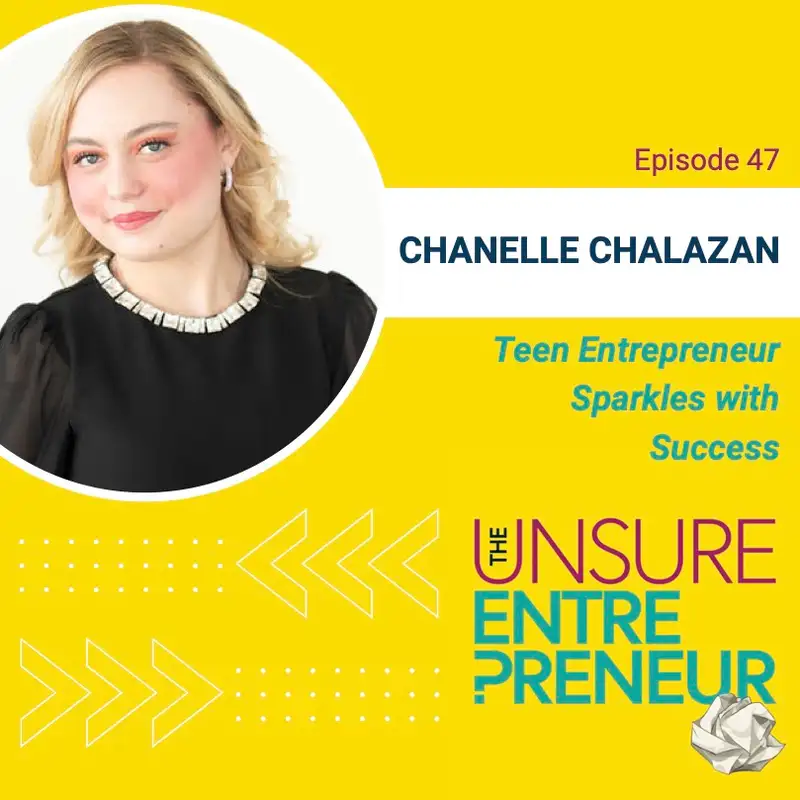
What a Teen Founder Can Teach You About Starting Up (w/Chanelle Chalazan)
Chanelle Chalazan
Episode 47
SUMMARY KEYWORDS
Entrepreneurship, young entrepreneurs, Chic and Charmed Boutique, sterling silver jewelry, trade shows, social media marketing, time management, business growth, high school, risk-taking, customer service, business awards, media coverage, family business.
SPEAKERS
Chanelle Chalazan, Roger Pierce,
Chanelle Chalazan 00:00
When I sell a pair of earrings for $20 and our competition's $80 somebody's just being a little bit more greedy and making a little bit more money.
Speaker 2 00:08
You're listening to the Unsure Entrepreneur podcast with Roger Pierce. Whether you're scribbling business ideas on a napkin or wrestling with the should I shouldn't I question, get ready to explore the realities, the risks, and the rewards of entrepreneurship, as we share the stories, scars, and successes of small business owners.
Roger Pierce 00:28
Welcome back to the Unsure Entrepreneur Podcast, where we talk to founders, experts, and small business owners about what it really takes to start and run a business. Now, today I'm talking with Chanelle Shalazan, the young founder of Chic and Charmed Boutique by Chanelle, a Canadian jewelry brand offering affordable, high-quality sterling silver pieces designed for everyday wear. The website is, and we'll plug it throughout the show, chicandcharmedjewelry.com. Now Chanelle's got a very interesting story and situation. I think you're going to love. She started selling earrings when she was just 13 years old. Wow! Since then, Chic and Charmed has grown into a nationally recognized Canadian jewelry brand, appearing at major trade shows and events across the country. The business has also been recognized with the Saskatchewan Wedding Industry Award for Best Wedding Service, it's been featured in media including CTV News. And in May 2025, Chanelle received an Entrepreneur of the Year nomination from Canadian SME. Actually, I got that wrong. You were nominated this year for last year. Is that correct?
Chanelle Chalazan 01:39
Yeah, but it was for last year. Yeah, it was 2025, but they put it a year behind. I think that's what they do.
Roger Pierce 01:45
That's awesome. And she's also been covered by Global News, City News, C95 Radio, Retail Insider, and more. Now, what makes the story especially interesting is that Chanelle is building this business while she's in high school. That raises a bigger question: What can young entrepreneurs teach the rest of us about starting before you feel ready, learning by doing, and turning early curiosity into something real? Welcome, Chanelle.
Chanelle Chalazan 02:11
Thank you for having me. I'm very excited.
Roger Pierce 02:13
Fantastic to have you here. Now, if I got it, if I don't mind me sharing, you are 16.
Chanelle Chalazan 02:17
Yes,
Roger Pierce 02:18
that is fantastic, and you've been doing this business for three years,
Chanelle Chalazan 02:21
yes, feels like a whole nother lifetime of doing business, but it's such a small time. But I enjoy what I do.
Roger Pierce 02:29
Well, you do, and and it's it's clear you're very passionate about it. You're you're if they're talking about your business, I'm going to poke and prod into your story here a bit. But congratulations on starting a business so young. That puts you miles ahead of all the other people out there, old guys like me. By getting it going so early, you are off to the races in a major way. I really see that.
Chanelle Chalazan 02:51
Thank you.
Roger Pierce 02:52
So we're going to go back to kind of the beginning because I want people to hear kind of your origin story, if that's okay.
Chanelle Chalazan 02:58
Absolutely.
Roger Pierce 02:59
As far as I can tell, it started with a simple idea and a willingness to try something new. You began selling earrings as a young teenager, even younger than you are now. You saw interest quickly, and you started learning business the old-fashioned way by getting in front of people and making sales. So, take me back to the beginning, Chanelle. What made you decide to start this business?
Chanelle Chalazan 03:20
So, my dad's an entrepreneur. He's in the construction field. So from as small as I could remember, I'm watching him run his own company. And at first, I didn't really think of him as an entrepreneur. It just my dad is in construction. He builds houses. That's all I thought. So now, when I got older, I understood he was an entrepreneur, and that's what he was doing, building his company. And my mom, she was always blinged up and always wearing jewelry like me. She always had hoops or different kind of studs and necklaces. And I think my dad, being an entrepreneur, and my mom always being blinged up, kind of interconnected into my jewelry business. And that's kind of where the idea started. And when I first kind of got that main thing, thinking, well, this could be like a business. I started putting colors of jewelry together and seeing what looked good. And of course, it wasn't the best. There was you know clay sticking up, or the crystals weren't right. But it worked for what we were going for, right? As this newly business, and we first started selling on Facebook Marketplace. And of course, it's not perfect, but women were coming to my house. You know, there was one girl coming a day to my house to buy jewelry, which at that point I was surprised that people would even love the jewelry that I was providing, and it turned into 20 women coming a day to buy. And that's when I think we realized that if we wanted to continue this business, that it could really go far.
Roger Pierce 04:36
Wow, I love that origin story. Dad, an entrepreneur, business owner, construction, and mom blinged up, inspiring your fashion channel that you've pursued. That's a great combination of inspiration from both the parents for different reasons. I love it,
Chanelle Chalazan 04:52
absolutely, and it's one great duo.
Roger Pierce 04:54
Are your parents involved in the business today, or do they kind of let you be?
Chanelle Chalazan 04:59
So my mom, she helps behind the scenes, right? But my dad's-he's more in front of everything. He's always trying to get with the media, and he's-he's not shy. Let's put it that way. He's-he's everywhere in the business. If you see me with him, I'm always with him. So you can't see me alone.
Roger Pierce 05:15
That's fantastic. I love it. It's kind of a family business in a way. That's perfect. So you talked about people coming to the house, 20 women at the beginning, and now you're of course across the country. What did those first few sales teach you?
Chanelle Chalazan 05:27
So selling on Facebook Marketplace-it's a whole different market than just selling online on through a website or going to trade shows and connecting with people in person, right? You're connecting more of just talking, and then they're coming to pick up. So of course, when you start, and of course, when you're young, school doesn't teach you how to communicate and all these entrepreneurial skills that you learn throughout running a company. So, you know, I'm learning how to deal with people and communication, of course, online and in person, and making sure people's needs are met. And you learn so much from just doing things in person, and you can look at a book so many times until you actually take some action into it and you learn, right? And I think just making those first sales, and of course, like I mentioned, I was shocked that people were even buying our products and that people loved it as much as I want loved it because that was the whole point of the business. I was empowered by being always blinged up and always having accessories on, and I wanted to share that with the world.
Roger Pierce 06:22
That's terrific, and you you are learning through experience. You raised a good point there. I touched upon this in an earlier podcast about schools not really teaching enough entrepreneurship, and has that been your experience?
Chanelle Chalazan 06:35
Well, I just spoke at a Centennial Collegiate here in Saskatoon, and there's about maybe 10 or 12 kids in that entrepreneurship class, and we have about 20 high schools here in Saskatoon. And I would say over 15 of them shut down their entrepreneurship class because there's not enough students interested. And what I think personally is the reason is that when I was younger, I didn't know what entrepreneurship was at all because school teaches you to get a job. So that's what I thought my dad was doing all his life, right, working for his job, but it was actually because he's self-employed and he's an entrepreneur. So I think kids just don't understand what it is. And for heaven's sakes, I don't think they know what an entrepreneur is in general when you're young. So when you go into high school and when you transition, you don't really take it because you don't know what it
Roger Pierce 07:16
is. Well, you know what? We're doing our part to change that.
Chanelle Chalazan 07:19
Absolutely, every little small step at a time.
Roger Pierce 07:22
That's right. That's right. One step at a time. Hopefully, someone in high school listens to our podcast and hears your story and goes, "Hey, I could do that. I'll try.
Chanelle Chalazan 07:31
Everything's possible. Nothing's impossible.
Roger Pierce 07:34
We definitely need more young entrepreneurs. We'll talk a little bit more about youth entrepreneurship towards the end. But a couple more questions about your business, because I'm so curious. What part of of running the business has come naturally to you?
Chanelle Chalazan 07:47
I think when we first started doing trade shows, which at first I was nervous because it's getting my brand out there with you're selling out of your house, which makes you feel comfortable because you're in your personal space, and now you're bringing your company to life at these shows, and at first I'm a little scared, and I'm excited at the same time because I'm starting a business and I'm taking action, and it kind of just shocked me of how it all went, and it just, and you know, people are buying at these shows, and of course, it all works out perfectly, and it went well. It really shocked me of how that you get that feedback at when you first start selling, and you know when you, and then you get a little bit bigger. So then we started doing bigger shows, of course, and started going Canada wide, and we did the national wide tour with the National Women's Show, and we did Calgary Stampede, and you kind of just put your foot on the pedal, and you kept going, and that's just kind of how we did it, and it worked great. And then we started getting more website orders, of course, and getting a website, and it kind of just all interconnected, and it worked well.
Roger Pierce 08:46
Did you get to wear a cowboy hat at the Stampede?
Chanelle Chalazan 08:49
I did. Sparkly hat, of course, to match the brand. The
Roger Pierce 08:52
bling, you got to have the bling.
Chanelle Chalazan 08:53
Yes.
Roger Pierce 08:54
So I want to drill down to that. So the trade shows have been. You got a couple marketing channels. You're doing trade shows. You're doing online.
Chanelle Chalazan 09:02
We have billboards advertising with Patterson all across Saskatoon, and we have radio campaigns, and we're going hard on social media and just kind of going with the traditional advertising and now the modern generation advertising as well, and hoping that we get our name out. A
Roger Pierce 09:17
lot of digital marketing. So if I buy from your website, it just gets shipped to me. Is that the way it's working?
Chanelle Chalazan 09:23
Correct.
Roger Pierce 09:24
Okay. Do you have any plans for a retail store, or is that not necessary?
Chanelle Chalazan 09:28
So when we started the business, what we first looked at was our competition in Canada, and we had a couple of them. But one of the biggest ones, she's four times our price, but she has 30 stores across Canada, and she has over three employees. And if we look at a smaller competition here in Saskatchewan that we have, she's double our price, and she has three stores. And their prices, of course, are way more because you have all the overhead, you have employees, you have inventory to cover, and you have you know when you have a store, you have flights and all these different things you have to pay for, and you have theft now, which is pretty bad. And. Retail world, and you have to pay for all of that, and that's the consumers are paying for that when they buy something. So what we thought is, why don't we cut out all the stores, cut out all the employees, so we don't have any overhead, and bring that down so we can be a quarter of the price of our huge competition. When I sell a pair of earrings for $20 and our competition's $80 somebody's just being a little bit more greedy and making a little bit more money.
Roger Pierce 10:24
You're right about that. And I failed to ask earlier. Tell me a little bit more about the products. Let's pause there and describe the things you're you're making and you're selling for
Chanelle Chalazan 10:33
us. Absolutely. So I'll just go back from when I was first making it. We had a clay base, of course, with crystals all around rhinestones and Swarovski crystals, and that's how you get that bling and that shine. So after a while of making, it wasn't perfect. Like I said, sometimes you could see the glue or the crystal wasn't on right because it's you know anything that's man-made. It's hard to get perfect. It's just how it is. So when we got that going and we started having great trade shows and people were buying. We met a couple suppliers in BC because my brother's a doctor out there, so he knew a couple chemists, and the chemists went to suppliers. And at first, they said, "I'm not going to deal with this girl. You know, she's 14 at I was 14 at the time, and she's a kid. We don't deal with kids. And my dad said, "Well, you're dealing with me. You're not dealing with her, right? So then they said, "You know what? They started looking at the brand of you know we were getting a little bit bigger there and I said this is my mission this is my goal I have a passion towards this and they said you know what we're going to take a chance on you and you know when we talk to them now they said that's the best thing they ever did because our sales are tripling with them and they're getting more orders and it works perfectly and when I started the company I wanted it like when I seen there was a gap in the market. There was either low quality jewelry for low prices, or there was either high quality jewelry for very high or higher prices, of course, than the lower. So what I wanted was to make a high quality earring and necklace and rings and so forth, but keep it affordable, so it's not too much and it's still high quality and it's life proof. So we made sure all our jewelry was waterproof. So you know, if you're sweating, it's not going to decay like some other competitions or some cheaper jewelry. And then it moves with you. You're going to the lake. You can wear it. Don't be worried. You're going to the beach and so forth. And it lives with you. And that's what I wanted. And it works great. And you know women love it. And we made sure all our products were 925 sterling silver, like you mentioned at the first. So it's still high quality, it's nickel free, and it's hypoallergenic. And you know, women want something that's going to live and work with them, and that's what I wanted for my jewelry brand.
Roger Pierce 12:36
Is it silver and gold, or just silver?
Chanelle Chalazan 12:38
A 925 sterling silver, but then sometimes what we have is rolled gold plate over top or gold plating over top. But that 925 sterling silver makes it so it doesn't tarnish or decay and so forth.
Roger Pierce 12:50
I'm reminded of you talked about overheads, and I can't think of a better example. Maybe you can of a business, a jewelry store that has more overhead than Tiffany's here in Toronto. There's a nice one up on Bloor Street, but you walk in there and there's like you know 20 people just hanging around, ready to help you out, which is nice. But you're going to pay for that, aren't you? It's going to beef up the price,
Chanelle Chalazan 13:10
and it's not the business owner. It's going to be the consumers and the customers coming to buy. I
Roger Pierce 13:15
like your focus. You're offering good quality jewelry, innovative designs, reasonable price wherever you want. It's got lots of lifespan.
Chanelle Chalazan 13:24
And our goal was to when I started was with my dad. Even he said he said, for example, when a pair of our earrings are $15 our small studs. He said he wanted even girls who work at McDonald's to afford a pair because not every girl has $100 to spend on a pair of earrings, I know most adults don't have that nowadays. So he said he wanted everybody. He wants everybody in Canada to have a pair of my earrings. That's his goal, and that's my goal as well.
Roger Pierce 13:50
What's your dad's name?
Chanelle Chalazan 13:51
Wayne.
Roger Pierce 13:52
Wayne. Thank you, Wayne. That's great advice for a young young entrepreneur. Make it accessible, right? I love it. I love it. So I mean, obviously, this is this is not a hobby business. This is a serious business. It's appeared in major shows. You've traveled across the country. It's got recognition in the wedding industry. You've got media coverage. For goodness' sakes, you earned an Entrepreneur of the Year nomination from Canadian SME. That's a lot of momentum for any founder. Never mind someone who is still in high school?
Chanelle Chalazan 14:22
Yes, he is.
Roger Pierce 14:23
Take that in, listeners. How did you come up with this brand, like the Chic and Charmed name? How did you come up with that?
Chanelle Chalazan 14:29
So, with Chic and Charmed, what I was wanting is something that kind of connects with my name. So, I've Chanelle Chalazan is my name. So, you have all the C's, of course, right? My middle name starts with a C, it's Charisse as well. So I'm just a C person. So what I wanted was chic and charmed to represent me as a person because the brand I wanted the brand to feel personal because of course I'm running it. So what I thought was chic and charmed, right? We have chic jewelry that's fancy and accessible, of course, and charmed. We have all different items. That's kind of. Charms like when you have a charm bracelet, there's all different charms. So what I wanted it to represent is all different items that you can purchase. So chic and charmed, kind of just that's kind of how it became of that. And boutique, I wanted something where it had that store kind of feeling, but it felt more inside, more closed, not like a whole retail store, but it's like a small boutique. It's somewhere where you're going local, and you feel more comfortable buying, and you're it's trustworthy and has that credibility behind it, and that's kind of where it became. And of course, I have by Chanelle on the bottom, so it's all C's. But now we're just Chic and Charm Boutique. That's what we kind of try to push out now.
Roger Pierce 15:36
I like the letter C as well. My son's name is Connor, so there you go.
Chanelle Chalazan 15:39
Yeah.
Roger Pierce 15:40
So tell me, I mean, what have you learned along the way? You've been doing this now for three years. I mean, my God, what are some of the lessons you've you've taken from the business? What are some of the challenges you've experienced?
Chanelle Chalazan 15:51
Being in entrepreneurship, you learn so much by doing, right? There's so much skills and lessons and advice that you learn through it. But when I first started, I think I've learned how to have so much time management and what to prioritize because of course you have school and you have the business but you also have your personal life and your friends and so forth. And when I first started the business, I didn't realize how big it would have got. Right? Who would have known that? Why would have just kept pushing through and kept getting the momentum going? But it just worked like that, and I didn't think I would have to have so much time management. I didn't think it would be so hard with school, but when I first started, it it worked great because it was so small at the time. But now that you have to learn how to keep everything going and keep going well and keep your customer service up there and making sure that you're still going to shows, and I can't say, oh, I'm just going to cancel because I don't feel like it. That's not what entrepreneurs do. We keep going and we keep pushing through, but you have to learn those skills to get there and how to keep everything going well.
Roger Pierce 16:48
Wow, so much to unpack there. I mean, that is a huge. We we got to remember. I'm chuckling because an entrepreneur can spend 50, 6070, hours a week running a business, and you're doing all this as well as school.
Chanelle Chalazan 17:00
Yes.
Roger Pierce 17:01
How do you manage your time?
Chanelle Chalazan 17:03
My dad said when I first started the company, school was prioritized. You have to make sure your schooling is good, and I also want to go into medicine after I finish high school as well. So that was our number one goal. I'm in the high 90s at school, and it's really just if there's a test, you study for it right away. You put the business aside for a little bit, and then you focus on the business. And I made sure school was going great, so I could work on the business. And any times, like I said, if there's a test, I'm studying for it. If there's assignments, I'm making sure they're done. And you know, I'm always doing stuff at lunchtime and at recess, and making sure that school is going well, so that the business can keep going. And then once that is going well, I work on the business and I package orders and I make ads and I connect with customers and of course you have shows and it just works all great together. But you have to have ambition and drive and you have to have passion towards a business because if you don't have a goal or you don't have something you're working towards, it just won't work because you have no momentum going for you. And I think my goal was to keep pushing with this business, and I wondered how far it could get and how big it could get. And I'm just living proof that you can achieve anything you would like if you put your mind to it.
Roger Pierce 18:10
So while the other kids are sitting in the cafeteria eating French fries and gravy, you're on the phone looking after orders, managing stock, talking to customers. You're not sitting around, are you?
Chanelle Chalazan 18:22
No, I'm always constantly doing something, always working, but it keeps me going. It keeps me wanting to achieve more.
Roger Pierce 18:29
You've obviously got the energy for it. I can see that. The hours you're putting in, I'm just trying to wrap my head around that in between recess and sort of in between classes and lunch and after hours. And I love the deal you made with your your folks about keep those grades up. School comes first. I think that's really key. A lot of people would lose sight of school because the business like yours takes off and it's successful. That's a really nice bargain that you've made along the way with your folks. Have you got other people involved in the business beyond the parents, or is it primarily family?
Chanelle Chalazan 19:00
More and more, my my parents. I try to keep it personal with me, but my other when we when we were in Calgary, my aunt was there. My cousins all lived there, and you know we went to the National Women Show about a month ago, and my aunt was calling customers in on our booth, and they try to help when they can, but it's harder when you don't live in the same city or you're not the same times or shows and work. It gets in the way. But we all try to help out with the business, and we try to keep it succeeding. And I think it works well. And my parents are proud, and even my other family, who are not that close to, are proud. And I think it's just unbelievable how far the business has come in general.
Roger Pierce 19:35
It has come a long way. And and what what's going to happen in the future? Where are you going to take this business, Chanelle.
Chanelle Chalazan 19:41
My goal is to try to keep the business going. My goal is to finish high school, get my degree there, and then take undergrad of business for four years because you have to do something before you get into medicine. You can't get in right away. And my goal is to go into medicine for I like to say a backup plan, which lots of people laugh at. But nowadays, you never know what is the business. One day it just goes down, and nobody wants your product. You have to watch because things are changing every day. We look at this with the job insights nowadays, and we look at this with young entrepreneurs how it's down as well. So you have to have a backup plan, and that's why I have these degrees. Of course, I can continue business if I get that degree, and I continue medicine. But if the business is soaring and it's still doing well in 10 years, great, it worked out. But you have to make sure that you're planning and you have plan A, B, and C in case plan A and B fails or plan A goes. Right?
Roger Pierce 20:32
That is so smart. I mean, you know, famously, Bill Gates dropped it at Harvard, right, to pursue Microsoft. Sorry, was that Mark Zuckerberg?
Chanelle Chalazan 20:40
But for him, he's just lucky it worked out because it could have went the other way, right? But we don't really think about that because it went the way he attended it to. But it could have went down south fast.
Roger Pierce 20:51
You're right. We got to have a backup plan. I'm going to play this podcast to my kids because they're teenagers and they're gonna they're gonna learn from you. That's fantastic.
Chanelle Chalazan 21:00
Absolutely, that's what it's for. That's everything I've learned. I try to explain and try to bring on to other people so they can learn as well, and they can take insights, and hopefully we can inspire other people as well.
Roger Pierce 21:11
So let's talk about that young entrepreneurs in Canada, and you know I've got a bit of a history working with young entrepreneurs. I was one once a long time ago, I failed at my first business at 17, Chanelle. So you're doing a lot better than I did way back then. But young entrepreneurship in Canada is is a topic close and dear to my heart because I think it's it's a solution a lot of people don't know about. It's a solution a lot of young entrepreneurs, like you said, aren't being exposed exposed to. We're potential entrepreneurs, and I think we could do a better job as a country to get young people interested in entrepreneurship. They don't have to start, but at least be interested, be exposed to it, so they can make up their own mind. If they choose to pursue a small business like you are, then of course we can take them down that path because there's lots of great resources out there, Startup Canada. There's incubators. There's Junior Achievement. I was in Junior Achievement all through high school, where we actually get to run a business and in a team with other teenagers. You make a product, you market it, you sell it, you report to the manager with your books. You do all the things an actual business does. There's programs by the provincial and federal government that give money to help young people get into business, and of course, there's lots of educational options. So there's a lot of potential out there for young entrepreneurs, and I'm glad to see that you are a living, walking example of success in that regard.
Chanelle Chalazan 22:36
Thank you. I I try to be.
Roger Pierce 22:39
Just to throw some stats of people to add some context to what I was just saying. Statistics Canada reports that youth unemployment for people aged 15 to 24 reached 14.3 percent in April 2026, just last month. At the same time, TD Canada found that 73 percent of Gen Z Canadians find the idea of starting a business appealing. Now that gets my heart pumping because that means there's interest out there, and there's a lot of folks out there we can expose to entrepreneurship and hopefully get them to take those first steps. So, a question about that: What advice would you give to another young person, maybe someone 14, 1516, or 13. When you started, what advice would you give to another young person who has an idea but but maybe is unsure or feeling nervous to start?
Chanelle Chalazan 23:29
I always say, and I've always kind of grew with this saying: is turn any no or maybe into yes. You kind of have to be a risk taker in entrepreneurship. It's just how the job is. It's how we are, and if I wouldn't have risked when I first started, if I wouldn't have even started the company, I wouldn't even have one now. I wouldn't be able to come on your podcast and talk because I wouldn't took that risk. And if I didn't travel across the country and got my name out and did all these different things, my name wouldn't be out there, and people wouldn't know me. And of course, you take on lots of stress. You have financial risk, of course, and business success risk. It might go down. It might be a failure, but you just have to try because if you don't try, you never know.
Roger Pierce 24:08
You don't try, you never know. You miss all the shots you don't take, as they say.
Chanelle Chalazan 24:13
And the best thing is, what happens is it soars off your business and it goes great and it works of how you intended. Great, but if it doesn't and it fails, you've learned all these life lessons that you wouldn't have learned, and you have life experience.
Roger Pierce 24:25
You know, I'm really glad you brought that up. That's something that came up in an earlier conversation I had on another podcast. Evan Carmichael talking about entrepreneurship education. He made a point that you know a lot of schools don't teach kids how to fail and recover from failure. There is a lot of lessons to be learned from failure. It's not a bad thing, like a lot of people think, is it?
Chanelle Chalazan 24:42
It's one of the best things about entrepreneurship is rejection. Of course, is interconnected into that, and you have to learn how to. You know, when I started out, it seems like for the life of me, I couldn't get an interview, I couldn't get media, I couldn't get into all these different shows, but I had to learn how to take. Rejection on early, so when I was getting rejected more, I knew how to say okay, thank you, and move on instead of getting you know heated and excited about it. But now I'm getting on media and I'm on articles and getting on podcasts. But you have to learn all these different skills and kind of work your way up to get to be able to where I am today. And you can even go even higher than I am, and the sky's the limit. I like to say,
Roger Pierce 25:24
the sky's the limit. You're on billboards for goodness sakes. I saw the pictures.
Speaker 3 25:29
Yes.
Roger Pierce 25:30
Don't take rejection seriously. Learn from your mistakes. Be courageous. Go for it.
Chanelle Chalazan 25:36
Absolutely. And one funny thing too is when you're such a young age, people. I don't know what it is, but I think they kind of make assumptions that you're not able to do it all. Like when I first wanted to do a billboard campaign, I called Phil in Saskatoon. He's with Patterson, and I said, "Hi, I want to do a billboard campaign, and I'm 14, and blah blah blah blah blah, right? And he said, "We don't deal as kids. How do I even know you're real? So I gave him my dad's phone number, and he phoned my dad and he says I have this some 14 year old girl who phones me who wants to do billboards and my dad says yeah you got it right and you know he talked to my dad and we met him in his office and he says you know once I meet you you're a little bit different you're more mature and you obviously have a passion for entrepreneurship but people make assumptions that you can't do it all or maybe you're fake or maybe you're not real. But once you kind of push that out of the window and you keep moving forward, people kind of believe in you, and they want to help you succeed. And now we're doing billboards. We have, of course, we did our second campaign here in April and May in Saskatoon, but now we're doing Regina and Calgary billboards. And my goal in the next five years is to be all across Canada with our billboards, like our trade shows.
Roger Pierce 26:41
Push past that initial resistance and hesitation. Let people see that you're serious, no matter what your age, and they're gonna they're gonna come around. Do do you find people want to help you because they know they see how young you are, and they go, "Oh, I want to help this young entrepreneur. Do you find that stuff there too?
Chanelle Chalazan 26:56
I think so as well. I think even when people stop by, first they think I'm a lot older, but then we have a sign, and it says I'm 16, and says 16-year entrepreneur, and it has a little bio about me. And my dad says, "Oh, just stop! You can always look. You don't have to buy. And then he says, "Well, you know, she is 16, and you know, my dad's not shy. He pumps it up even when we go grocery shopping. If he sees somebody with competition on or earrings, he runs right up to them and gives them a business card. And like I said, it's just getting our name out, of course. And you know, when he says I'm 16, they they're surprised. And then he explains all what we've done in the year and a half and two years of the business kind of running and going. And you know, people want to support somebody young, but I also think people want to support somebody who has dreams and passion. And even it doesn't even have to be with entrepreneurship. It's what you can think of your own children at home. You know, if I had a daughter or a son, and let's say they said they wanted to go into, let's say, law or business or even other different universities in the job world, and they said, you know, I'm going to work really hard in school. You're going to want to help them, and you're going to say, is there anything I can do to push you even forward to make sure you go into your dreams and your hopes and your passions, and keep pushing you forward. And I think, as a parent, you would want to help your children, and other people want to help as well when you're young. But I think people want to help when you have the momentum to achieve something.
Roger Pierce 28:14
That's great insight. I appreciate that. I love the fact that your dad is your your biggest advocate. I would say
Chanelle Chalazan 28:20
he's my number one supporter,
Roger Pierce 28:22
number one fan. Wow, coming to a billboard near you.
Chanelle Chalazan 28:26
Absolutely,
Roger Pierce 28:27
Chanelle Shalazan. So, what are you finishing up? Grade grade 11?
Chanelle Chalazan 28:31
Grade 10. I'm just going to grade 11 next year.
Roger Pierce 28:36
And the summer coming up. We're we're in May right now. What are you going to be working at your business? I assume all summer.
Chanelle Chalazan 28:41
Absolutely. So in the next couple weeks, we have a show here. It's a small town in Warman. We're going, and that's actually the first show I started was at Warmen. So I try to go back and connect with all my peers, and then we're going to Calgary's Lilac Festival. And that weekend, you get 100,000 people in one day. So it's a pretty big festival. And then we're going back to the Calgary Stampede, and then we have a Canada-wide tour with the Rock and Gem Show. So just going everywhere across Canada.
Roger Pierce 29:08
That's fantastic! You've got so much going on. I'm dizzy just listening to both. It
Chanelle Chalazan 29:14
seems like a lot, but it's very fun. It's very fun, and it's it's exciting.
Roger Pierce 29:19
Well, you you've got a lot of energy, and you know what? Leverage that. That entrepreneurship requires a lot of passion and energy and enthusiasm. You've got all those things, so you're in good shape, and I have no doubt your your your future success is guaranteed.
Chanelle Chalazan 29:33
Thank you.
Roger Pierce 29:34
So, Chanelle, we've got to head towards the wrap. This has been a fantastic conversation. I really appreciate you being here. But what's the best way for someone to get in touch with you or to buy your product?
Chanelle Chalazan 29:44
Absolutely, you can find us on our website, like you mentioned, chicancharmjewelry.com, and we're all across Canada. So I bet you'll see us one a one show at a trade show, and we're always all over. If I'm in a city, you can always call me and pick up some jewelry and go from there.
Roger Pierce 30:00
Absolutely, visit the website. Support this young entrepreneur. Buy some of that bling and show it off.
Chanelle Chalazan 30:07
Absolutely, that's what it's for.
Roger Pierce 30:09
I love it. I love it. Well, thank you so much. I really appreciate all this. Again, please visit the website and watch for Chanelle out there in the universe. For listeners, if you're thinking about starting a business, or if you're unsure, I wrote a book for you. It's called The Unsure Entrepreneur. It's a decision guide for people who want honest answers about the risks, the rewards, and the realities of entrepreneurship before they take that leap. You can find more about it at unsureentrepreneur.com/book. There's also something new coming out. I'm launching a newsletter called Almost a Boss. It serves up founder stories you can learn from, delivers advice, and shares resources to help you explore entrepreneurship. Again, you'll find it all at unsureentrepreneur.com. That's it for now, audience. If you're unsure, you're in the right place. Thanks for listening.
Speaker 2 30:59
That's it for this episode of the Unsure Entrepreneur podcast. Thanks for listening. Be sure to subscribe so you don't miss other candid conversations with small business owners, and be sure to check us at unsureentrepreneur.com