Entrepreneurship Is a Team Sport, Says Rick Spence
Rick Spence on The Unsure Entrepreneur
EPISODE 50
SUMMARY KEYWORDS
entrepreneurship, small business, innovation, growth, Canada, risk, success, scaling, mentorship, capital, competition, leadership, creativity, resilience, strategy
SPEAKERS
Rick Spence, Roger Pierce
Rick Spence 00:00
When you have a really good product market fit, it's a brilliant place to be. You can make tons of money, set your own hours, deal with the people you want to deal with, fire the customers you don't like. It's the best self development platform, the best platform for developing your own personal wealth, the best platform for building the life you want.
Intro 1 00:23
You're listening to the Unsure Entrepreneur podcast with Roger Pierce. Whether you're scribbling business ideas on a napkin or wrestling with the "should I, shouldn't I? question, get ready to explore the realities, the risks, and the rewards of entrepreneurship as we share the stories, scars, and successes of small business owners.
Roger Pierce 00:43
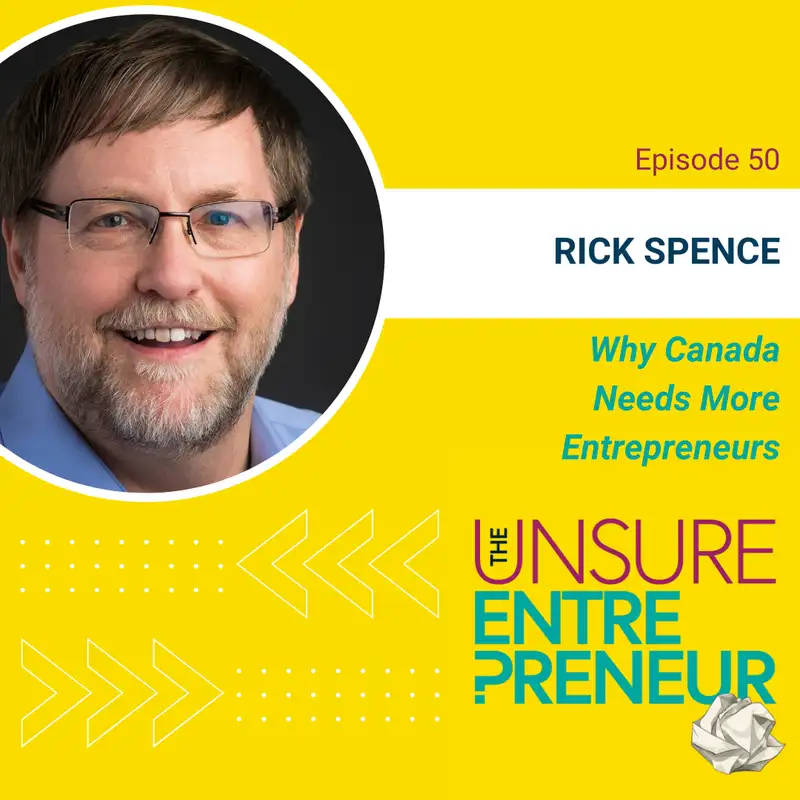
Hey, everyone, and welcome to the Unsure Entrepreneur Podcast. Today, I'm speaking with Rick Spence, one of Canada's most experienced observers and champions of entrepreneurship. Rick is a business journalist, author, editor, speaker, consultant, and entrepreneur who has spent decades studying the people who start and grow Canadian companies. He's the former editor and publisher of Profit Magazine. I've written a few articles for them for 15 years. He wrote a weekly column on entrepreneurship and innovation for the National Post and Post Media newspapers, reaching almost 1 million readers a week. Wow! He is also the author of *Secret of Success from Canada's Fastest Growing Companies* described as the first Canadian book about scaling a business. Now, today, Rick is the host of the Startup Canada podcast, where he speaks with entrepreneurs and leaders about innovation, growth, and the future of Canadian businesses. He also writes Canadian Entrepreneur, his long-running blog about entrepreneurship and opportunity. We'll give you the coordinates for that. In this episode, we're going to talk about you know why Canada needs more entrepreneurs, what is holding people back, and what Rick has learned from interviewing hundreds of founders. And most importantly, we're going to talk about you know what aspiring entrepreneurs should understand before deciding whether business ownership is right for them. So good to see you, Rick.
Rick Spence 02:11
Great to see you, Roger. We we worked together a couple times in the past, but it's great to reconnect.
Roger Pierce 02:17
I'm so glad to have you here. And you're right, you and I have been in this entrepreneurship education industry-I guess I'll call it-for for a long time, and our paths have crossed on various projects and events and whatnot. Yeah, and you offered me several times to use your office in downtown Toronto, and when I was in the stuck in the boonies, and you were very generous with that, and I appreciated that. Thank you. You're more than welcome anytime. My office is your office. But you and I crossed paths recently. I think it was with David Cohen. He was hosting an event talking about the state of entrepreneurship in Canada, and that's where this idea for today's show kind of originated because you you spoke so well in that event about the challenges facing Canada's entrepreneurs and and how we can help them, and I said, you know what, I got to get Rick on the podcast. I got to pick a spring on this some more. So thank you for being here.
Rick Spence 03:09
Well, thank you for having me.
Roger Pierce 03:09
So let's dig in because I know we got a lot to cover, and your time is limited. I think it's safe to say that you and I would both like to see more entrepreneurs. So let's begin with some broader, broader scope. Right now, as you know, there are over 2.7 million self-employed people in Canada, according to Stats Canada. But BDC, the Business Development Bank of Canada, reported that there are 100,000 fewer small businesses, small business owners, than 20 years ago, so my question for discussion with you, Rick, is why does Canada need more entrepreneurs at this moment, and what do we risk economically and socially if fewer Canadians choose to start businesses?
Rick Spence 03:54
There's so much in that question. Thank you for that, and there's many ways to unpack it. But let's just start personally. We need more entrepreneurs because we need more better services. We need more stores closer to us. More stores that sell the stuff we want to buy. We want more tradespeople who can come in and fix our stuff. We want to go out and visit small towns and see cute little shops and stay in cute boutiques. Entrepreneurs bring us these things, not big businesses. And it's the individual decisions of individual Canadians that create so much of the infrastructure we care about. Big businesses create big factories on the edge of town and tall buildings, and they don't fulfill all our needs, and I would argue small and medium-sized businesses do more of that than the big businesses do. So we, as consumers, need more businesses out there giving us better, more customized, and more price competitive services. So that's just on a. Personal point of view: If you look around and say, "Man, remember that flower store that closed around the street? I love them. So we want all these people to be back and providing us services. COVID was a huge disruption that is still echoing today. We still need to build back from that. So that's one of the reasons we need more entrepreneurs. We also need entrepreneurs because they are the ones who grease the wheels of bigger businesses. Generally speaking, the more scalable businesses, the more profitable businesses, will be those that sell to other businesses, usually bigger business. We need lots of those because our businesses need to be more efficient. Our big businesses need to be more creative. They need to have more choice of suppliers, and they need to be more competitive on a global market. So that so they certainly need lots of new ideas, new people coming into them saying, "Hey, we can save you money on your janitorial services. We can help you with your communication services. We can do a better job of of finding great employees for you than you can. Big businesses aren't that good at that many. Aren't so good at many many things. And we need entrepreneurs to be on the lookout and being those people who are just in out in front of the bigger businesses and saying, "Here's how we can help you become more efficient, develop better products, become a better employer. That's the role of entrepreneurs in Canada. It's a very important role. We're turning out lots of entrepreneurs, but we're not seeing the growth that we need. And again, a lot of it goes back to COVID. It's sort of hit us in the gut, and a lot of people lost businesses, and a lot of people lost confidence. And we're still building that up, we're still reeling from that.
Roger Pierce 06:41
Yeah, and now we've got other issues hitting us: inflation and the the U.S. situation and all these other things. I feel sad for small businesses because there's so many challenges, but I'm also encouraged by their resilience and, like you said, how they they continue to fight the good fight and keep going.
Rick Spence 06:58
Yeah, you know what? But but we see, I'm going to push back on that. I don't feel sad for them when you have a really good product market fit. When you have the right person leading the right company that actually has solutions that people want, it's a brilliant place to be. You can make tons of money, set your own hours, deal with the people you want to deal with, fire the customers you don't like. It's the best self development platform, the best platform for developing your own personal wealth, the best platform for building the life you want.
Roger Pierce 07:31
Building the life you want. Well said. It is true. You can be the best version of yourself as an entrepreneur.
Rick Spence 07:37
Yeah, it's not easy, and heaven forfend that that that if if we're in the the evangelization of entrepreneurship business, you always have to start by saying it's not easy, and there there's no guarantees anywhere along the way. But the journey itself is so rewarding, and I've been in this business long enough that I've seen people grow from high schoolers to seniors, well, almost seniors, and building tremendous lives doing the things they want.
Roger Pierce 08:09
Yeah, it's encouraging. Just a couple episodes ago, I had a 16-year-old entrepreneur on the show, Chanelle Chalazan from Saskatoon, and she's building this little national jewelry brand. 16, going into grade 11.
Rick Spence 08:23
Ah, yeah, I interviewed a 15-year-old last week.
Roger Pierce 08:26
Oh, you beat me. There you go.
Rick Spence 08:29
Her mother was there. She's still shy about what she's doing. So, so her mother was there on the other side of the microphone as well. But I love it at Profit Magazine, which is a magazine that went out of business 15 years ago now, so it's been a long time, but it was a national, a glossy magazine about entrepreneurship, which we could dearly use back again. We almost got into a competition to see how young we could find someone worthwhile to write about. We wouldn't sacrifice our standards; it had to be a successful business with some purposefulness behind it, and I think we got down to nine years old before we called it off.
Roger Pierce 09:05
Well, I sold frustration pencils at the farmers market when I was 10. Does that count?
Rick Spence 09:10
Frustration pencils?
Roger Pierce 09:12
Oh, you put them in your hands. They got fuzzy hair. It's like an '80s thing.
Rick Spence 09:17
Oh, okay, yeah, I think so. I'm sorry we didn't interview you.
Roger Pierce 09:22
I missed my chance at fame early.
Rick Spence 09:25
You were talking about numbers there with BDC, 100,000 fewer small business owners than 20 years ago, and everything. We got to watch the numbers. The CFIB, the Canadian Federation of Independent Business, says Canada has 939,000 businesses with employees at Profit Magazine, 20 years ago, we used the round number of a million, so that's not far off it, but a little bit below the number of businesses with employees is up just 3.6% over the last seven years, but it's sort of plateaued for the last two years, and the CFIB is blamed. Government red tape, high taxes, and other non-market forces. Now, as I mentioned earlier, being in your own business is always going to be tough, and government demands and taxes and red tape is always going to be part of that. The scary thing is, according to the CFIB, 55% of business owners would discourage other people from starting businesses now, so I think we got to take that seriously. There are problems. What you also have to realize that CFIB is an ideological group whose whole purpose is to argue for smaller government and less red tape. So this is, you know, a wheelhouse activity for them. This is business as usual for them. We came out so heavily against the GST when the Goods and Services Tax, when it was introduced 30 years ago, 35 years ago, because it put such an onus on entrepreneurs who had never had to actually deal with taxes like these before. So there are things government has to answer for, but in the end, I think that if you can find the right accountant and the right professional people to advise you, you can set all that aside and focus on your customers and your products and build a substantial business and a really good life.
Roger Pierce 11:13
I'm so glad you brought that up. the The topic of ambition, because that that flows in nicely to the next question. Speaking of statistics, there's more for you. Report from the Royal Bank last year, 2025, talked about ambition, and they said 59 of Canadians said they do want to own a business, like you read in that CFIB report. RBC report says this is up 13 points over two years, so it's claiming to trend up. But it made me think: Do you think Canada has an ambition problem, a startup problem, a scale up challenge. What do you think about those issues?
Rick Spence 11:48
You were telling me about these pencils you used to sell. I think Canadians are born entrepreneurs. I think we're smart people. We look around the world. We see what's missing. We we see what we love and we see what's missing, and so many kids are into new product ideas, new business ideas. They're into their lemonade stands. We used to have paper routes as a kid. I had three paper routes at one point. We don't even have newspapers anymore, let alone paper routes.
Roger Pierce 12:17
I hated delivering the Toronto Star on Saturdays. It was like a Bible. Oh yeah,
Rick Spence 12:23
that that that was brutal. Yes, a lot of people are running businesses in high school, and the trouble is, is that the culture as a whole doesn't talk much about entrepreneurship. One of the things that we tried to do at and man, you're bringing back nightmares for me now at Profit Magazine. One of the things we wanted to do was redeem the word entrepreneur. We looked around for an alternative, for a synonym for entrepreneurship, running your own business, all sorts of things. We couldn't find a synonym for entrepreneur that we liked. So we realized, you know, this entrepreneur four-syllable French word to to express such a fun, creative, vital force in our lives, and we failed at finding an alternative. So we decided we just have to support that. Encourage more Canadians to look at entrepreneurship. Young people, as you know, are encouraged early on become a doctor, become a lawyer, pick out a career path. Entrepreneurs have longings. It's not really a career path. If you tell Uncle George that you want to start your own business, he'll presume it's skate shop or something. There's a lot of forces in life that are pushing you in a different direction, but fortunately, a lot of entrepreneurs go their own way, and a lot of people who do, you know, get into the workforce, whether it's business or teaching or whatever, they find out that the workforce isn't the best place to be, and they come to entrepreneurship naturally anyway. After a few years in, that's good. I think every entrepreneur should have lots of experience in an industry before they actually decide what it is they want to dedicate their life to, what solutions they have that are unique to them. So the more experience, the more diverse experience you have. Probably the more opportunities in life you see. The more inefficiencies in current markets, the more people are failing to to see the potential of of new ideas or new technologies, and that all that makes you a better entrepreneur. So I think we have a cultural problem. I'm not sure it's if I don't think it's an ambitious ambition problem. I think it's a cultural problem. I think there's also a problem that on and just do this one more time. Entrepreneurship is hard, and people don't realize how long it takes to get a retail store open. It takes longer than you think to open a business. It takes longer than you expect for the business to become profitable or at least break even. Building a successful business takes years, and if you don't have the requisite capital to survive on, if you don't have contacts in the field already prepared, then you're going to have a rough time. A job takes a lot of courage. Starting a new business requires really careful planning, and people will say market research. I like to call it market outreach. You don't have to spend time looking at stats, but do call people in the in who are in that industry already and make them friends and advisors, and find out what's going on, so that you can. There aren't a lot of shortcuts in small business, but there are a few, and you can take advantage of it. The problem is that small business is hard, and we're not teaching people the skills they need to cut it any short.
Roger Pierce 15:34
How do you think the public at large views entrepreneurs and entrepreneurship as a career choice,
Rick Spence 15:41
I think they'd rather you be a doctor or a lawyer. On the other hand, ask them about their favorite stores, their favorite products, and you'll find they were probably the the products of entrepreneurs, proud, proudly owned by small business people who had a vision for doing things better. When I was Grant, we thought that big business had all the answers. Then we found out that no corporate restaurants suck. The corporate foods, canned foods, suck. We wanted to go to the fish markets and get real fish. We wanted to go stay in a in a small boutique hotel rather than the Holiday Inn. Big businesses had its day. They know how to do big capital projects that entrepreneurs can't afford to do. If one goes to stay in a Hawaiian resort, it's going to be owned by a big chain. But for the most part, entrepreneurs can deliver a better service experience or a product quality experience much better than a great big dehumanized corporation. So that's the goal for entrepreneurs to realize that there is a market for their vision. They got to test it out and make sure. But if you're providing a real service that has something new and better in the marketplace, then you are probably going to do well.
Roger Pierce 16:54
You raised a good point. We got to remember small businesses are the ones we walk by every day: the neighborhood bakery, the pub, the hairdresser-that's
Rick Spence 17:02
the one we tell other people about.
Roger Pierce 17:04
Yeah, the tradesperson,
Rick Spence 17:05
and that's why the Bay and Eaton's and all the old department stores are have failed. That's why our only our only big retail outlet now is Walmart and Dollarama. It's a hard world out there, but it's entrepreneurs that make it better.
Roger Pierce 17:20
I live downtown Toronto, and I walked by a nail salon that had just closed. Always breaks my heart to see a business go under. I don't know why they went under. Maybe they moved, but they had this sign they printed up and they put in the window, and it really caught my attention and kind of spoke to what we're speaking about today. It said, "Thank you to our loyal customers. We've served 10s of 1000s of customers over the last 15 years. We're also proud of the 1000s of careers we launched out of our nail salon, and I'm thinking that's interesting. Yeah, they did. They probably had a lot of people get their early start in that profession through their business. So that's an impact. That's beautiful. Yeah. And then they also talked about all the all the dreams that the various owners and those people who work there were able to nurture and launch because they had that experience in that small business, and I thought that was a really poignant poster to put in the window.
Rick Spence 18:14
That's beautiful. Did you get a shot of that?
Roger Pierce 18:16
I got to go back and take a picture of it. I will. Yeah, but it just speaks to the impact that one little business can have, right?
Rick Spence 18:23
You got to go there quick before it get taken over by a vacuum cleaner repair firm. But yeah, that's what it's all about-that a successful business becomes the custodian and the platform for so many other people's dreams, and it's a beautiful thing. Business is a much cooler thing than people think. I remember when I was in university, and that was a very long time ago. Every business student carried around this giant 800-page book about accounting. Now we know that accounting is important, but other people can look after that for us. Business is a creative endeavor. It's a human endeavor. It's done by people for people, and the more we remember that, the better future we're going to have.
Roger Pierce 19:05
Let's expand on that. Are we giving founders the help we need? So here's my my question to you on that. Canada offers billions of dollars. I like to say billions of dollars of grants, subsidies, programs, funding. There are business accelerators. There are support programs. You and I have, you know, Startup Canada is one such one such organization that helps people get into business and succeed. So my question to you is: Are we solving the problems that founders have, and do you have any ideas where the system is like falling short and could be improved?
Rick Spence 19:38
The thing is, is that small business it's an incredible force in society, but it's not a force. It's a million little forces working together, and it's really hard for something as big and stupid like government to serve them properly. Yes, they can cut taxes, and we would all like them to do that. CFIB and I share that to some extent, but there's. Very few few things that the government can do. Shout out to Futurepreneur, which is a program that was established by the chartered banks by a couple chartered banks to offer financial services to startup entrepreneurs. One of those banks dropped out, but one of the one bank is still involved in it. I think at this point, and futurepreneurs become, I think, a pretty successful group because they understand entrepreneurship. From the beginning, they said we will not only get you started with some low-cost lending, no free grants, and I believe in that. We'll get you some money at a good price, but they would also tie it to mentorship, so that you get the direct connection with someone who understands entrepreneurship, they've been able to convince some very good business people all right across the country to become mentors for them. And to these young people, I've talked to a number of people who've been part of that program, and they stay friends with those mentors in many cases for years. And that service works because it was built by humans for humans, the unfortunate thing is that many of the charter banks now say, "You want to start up long, go see Futurepreneur. That's not our job. So there's more pressure on them than there probably should be. I'd like to see more programs, more alternative solutions like Futurepreneur, the Canadian banks that take billions of dollars in profits in this country, I think they should be able to put a little bit more money and creativity into serving the entrepreneurs who are the lifeblood of Canadian business and support them. But I think, in general, if you're an entrepreneur, I've talked to so many entrepreneurs who I've said, "Have you gotten any government grants or anything to start with. He said, "Well, we tried to spend a year on it. wasn't worth the time. There may be some programs. I will almost never speak in absolutes about entrepreneurship, but I think most entrepreneurs we're better off not even bothering with big trickle down solutions and grants and things. But in general, build a business that can compete from day one in the real world, and that means that you don't quit your day job. You stay in that. You build up your income. You pay your rent, and hopefully build up some capital. You're better off just understanding your financial needs and finding patient capital. Patient capital, love money from family and friends, the people who know you and understand you. Sometimes your parents' friends have done well, and they've seen you grow up, and they're prepared to put a little bit money into your business. So the solution you find closest to home is probably going to be the best one for you. And if you don't make your payments on time, they might not send you to jail. So that's good.
Roger Pierce 22:38
You raised so many good points there. Actually, I mentioned that in the book. Love capital. I borrowed money from my parents years and years ago to start one of my businesses, and I paid them back with interest in a year. So I avoided any unpleasant family reunions. So, which is a danger of love capital. Every form of money has its strings, right? So we got to be careful that. But I want to go back to what you said a minute ago.
Rick Spence 23:02
But no, just a sec. Again, I'm not going to let that stand. So, if you set people up and say, "I have every intention of paying you back, but if this doesn't work, I may not be able to. Then you can go to those family reunions if you want.
Roger Pierce 23:17
Depends on whether the uncle is carrying a knife, I guess.
Rick Spence 23:21
Okay, my relatives were were a different family than yours, I guess. Yeah, the point in entrepreneurship is always to understand is to do the research to understand what your real needs are, and being purposeful about finding the solutions that are best structured for you and the risks you're about to take.
Roger Pierce 23:43
Good advice. The point I wanted to extract from your last comment was the combination of capital and mentoring. How important is that?
Rick Spence 23:51
I think every entrepreneur should have a mentor. My favorite entrepreneurs are the ones who build an advisory board before they even start. And how many do that? Less than 1% How many could do that? All of them. So many people start a business without actually talking to other people who are in that business or who supply that business or know that business, and that's totally wrong. Entrepreneurship is a do-it-yourself thing, but you don't have to do it by yourself. I just made that up as I went along. I like that, right? You don't have to do it by yourself. I'm totally in favor of mentors, as I mentioned. Turn mentors into an advisory board. An advisory board doesn't ever have to meet. They could just be a group of people who advise you on occasion or answer the phone when you call, because you will have questions. And if you have to call a help number, it's going to take you forever, but if you can call your new contacts, the people who are a few years ahead of you in this business, who are happy to encourage others in this business, then you will get the answers you need, and you'll get them faster. So it takes a lot of courage to reach out and call someone you don't know. You start out by saying, "Hey, could I pick your?" For a minute, and if they say yes, and if you have a good experience with them, then you say, "Hey, could I call you again sometime? And they'll say, "Sure, and boom, you've got an advisor. And you don't just settle for one advisor. There's so many aspects of business. Maybe you need an advisor on finances, an advisor about how to grow in the industry you've chosen? Maybe another advisor who could tell you good ideas about hiring and recruiting and developing your people. There are so many individual skills in business. None of us has all the skills we need. So if you can devise your own personal board of advisors to put that expertise into a package that you alone can tap into, then you're way ahead of everybody.
Roger Pierce 25:44
You've just touched upon a brilliant theme. You know, you're not alone. You don't have to be alone.
Rick Spence 25:49
I say entrepreneurship is a team sport. So many people think it's me against the world. Yeah, good luck, buddy. Why not put the get the world on your side first?
Roger Pierce 25:59
You're so right, and the other point you touched upon is we don't have to be original entrepreneurs. It's a bit misleading to think, oh, no one else has gone through this. Trust me, whatever you're experiencing as an entrepreneur, someone else has gone through it. So all you got to do is learn from them, like you're saying by reaching out.
Rick Spence 26:18
Yeah, in my experience, entrepreneurs are really busy people, but almost all of them remember when they started out, and they remember how tough it was, and they remember the people who helped them, and they will pay that back by helping you.
Roger Pierce 26:35
Very good point. Okay, great segue to the next topic: what entrepreneurship demands from the person. Now I know you've interviewed hundreds of people on the podcast, and you've worked with entrepreneurs for decades. You've written about entrepreneurs, so I'm kind of curious about what you can extract from those interactions to maybe help the audience. Are there any things that stand out in terms of the top qualities, Rick, that successful entrepreneurs have?
Rick Spence 27:02
Oh. oh, I once made a list of them, and it I just typed them out on a sheet of sheet of paper. I had, and it was three sheets long when I gave up. I was just thinking I should turn that into a blog post or something. I think humility is the most important thing. Under and the market generally makes you humble if you didn't start out that way, if you're humble enough to know that you don't know everything, if you're humble enough to ask for help, if you're humble enough to pay attention
Rick Spence 27:30
to the signals that the market is sending you, I hear so many stories about entrepreneurs who sat in their basement and worked on their project, this new software piece of software, piece of tech, any type of product, all by themselves for a year or more to get it just right, and then I take it out and start showing it to people, and they say, "No, that's not what I want. No, that's what. It's way too small. It's way too big. Way way too expensive. Way too cheap. Whatever. If you're humble enough to ask for that help in advance, it's going to speed your development and ensure a much better fit with the intended market. So the humility of knowing that you don't know it all, but the answers are out there if you're brave enough, gutsy enough to reach out for it, one of my favorite entrepreneurship gurus is Steve Blank, who was one of the sort of founders of Silicon Valley and that whole tech community there. And he always said, "The answers are not in your office. The answers are out there. And most entrepreneurs say they don't have an office. The answers are not in your basement. They're not in this bare bedroom. They're out there where your customers live, where your users live, and you've got to get in touch with them. And then part of that then is always iterating. Your product will never be finished. It'll never be perfect. You've always got to play with it, and that's a fun thing to do. It's creative. Let's make it bigger. Let's make it smaller. Let's make it two for the price of one. Let's package it with something else. Always iterating. Always innovating. Never losing that edge of saying, "How can I make this better?
Roger Pierce 29:10
Okay, that's excellent point. I'm going to ask you a similar one. In your experience with working with all these entrepreneurs, do you think most startups underestimate how much selling will be involved.
Rick Spence 29:21
Interesting question. That's probably true. You're always selling, even when you're asking an advisor for help. You're selling when you're trying to recruit someone to work on your business for free or at minimum wage in the early days. You're selling. So selling is really important. The key to selling is not being able to persuade people, but to understand people and to understand what motivates them and how you can best get them on side. So again, a very creative thing. Most entrepreneurs hate selling, so they try to minimize that, and not a great idea. The greatest entrepreneurs, you know. Steve Jobs of the world were also the greatest salespeople. Part of selling is building trust, and I think that's one of the most important things an entrepreneur can do. And you build trust in a very active way. You do what you say you're going to do. You get your work done early. You get it done under budget. You keep people informed if there's any setbacks or problems along the way, you want to be the supplier that your clients will brag about to other people, and that's what building trust is all about.
Roger Pierce 30:32
I love it. No, you're so right. Trust is important, and and confidence too in what you have. And one of my favorite expressions is, "Nothing sells itself. Be prepared to really work hard at getting that trust and getting that product or service out there.
Rick Spence 30:46
Yeah, I love that. Yeah, nothing sells itself. You think it will, but no. You you got to practice your pitch. You got to find the right words. You got to find the right numbers that that speak to the impact of this. But it's all part of knowing your product and knowing your customer and knowing your customer's
Roger Pierce 31:04
needs-that's perfect.
Rick Spence 31:05
There's a certain confidence. I mean, I don't believe in arrogance, but I believe in confidence. I remember one entrepreneur, he's a young entrepreneur in the communications hardware business in Saskatchewan that I interviewed for Profit Magazine years ago, and I was surprised to learn that he had dropped out of school in grade 12, and he said school wasn't cut out for me. It wasn't that I wasn't cut out for school. School wasn't cut out for me. I loved the confidence of that, and I think that I think that type of confidence is really important for entrepreneurs. I see the world as it is, but I need to interpret it in a different way, and I think that's okay.
Roger Pierce 31:46
Well, and that's a very good point you just raised. I love that story, and that's a great segue into the last one of the last questions I have for you. All these entrepreneurs-it's impossible not to get influenced by them because you know you soak it in, you listen, you hear. What have they taught you? Is there anything that all these entrepreneurs you've interviewed have taught you in terms of a lesson or things you would do differently in your own business ventures? Well, there's two types of learning. There's things that you learn and then you forget, and the things that you never forget. And sadly, I forget almost all of it. It's really hard. But I got to tell you, my favorite entrepreneur of all time is an old geezer, and his name is Donald Cooper, and he was the son of the owner of Cooper Sporting Goods. And if you're of a certain
Rick Spence 32:30
age, you'll remember Cooper Sporting Goods. They started out making goalie pads and hockey pads, and then they riffed off into all sorts of other sporting goods, and the label was eventually sold, so I think the brand is still around, although the that company is not. Donald Cooper was the second son in the family, so his brother got the sporting goods stuff to run, so he got to hang out with Bobby Hull or the great the great hockey stars of of those days. Donald got the wallet division, the leather goods division, and that wasn't much fun. So he became an entrepreneur early on, and he started one business that kind of failed. And he realized that you know this is going to be harder than he thought, and so he started about 20 years ago. He started a retail off-price women's fashion store called Alive and Well in the suburbs north of Toronto, and he became the world champion at meeting his customers' needs. He learned from that first failure, and so he had off-price, cutting-edge fashions. His target was primarily women, and they got free refreshments when they shopped at the store. Tons of parking really close to the store, they got champagne and a rose on their birthday. They could take as many outfits into the change room as they wished to. As you know, the department stores would say no more than three outfits at any time. And Donald put a pirate ship, a life-size model of a pirate ship in the middle of the store to keep the kids busy, while so the moms had more time to shop. So it was a business built around customer needs and made a ton of money. And he ended up selling the business to another organization. That that other organization saw all these frills going on as money going straight out the door, so they got rid of the pirate ship and maximized the retail space, and they did away with some of those frills. And the store ended up closing within a year or so. So Donald had tapped. You know, we know how tough retail is. We know women's retail is among the toughest. Donald made it by actually thinking like his customer, and the fact that the people who bought and paid cash for the company couldn't do that just reminds us how important it is. But the cool thing is that that Donald went on to become a public speaker and a consultant, specializing in helping business owners all across. North America tap into their own creative and innovative cells. Business repays creativity and innovation 1000 times over. Donald's one of the best examples of that, and that's the lesson that I hope people will take away today. We can make our own marks on business. We can make our own mark on the industry. It's our creativity that will get us through.
Roger Pierce 35:22
Creativity. Think like a customer-all good stuff. You know, Rick. Entrepreneurs come from all different walks of life, different paths-corporate path, maybe a student path, maybe they're an early retiree. All different personalities, all different situations with their own circumstances. Because this is what the show is all about. What would you say to someone who is at that point? They're on the fence. They're undecided. They're considering entrepreneurship, but they're just not convinced.
Rick Spence 35:48
I have to say that how much I loved your brand about the unsure entrepreneur. That decision point that you're sort of looking at. Do I take a risk and and pursue this idea? That's so important. It's so important to the person, to the people thinking that, and it's so important to the marketplaces that they may or may not get into and revolutionize. So I do hope most people will go from unsureness to confidence because we need entrepreneurs. All of our markets are still inefficient. We still need more imagination. We still need more lower price options. We still need better quality services and goods. And entrepreneurs are in a position to provide those. So we need these entrepreneurs. The important thing is that you have to be sure that you are providing something new. If you're just getting into business to copy what other people are doing, then you're likely not going to be successful. Yes, there are franchises and things that can let you start a business that's already been figured out for you, and the track record of those franchises is that some work and some don't. Entrepreneurs with new business ideas can control their futures, but they have to be really legit, you have to really understand your chances of success. If you're unsure, and the reason is because you don't really know if there's a market for your product, then you haven't researched the market enough. You haven't talked to enough of these people, these experts in the marketplace. You know, Canadians are sometimes stereotyped as sort of being shy, and as an entrepreneur, that's one thing you can't afford to be. You've got to be out there. You got to talk your way into the industry conferences. You've got to be able to call people, cold cold call them. Yes, on the telephone, or you can email them, but they can ignore email better than a call. You've got to get out there, meet people, understand the trenches in the industry you're looking at. Understand what all the trends are. See what's working. See what isn't. And you have to have a vision. The vision is for something that's different. It's going to be better than what Company A is doing and cheaper than what Company B is doing. And so that way, I think we can get in there and survive. And you have to be broad-minded enough to realize that if you start making an impact in an industry, other people may respond. Your competitors may say, "Okay, we're going to cut our prices for a few weeks, cut this guy out of the market, and then raise them up again. So you need the wherewithal to withstand challenges to your innovation. So these are all the things you have to consider. Don't jump off the fence if you're on the fence. Don't jump off it until you're sure that there's something going on there. Because I'm presuming that you're investing some money into this. If you've got a marketplace that you can devise something using AI and throw something in there, then yeah, go for it. Start all the businesses you want. But if we're talking about a real world business that that takes capital that requires real planning and investment, then you've got to be careful about it. One of the ways to do that, by the way, is and and probably no one needs to be told this, is you could try starting your business part time, put together a convincing pitch. Use platforms like eBay or Amazon or Marketplace or even TikTok. Get your idea out there. Get some reaction from people. But most important is to learn all about the business, to build your customer list, and build that network of positive, caring advisors. And if you really want to jump off that fence? You could also start advising other entrepreneurs because you're going to learn more from them than they're going to learn from you. So it's all good. You just got to keep learning, keep learning, keep learning, and stay positive.
Roger Pierce 39:33
I love it. Learning, learning, learning. Those are all great points. I hope people will rewind the tape and listen to that again because that's that's all good stuff. You mentioned competition. I wrote this down. I wanted to bring it up. It's a fun way maybe to wrap it up. In one of your podcasts, you talked about how to outrun a grizzly. Can you tell us about that?
Rick Spence 39:52
I actually used to finish finish a lot of my presentations with this that I went back when I was in the speaking. And stuff, because irrespective of the fact that there's a grizzly in this story, I think is actually pretty optimistic and inspirational. The story is there were just these two trappers walking through the forest in a Canadian winter, and then all of a sudden, this grizzly appears from the trees and growls at them, and one of the entrepreneurs immediately starts dropping his pack and and his tool belt and everything and tying up his shoes. And the other guy says, "What are you doing? You don't seriously think you can outrun a grizzly, do you? And his friend says, "I don't have to outrun the grizzly. I just have to outrun you, and that's a reminder: we don't have to be perfect in business, but we do have to be better than the people around us.
Roger Pierce 40:48
Just a little bit faster. A little bit is the key in what you just said. You just have to be a tiny bit faster, and that tiny difference is all the difference. I love it. And by the way, I found my frustration pencil. See?
Rick Spence 41:04
Oh wow! You're gonna have to put a picture of that in the show notes. Does
Roger Pierce 41:09
it
Rick Spence 41:10
have the googly eyes?
Roger Pierce 41:11
No, this one doesn't. I guess it was incomplete, poor production quality,
Rick Spence 41:16
or just a different version, slightly cheaper than the competition.
Roger Pierce 41:20
I'll shave five cents off the price. Oh man, this has been great. I could talk to you all day, but I know you got things to do. So, Rick, can you wrap by telling us where can people find out about you, and where can they listen to your podcast?
Rick Spence 41:35
If you Google the Startup Canada podcast, we talk to entrepreneurs every week from across Canada, grizzled old timers and 15-year-olds just starting out, always looking for the innovation that they're bringing to the market, and you know the lessons they've learned along the way. The great thing about entrepreneurs is that they are always willing to share, and that's why I encourage. That's why the sub theme of this whole thing has been to get out and talk to other entrepreneurs because they will want to share with you what they've learned, and they do care about you. They do care about helping you do better as well and to win what you're doing. And I have a blog that I rarely update called Canadian Entrepreneur. Yeah, that's about it.
Roger Pierce 42:20
Okay, I'll put those links in the show notes. And Rick is being kind of modest because that podcast has over 500 episodes. Wow!
Rick Spence 42:28
Yeah, someone else did the first 300, but
Roger Pierce 42:32
still, wow, that's a lot of shows.
Rick Spence 42:35
Yeah, I've been doing it for six years. Six years times 50. Yeah, okay, yeah, 300 for mine. That's right. It's inspiring listening, and these people are just the lifeblood of Canada. It's always been a privilege for me to work with entrepreneurs for the past 35 years, and I intend to keep going until I drop.
Roger Pierce 42:55
Keep doing what you're doing, my friend.
Rick Spence 42:57
Thank you, Roger. It's been so great to catch up, and thanks for asking all those great questions.
Roger Pierce 43:01
You're welcome. You're welcome. Great to have you, Rick. And for those listening, if you're considering entrepreneurship but still unsure, visit unsureentrepreneur.com for more founder stories, resources, experts like Rick, and of course episodes of this podcast. And it's also where you can grab a copy of my new book. Thanks for listening.