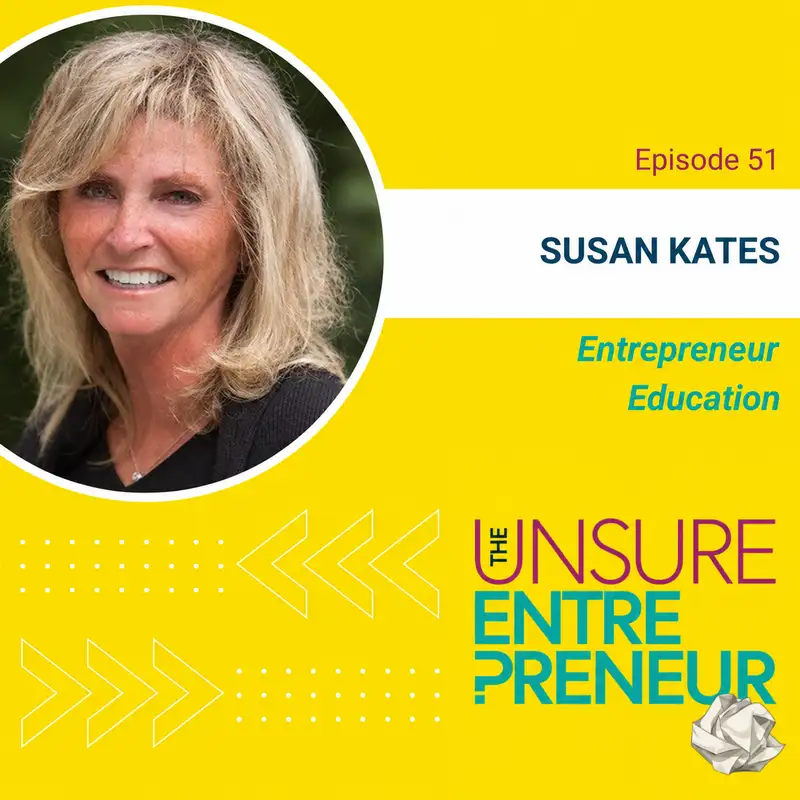
Can You Learn to Be an Entrepreneur? (w/Susan Kates)
Susan Kates
Episode 51 on The Unsure Entrepreneur
SUMMARY KEYWORDS
entrepreneurship, education, innovation, research, mindset, training, awareness, career choice, side hustle, intrapreneurship, problem solving, experiential learning, mentorship, small business, social impact
SPEAKERS
Susan Kates, Roger Pierce
Susan Kates 00:00
Innovation is not revolutionary. It just means that you have to do something a little bit better. You're listening to the Unsure Entrepreneur podcast with Roger Pierce. Whether you're scribbling business ideas on a napkin or wrestling with the "should I, shouldn't I?" question, get ready to explore the realities, the risks, and the rewards of entrepreneurship as we share the stories, scars, and successes of small business owners.
Roger Pierce 00:27
Hey, everyone! Welcome back to the Unsure Entrepreneur. I'm Roger Pierce. Today, we're going to talk about entrepreneurship education in Canada. Canada needs people willing to build businesses, yet the decision to become an entrepreneur deserves more than a pitch competition or a motivational talk. So I want to get into this with our special guest, educator Susan Cates, to ask what entrepreneurship education prepares students to do. Let me tell you a little bit about Susan's background. Susan is a professor at Humber Polytechnic, where she teaches entrepreneurship and has coordinated its entrepreneurial enterprise business management program. I'm hoping to get out there and speak to some of her students soon. She is also a faculty advisor to Enactus Humber, mentoring students as they develop projects that address social and environmental challenges. Now, in 2026, she received the Ontario Center of Innovation's inaugural Educator Innovation and Entrepreneurship Award for her work supporting student entrepreneurs. Fantastic! Welcome, Susan.
Susan Kates 01:34
Thank you so much. Every time I hear that, I'm like, I did. I won that.
Roger Pierce 01:40
It says right here, you did.
Susan Kates 01:42
I have the little statue over there. It's like a little iceberg, and I'm like, I did. How did I do that?
Roger Pierce 01:48
Do people give you free drinks now because of that?
Susan Kates 01:52
No, no,and they haven't thrown me money either.
Roger Pierce 01:54
Give it time. Give it time. Okay. Well, congratulations on that. That's quite a distinction.
Susan Kates 02:00
Thank you.
Roger Pierce 02:00
I got to throw this question right out there because it's a great icebreaker. When you meet a student that says, "I want to be an entrepreneur," what do you first want to understand from them?
Susan Kates 02:09
The very first thing that I want to understand from a student who says they want to be an entrepreneur is why. Why would you want to be an entrepreneur? And the answers are interesting, to say the least. Some of them want to be entrepreneurs because their parents were entrepreneurs, and they grew up in a very entrepreneurial family, and so they see that as something that they'd like to be doing. Some want to do it because they want flexibility in their lives. Some want to be entrepreneurs because they think they have a fantastic idea that nobody else has, and they think that whatever their idea is is going to change the world. Another reason that they say they want to be an entrepreneur is because they want to have control over their lives, not just flexibility but control. Those are sort of the main reasons that they say they like to be an entrepreneur. It's not often that you do get students who say that, but when they do, it's really kind of heartwarming because, as someone who has been an entrepreneur myself and believes in entrepreneurship, I think it's a really wonderful way to challenge yourself.
Roger Pierce 03:23
Hear, hear! Couldn't agree more. It's a great response you've got to someone who asks that question. We're going to dig into dig into why why that is and and how we can help them in in our talk. I've kind of got four major themes to talk with you about. So playing off what you just said, the first topic to me is is why entrepreneurship education matters. You're an educator. You're working with students. You're on the front lines. Let me read you a stat I got here from the Business Development Bank. It reported that 1.3 in every 1000 Canadians started a business in 2022, compared with three in every 1000 in 2000, so going down. It also found that roughly 1/3 of new businesses close within five years. One of my default stats: half of all small businesses fail within the first five years. That's kind of a North American standard.
Susan Kates 04:17
Yes.
Roger Pierce 04:17
Now those figures, as you could appreciate, raise questions about both the number of people starting and the preparation they receive. So my question to you is: What role can education realistically play in helping more Canadians consider entrepreneurship and make an informed choice?
Susan Kates 04:38
Well, that's actually an excellent question because entrepreneurial education, I think, is critical for someone who's interested or thinking about entrepreneurship. I'll go back to when I was an entrepreneur. I mean, I think I still am an entrepreneur. I was. It just. It just. I might not be running a business right now, but I. I do. Lot of entrepreneurial things at the college level. I think when I was running my own business, I didn't have a process. I didn't have someone that could say to me that this is the right way to do it. These are the wrong ways to do it, and these are the things that you should be doing. So going through some kind of an entrepreneurial program with someone who's thinking about an entrepreneurial path, we can give them some very good processes that they could be thinking about to figure out: Does this make sense, or does this not make sense? Because a lot of the time, the reason entrepreneurship fails or entrepreneurs fail, is because they couldn't find the right target market to sell their products to, or their services, or they invested too much money in doing it, and then ran out of money, and then had to go, or they used it as sort of a default. Said, well, I can't seem to get another job, so I'll just become an entrepreneur. But I think that there is a process to entrepreneurship, which I actually went back and did a master's in innovation and entrepreneurship, and I did it because I wanted to understand that process. I wanted to understand what does that actually look like for someone who has an idea, you have to go through some rigorous background work before you actually go into or decide to launch something. And probably, if I could say, one of the biggest mistakes that entrepreneurs tend to have is that they don't do their research. They just jump into it. They think they have this amazing idea and then they jump into it, which good for them for you know believing in themselves that somehow this is going to work, but then they get hit later on by this realization that really nobody actually wants what you've got to sell.
Roger Pierce 06:58
Guilty, yeah.
Susan Kates 06:59
It's very, very, very challenging. So, and that's one of the things that we teach very early on: is understand that you need to do the research, you need to talk to people, you need to actually go out there and see if there is someone that is interested in what you're actually selling. Eric Rees says if you don't have someone who's going to buy something from you, then you don't actually have a business.
Roger Pierce 07:25
Love his work, yeah. And it can't just be your mother or father or brother or sister buying your stuff. It's got to be a real customer.
Susan Kates 07:32
It has to be a real customer, exactly, exactly.
Roger Pierce 07:36
You can sell to them, but you know
Susan Kates 07:39
that's very nice. But it's going to be very limited, and it's not going to last long.
Roger Pierce 07:44
You know, I was out cycling the other day. I like to cycle along Toronto's waterfront down to the Humber River, and there's a farmers market out there, Humber Humber Bay Shores. You know, sometimes I'll stop and wander around, and this has always reminded me of what a great opportunity that is to test a business, right? You don't need a big fancy setup or a storefront or hundreds of 1000s of dollars. Just get a booth at the farmers market if you if you get a little product you want to test market, and that's where a lot of entrepreneurs do start out, don't they?
Susan Kates 08:14
Absolutely. Interesting story. Many years ago, after I had finished my program at Queens. I was an advisor to a young group of students who were looking to launch a business, and their business was called Culture Snacks. Really interesting little business. Three women that were part of Culture Snacks came from three very distinct cultures, and they saw an opportunity to have snacks that are very culturally specific, and they put it together in sort of a little package box, kind of like a little gift box. And I remember talking to them and advising them, and I said the very first thing you should really do is go to farmers market and test the product and see whether you can get sales that way, and see which of the snacks seems to resonate the most with the customer. And they did do that, and they did find that they had to play around a little bit with the the snacks themselves to be able to actually appeal to the customer. We ideated after that because we had to look at it from various different perspectives and kind of create other boxes. Sadly, the three of them ended up closing down the business not because it wasn't a fantastic idea, but simply because they had to have real jobs.
Roger Pierce 09:41
Why do they have to have real jobs?
Susan Kates 09:43
They all wanted to ensure some security in terms of actually making some money because they could see that it was very challenging with three of them. One of them went back to their home country, and then two of them left. So, but again, it was just it was a wonderful idea. I think. It still has some merit, believe it or not. But they went to the a farmers market and tested it, and that's where they were really getting their research information.
Roger Pierce 10:10
See, I love that. Just try it on a small scale experiment. They had a taste of entrepreneurship. They decided to go another path. That's fine. I I don't mind that as long as somebody gives it a sample, you know,
Susan Kates 10:23
and it doesn't mean that later on in life they're not going to come back to it.
Roger Pierce 10:26
Good point. You know, you obviously believe entrepreneurship education matters. This is your your your life's work, and I'm going to delineate a little bit too. There's kind of two forms of entrepreneurship education. There's what you guys are doing, which is you know giving people the skills and the experiences and the training to get out there and start up their businesses. And I think you're also doing the second part, but you can elaborate. The other part that's missing is awareness of entrepreneurship as a career choice. And you and I talked about that. How you know a lot of people just don't. You're not at the stage where trying to train them how to be entrepreneurs. You know, you're at the stage where you're just introducing it as a career choice, as an option to make an income, maybe you can speak about that. Are we needing a lot more of that kind of awareness?
Susan Kates 11:08
Absolutely, building awareness around it is incredibly important. But here is the real dilemma: when you're in the education system, one of the things that they look at is, can this student go out and be employed? And in the world of entrepreneurship, you are self-employed, so technically speaking, they can't measure the success of that student because they've gone on a different. Like it's not like Susan Cates got a job at RBC. You know, Roger Pierce got a job at TD Bank. It's not as measurable. It's a very challenging path for them to go in. What we try to suggest to the students is that go get that job at whatever company you'd like, and then create a side hustle.
Roger Pierce 11:58
Absolutely.
Susan Kates 11:59
And then you have the safety net of the job, but then you can go out and spread your wings. One of the things that we really try to emphasize in the education system is not so much entrepreneurship, but entrepreneurial thinking, so that the student will go off into whatever role they find for themselves and use that entrepreneurial thinking, that entrepreneurial mindset to be able to impact that organization that they go into, and then bring value to their company that they're with, and then potentially have a side hustle where they can continue to expand that entrepreneurial mindset.
Roger Pierce 12:41
We got to dig into that, and I know this this segues nicely into you know what you're doing at Humber and Enactus, and we'll get we'll get into that too. But can you elaborate for people who don't understand entrepreneurial thinking? I used to call it intrapreneurship, having entrepreneurial mindset at a bigger environment or or at a job. But maybe you've got your own take.
Susan Kates 13:00
When I think about entrepreneurial mindset, I I look at things like being observant, looking at what's currently going on within the organization. What can I improve? What isn't working in the way that it should? And what if we did it differently? And looking for the gaps that could potentially be right in front of your eyes that you don't necessarily see. One thing that I was was amazing to me at the internship program over at Centennial College, and one of the companies that I used to work with, the president of the company, he would say to me, "Tell your students to stop bringing me problems. Tell me, tell them to start bringing me solutions. So that's really where that entrepreneurial thinking comes in. Don't just go to your boss and say, "Well, I see a problem over here with the amount of paper that we're using. What is the solution to that?" But that's really what they have to be thinking about when you're thinking about entrepreneurial mindset. Thinking about what is the problem that's existing within the company. What if we did it differently? And coming up with a solution and going to your superiors and saying, "What if we did it like this?"
Roger Pierce 14:10
Does it help in that situation to think, "Okay, if I own the company or if I was the boss, what would I do to solve this problem?"
Susan Kates 14:16
Well, absolutely. But again, a lot of people that go into organizations. Don't think that way. They think, well, I'm just working here. I'm getting a paycheck. Then I come in, put my time in, and then leave. And they don't really think about what else could I be doing for this organization that's going to bring them value that they're going to see and recognize and possibly implement. It doesn't mean that everything that you're going to come up with is going to be implementable, but at least they're going to see that you're thinking and see that you're offering some solutions, some suggestions as to what could be done differently. I won't say better because it might not be better, but taking things into consideration. Because the two things that we do in business is make money or save money. So which one of these is this solution going to impact? And if you think from that perspective, and again, that's a little bit of entrepreneurial thinking. You think from that perspective, and you go back to your supervisor and say, "I see this is something that can make us some money, or this is something that could save us some money. Then I think you're on the path to entrepreneurial thinking.
Roger Pierce 15:29
So whether it's entrepreneurial thinking or entrepreneurship training, entrepreneurship education is kind of put the umbrella over that. What's missing? What else would you like to see? Is there anything you self look self assessing. What what else could the educators out there be doing to to help more people go down this path?
Susan Kates 15:48
One of the things that educators should be doing to go down the path of entrepreneurship is having students work next to an entrepreneur. That's what I think is really really missing. A lot of it can come from the classroom, but the true learning is when you are actually put right in the the middle of an entrepreneurship and get to work with them, get to really understand like that that fast moving brain that they have,
Roger Pierce 16:18
frenetic brain. Yes,
Susan Kates 16:20
the frenetic brain that they have, and how they make certain decisions, and what opportunities do they see that others didn't, and how do they make connections, and how do they build partnerships? Just all those things that entrepreneurs just sometimes just do because they just know how to build something.
Roger Pierce 16:42
Shameless self-promotion, but in my book, The Unsure Entrepreneur, I talk about that. I call it job shadowing an entrepreneur as a next step in exploring entrepreneurship. If you think you got what it takes, don't jump in. Don't start the business yet. Go and offer to volunteer for a few days or a week at a local small business, be prepared to roll up your sleeves, do whatever, clean the toilets, stock the shelves. It's not all executive suit and tie work, right? Get to experience the full life of a small business owner and ask questions. Learn from them. Ask questions. Hey, why did you get into this? How'd you get into it? What don't you like? What do you like? There's not enough of that. Job shouting might not be the right word for it, but just getting out there and experiencing small business at least for a few days. And some people might go, "Yeah, this is for me." Others will go, "No way, man! I want to go get it. I'm going back to school to finish my education or whatever and get a job." Right.
Susan Kates 17:38
Well, one of the things that I'm doing right now in the entrepreneurship class that I'm teaching, is I'm making the students go out and talk to an entrepreneur.
Roger Pierce 17:46
Oh, I love it!
Susan Kates 17:47
Now, many of the students in this particular class that I have are coming from very specific backgrounds, so I'm asking them to go and find somebody that they can actually talk to that has started something and some of the challenges and the the ups and the downs and the goods and the bads and see is this the path that you want to be on because it's not right for everybody. Some people want the security of a of a nine to five job. Who doesn't? Because I mean, you know that it can be very challenging being an entrepreneur. You go to bed at night going, I don't know if I can do this another day, and then you wake up in the morning going, Let me just try again.
Roger Pierce 18:29
As I like to say, entrepreneurship is for anyone, but it's not for everyone.
Susan Kates 18:34
Exactly.
Roger Pierce 18:35
That's a very good point you've made, and and that's okay. You know, we're not here to sell it. I'm not here to. I love to see more entrepreneurs in Canada. I'm sure so would you. But I just want people to. The whole purpose of the podcast and the book is just to think about it, experiment with it, try it out, see if it's the right fit for you. It may not be, and then decide.
Susan Kates 18:53
And then decide. Absolutely.
Roger Pierce 18:55
But you raised a good point. Might not be today. Even if you got the training and some education about entrepreneurship now, you might go. All right, that's great. I've learned some things. I'm going to apply them in a job setting for the first few years, and then maybe down the road I'll start a business part time and look at that as a as a phase two.
Susan Kates 19:10
Absolutely. I mean, many entrepreneurs have worked somewhere else, saw that they could do something better than wherever it is that they're working, and then launch their business based on that.
Roger Pierce 19:22
Yeah, and that raises a good point. It's kind of like what I talked about with job shadowing, but actually taking a job. This is long-term thinking. It's hard to do for for for a lot of anxious people, young people. I know they want to get into it. But if I wanted to open up a retail store selling cowboy boots, geez, I really want to sell cowboy boots, but I know nothing about cowboy boots or making cowboy boots or sizing cowboy boots or marketing cowboy boots. I'm going to go take a job in a cowboy boot store in my city for that for a year or for six months, and I'm going to get paid to work there and learn from them, and then I'm going to use what I took and go open my own cowboy boots store. That is a long term. That's a longer term. But what a great opportunity to go and you know sponge it up for free and forget paid while you're there to learn how to run your own business.
Susan Kates 20:10
Absolutely, that's a perfect example of of someone who might be thinking about something. Again, it's it's a bit strategic in in a way, but it's a very good way to kind of boots on the ground, so to speak, cowboy boots on the ground. I love it, tying
Roger Pierce 20:27
in the boot reference.
Susan Kates 20:28
Exactly.
Roger Pierce 20:29
I was up at a country fair on the weekend. One of my relatives visiting one of my relatives, and and she was in a line dancing competition at the country fair, wearing wearing her her splashy cowboy boots. So I guess I have cowboy boots on my mind. Yes,
Susan Kates 20:44
they're very popular these days. Very popular.
Roger Pierce 20:47
Shout out to my relative Diane Parnell and John. Let's talk specifically what Humber and Enactus are doing. I know students study entrepreneurial enterprise and work with the the Longo Center. Is that right?
Susan Kates 20:59
So the Longo Center of Business, that's the faculty I'm a part of. So the Enactus is kind of landed there. However, the Enactus Humber is for all Humber students. Traditionally, a lot of times Enactus tends to land sort of within the business school, but it shouldn't because Enactus is is something that should be agnostic. It should be across the ecosystem of of an institution, and I'll give you an example of what I mean by I'm just blown away by this group of young people that came up with an idea. They belong to Enactus Prince Edward Island University of Prince Edward Island, a PEI Enactus, and they saw a problem to solve. And this does not come from the business school. Business needs to be involved in it because there is a business aspect to what an actus does, but it doesn't need to reside within the business school. They saw a problem that needed to be solved with people that have knee problems, either have had knee surgery or have knee problems that are walking around on crutches. So they developed a product called LimbRise. https://www.limbrise.com/ I'm promoting them because I think they're brilliant. Limrise, which literally takes frees up someone from using crutches and use it almost like a third leg, so that they can walk around. It looks really odd, but they've developed this product that basically takes the stress off of you, so that your hands are free and you don't, and you can actually walk around. It's called LimbRise. They've got a website.
Yeah, it's brilliant, and it does not reside in the business school. It resides at Enactus University of PEI, and there's an engineering student involved, and then there's there is a business student involved, and then the biomedical students. So it doesn't have to originate from a business faculty. In fact, what we're doing at Enactus Humber is really quite interesting. We work on a number of different projects, but the one that has gotten the most sort of recognition and has been our project called Reshade. Reshade is literally taking makeup used in terms of people who want to discard it, discarded makeup and expired makeup, and we literally scrape out makeup and turn it to artist grade paint. So that originated from a student who had a few sisters, and they had drawers full of cosmetics, and they said, "What if?" Again, one of those great, wonderful entrepreneurial questions. What if we could repurpose this? We looked into how. What was the? What's the possibility? What could it be made out of? What could we make it into? And artist gray paint was what we came up with. We then tested it. We went and we did a huge mural for the Transgender Awareness Day in 2025. It works beautifully. Like the paint is paint. It's real paint. Art is great. Sustainable paint. Now we've gone beyond that and we've brought in mechatronics students from the Barrett Center for Innovation and Technology, which is housed at Humber, and the Mechatronics students have created a product that automates the process of actually making the paint.
Roger Pierce 24:35
So they're working together.
Susan Kates 24:36
So we're working together, and we're going even beyond that, where we're going to try to get even more students involved, the biomedical students and engineering students, to figure out what do we do with the leftover packaging from after we scrape off the makeup, what do we do with the actual packaging? So we're looking at as a circular. Economy project, and it's gone way beyond just the business school. I
Roger Pierce 25:06
love it. Entrepreneurs are innovators.
Susan Kates 25:09
Well, I would say the other way around. I think innovators tend to be entrepreneurs. I see it as innovative thinking creates the entrepreneur.
Roger Pierce 25:20
Innovative thinking creates the entrepreneur, so they look, they come up with the innovation first, and then they look for a path to execute. Is that what you're saying?
Susan Kates 25:27
Exactly. I'll buy that, sure. Yeah, not to say that you know being an entrepreneur isn't someone who wants to you know start their own business, but a true entrepreneur does something that's a little bit innovative because one of the things that I truly believe is that if you cannot differentiate your product, then you're never going to be able to actually have a business. It has to be something different, and that's where the innovation comes in. That's where the innovative thinking comes in because if you could think about how can I do this a little bit differently? What market am I going to go after? Is there something that is going to be easier? Like for example, if I go to LimbRise just for a second, and I'm not going to do this, but if I decided to say to myself, you know, I want something that's going to be similar to the LimbRise product, I might make it out of a different material that might be cheaper to make. Figure out what that material would be, so that it might be lighter and easier to move around. Again, I'm not going to do that because I think whatever they're doing is is brilliant. But that's sort of where I'm talking about, sort of thinking about that innovative thinking to make it different, so that then I can go and become that entrepreneur that I want to be.
Roger Pierce 26:43
You remind me of my favorite thing. You just have to come up with a product or a service that's better, faster, or different than what the competition is doing. I think back to Pizza Pizza in Toronto Icon and years ago. You know, there are lots of pizza places out there. Their innovation was fast delivery. 30 minutes are free. I remember. That was the innovation,
Susan Kates 27:05
exactly. And interestingly enough, what I like to say: innovation doesn't have to be revolutionary.
Roger Pierce 27:11
That's a good point. You don't have to reinvent the wheel, do you?
Susan Kates 27:13
No, innovation is not revolutionary. It just means that you have to do something a little bit better.
Roger Pierce 27:20
A little bit better. So there you go, people. And pay attention to that out there, folks who are listening and considering entrepreneurship. If you're walking down the street, or you're buying something in the grocery store, or you're having an experience buying something from a small business, and you notice something that's missing, or maybe they could be doing better, or differently, or faster, as you just talked about, that's the genesis to me of a of a potential business idea, it's like, hmm, why aren't they doing it this way? Hmm, who else isn't doing it that way? Hmm, could I be doing that? You know what I mean? When we observe needs and opportunities in our everyday life, that's to me that's where some of the brilliant ideas come from.
Susan Kates 27:56
I really think that that's the truth, and if you do what if, that's always a really good sort of mantra to start with.
Roger Pierce 28:05
What if? Always, I love it. Curiosity. What could educators be be doing differently? What would you like to see more of in terms of entrepreneurship education?
Susan Kates 28:15
Again, I go back to that real life experience, putting students in situations where they really are trying ideas, talking to people, experiential learning. That's really where I see the opportunities. As someone who's in the classroom quite a bit, I see students are bored. We need to be edutainment. That's one of the words that's out there. We need to be doing song and dance in order to get their attention and get their eyeballs to be on us, as opposed to their phones or their laptops. So the only way that we can do that is if we get them into situations where they have to work on projects that are real life. And I think the more industry opportunities that we give them, the more likely they are to not get bored, and more likely to get engaged in what is actually going on. And I think that that's really, really important.
Roger Pierce 29:18
Experiential learning. We'll hope if more educators are listening, and we'll take that to heart because you're right. The more hands-on we are, it's going to stick, right?
Susan Kates 29:28
Well, I think so. And my experience with the students that do that, they actually at the end of the semester always say thank you. But what's really interesting is they actually go through the entrepreneurial process, because they start off with confusion. I don't know what I'm supposed to be doing. I tell them to do the research. I tell them to talk to whoever it is that I've matched them up with. I tell them to actually talk to customers, talk to potential customers, talk to the community, whatever. That might look like, and then start, you know, ideating and coming up with certain solutions. And I always tell them, come up with two or three or four different options, and then tell me why you chose the option that you did, and why the other options didn't work, so that there's a clear picture as to their critical thinking and their problem solving, and those are life lessons. Those are not just classroom lessons; those are life lessons, and that gets them to start thinking entrepreneurially.
Roger Pierce 30:34
That's great advice for anybody in the audience thinking about entrepreneurship, considering it, which is what the show is all about. Susan's just outlined some some steps, a little process you can follow to consider entrepreneurship and explore it until you either prove that it's viable or you discard it and go for another idea down the road. As we head into the wrap, Susan, any other advice on top of that for people on the fence about entrepreneurship?
Susan Kates 30:59
The one piece of advice I would give to anyone who's thinking of entrepreneurship is just go out and try something. Talk to people. What differentiates a true entrepreneur from once you decide to go the other route is persistence. I say this all the time. There's always a solution to the problem, it's just about finding the solution because giving up to me is just not an option. To me, that's just not an option. To me, you can find a solution to a problem, and whatever that problem is, putting it on hold, maybe that's okay. But come back to it and say, "Well, let me rethink this. How else could I potentially be doing something?
Roger Pierce 31:43
Excellent advice, and reach out to people and get input and get advice along the way. Someone else said that in the last podcast was well, our friend Rick Spence. He said, you know, you don't have to wait till you're in business to get mentorship and people to help you. You can talk to people even before you go into business to get their input.
Susan Kates 32:00
Pretty true. In fact, it's probably a better thing to do before you do it.
Roger Pierce 32:06
I love it. Yeah, make sure you talk to people and soak up as much information as you can going into
Susan Kates 32:11
it. Exactly. And you know, this reminds me. And sorry, maybe this is digressing a little bit, but it reminds me of a lot of people who go into real estate because they think somehow by going into real estate they're going to be able to run their own business and make all this money, right? Oh, there's big money in real estate, and they don't really understand that that too has a process, and they don't realize what it really takes. So talking to other real estate agents and finding out where they could because they're a dime a dozen. Everybody knows at least one, if not 10. If you are going to go into real estate, how are you going to make yourself different from anyone else? Check out the landscape. See what it is that you might want to. What target you might want to go after, then kind of going after it so that you you go in with a clear mind and not just saying, "Oh, I'll do real estate and then see what happens."
Roger Pierce 33:12
Do some research, have a plan, differentiate, innovate. I love it. Great advice. Well, listen, we gotta we gotta let you go and get back to your classroom. I'm sure, but Susan, thank you so much for joining me.
Susan Kates 33:26
This was my pleasure, and it was wonderful to talk about something I'm very passionate about, and also with someone who's also as passionate about it as I am.
Roger Pierce 33:35
Well, we are definitely two peas in a pod. Where can listeners learn more about your work and Humber and Enactus.
Susan Kates 33:41
Definitely reaching out to me at Humber would be a good start. So it's susan.kates@humber.ca. That's a really good start. They can find me on LinkedIn, which is also a wonderful place to find me. I do quite a bit of posting on LinkedIn about some of the things that are going on, you know, and reach out to me. I'm happy to talk. As you can see.
Roger Pierce 34:01
I will put your contact info if it's okay in the show notes to make it easy for people.
Susan Kates 34:06
Perfect.
Roger Pierce 34:07
Well, that's it for this episode. For listeners, if you are considering business ownership, be sure to visit unsureentrepreneur.com for more conversations that can help you decide what comes next. That's it for today. We see you next time.
Susan Kates 34:22
That's it for this episode of the Unsure Entrepreneur Podcast. Thanks for listening. Be sure to subscribe so you don't miss other candid conversations with small business owners and be sure to check us out at UnsureEntrepreneur.com.