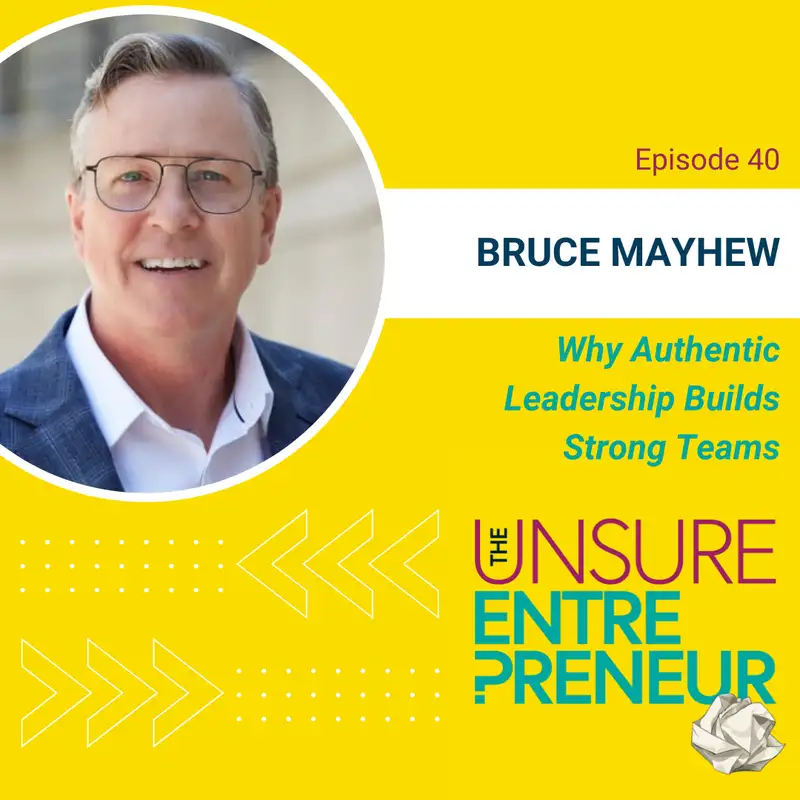
Why Authentic Leadership Builds Strong Teams (w/Bruce Mayhew)
Bruce Mayhew
The Unsure Entrepreneur
Episode 40
Roger Pierce, Bruce Mayhew
Bruce Mayhew 00:00
Authenticity doesn't mean that I have to be perfect. It doesn't mean that I have all the answers. It doesn't mean that I'm all seeing, all knowing. It actually sometimes means I'm vulnerable. It means being able to say I don't know.
Roger Pierce 00:34
Welcome back to the Unsure Entrepreneur Podcast. Today. We're talking about leadership, the kind that shapes culture, builds trust and helps people to do their best work. This conversation matters, whether you're an entrepreneur, people manager or someone just stepping into leadership. Now, my guest today is Bruce Mayhew. Now Bruce is the founder of Bruce Mayhew Consulting, and has spent more than 20 years working with leaders and teams on communication, leadership development and organizational effectiveness. Bruce is also the author of a exciting new book called The path of an inspired leader. We'll put a link to that in the show notes. It's a practical, very human guide to leadership, one that reminds us that Leadership isn't about control or hierarchy, but about empathy, self awareness and integrity. I've got some questions lined up to help us get a sneak peek into what this exciting new book offers. Now Bruce and I have spoken before, and this time, I wanted to connect his leadership philosophy to the realities many of our listeners face, leading people, clients or teams, often without formal training. Welcome back, Bruce. Oh, it's great to be here. Roger, excited to dig into your new book, your leadership training. What's new? All kinds of stuff to talk about. First of all, we just talked about briefly, but congratulations on the new book. That's quite an accomplishment. Thanks very much. It's been a year, plus, that's been really exciting to explore. Writing a book is all about it's a hell of a journey. It's funny because it's not done now, just because it's out, you got to promote it, you got to talk about it, you got to go on stage and explain its content. It's like a phase two, isn't it? Oh, yeah, I think phase three and four. Yeah, because writing was the easy part, and then it was the whole editing and then putting it together, and, yeah, now marketing it and getting it out there and letting people know about it. It's a whole other world. It just never ends. It's like having a child. I think that's what a lot of people say, for sure. Like I said, I'll put a link to the book in the show notes, and we'll get you to plug it again at the end. But let's start by talking about, you know your path, finding your path, rather as an inspired leader. Hence the name of the book Bruce, one of the ideas that really stood out to me is that leadership is not about becoming someone else. It's about finding your own path and leaning into who you already are. So I want to ask you, what does it mean to be an inspired leader today versus a traditional boss. That was a lesson that I learned over many, many years. I remember when I first became officially a leader of a team. It was a small team at the time, and really searching out who I wanted to be and what I wanted to accomplish as a leader. And at first, I think, which is what most people do. I tried. I saw somebody who was leading that I liked, and I thought, Okay, I'm going to be like them, and I'm going to do things the way that they did. It was like putting on somebody else's suit or somebody else's clothes, and you just don't feel right in it. The other thing is, nobody actually believes it's your suit, right? That's what I slowly learned. At first. It was that, hey, I had to be authentic to myself and to learn to get confident in becoming the person that I wanted to become, as a leader that took time, took a lot of watching other people, lot of figuring out what I wanted to do, and, frankly, a lot of reading, which is why I liked putting this book together. This book was sort of a an idea that I had 10-12, years ago. And I thought, hey, if I could speed myself through that process a little bit, that would be really great. Well, that's a great value in buying your book, shameless promotion, but it can speed things along and save people a lot of time having to pick up all these skills and learning themselves. So I really encourage listeners to go and get that copy. Tell me a little bit more. Why don't leaders need to have all the answers to earn trust. I think trust comes before all the answers. I have to be able to trust the the my leader that we're all going in the same direction, that we're all going to be treated in a similar fashion, that I know that I'm safe, that I'm not going to be hung out to dry. I have to know and trust my leader to really have the best interest of the team, as well as the project in mind, if the team feels.
Bruce Mayhew 05:00
Like all the leader wants is success for the project at the expense of the team. The team will actually never commit. They'll also be worried about protecting themselves, and so it's really important that the team trust their leader to be able to give their best in a safe, open, humble way, which will then best, best the project. It'll help the project succeed, and therefore the company succeed. So what is the role of, say, curiosity and humility and self awareness in a good leader and developing leadership skills? All of those are things that a I think there are things that we need today, our business, our world, our products, everything needs that curiosity. It's moving too quickly to be able to stand still. So all of those are components that our space requires. So the leader needs to demonstrate those traits to their team so that their team can say, Okay, I'm allowed to be curious, I'm allowed to be vulnerable, I'm allowed to be empathetic, I'm allowed to do all of these things which will then allow me to be creative and to be collaborative and to develop new ideas and explore both myself and my work. So the leader needs to demonstrate that those traits are accepted that those traits are valued. As soon as a teammate feels that the leader is not giving space, that's when they start protecting that's when they start maybe I won't speak up at this meeting, or maybe I won't share my opinion because they're going to make fun of me, or maybe I won't share this great idea, because my leader is going to grab that idea and call it their own. So as soon as that kind of thing happens within a team, the team starts contracting instead of expanding. It's a level of trust and curiosity and empathy and individuality that teams require. That's what the leader has to actually demonstrate themselves to their team for that team to be successful. So you're touching up on another angle there authenticity. You know, a lot of people throw this word around, but for leaders, it's especially important, right? And we don't want them to be perfect. We want them to be authentic. Can you comment on that? Absolutely authenticity, exactly what you said, Roger, it doesn't mean that I have to be perfect. It doesn't mean that I have all the answers. It doesn't mean that I'm all seeing, all knowing. It actually sometimes means I'm vulnerable, right? It means being able to say, I don't know, but I know what our vision is I know what our values are, I know what our purpose is, and I have confidence in you to help get us there. That's authenticity. That's what leaders need to do to demonstrate reality. 50 years ago, that boss needed to know everything and be perfect, not anymore. Nobody knows everything anymore, and it's okay to admit that. And that was another one of my points, because you're learning, it's okay to learn in public as a leader and say, hey, you know what gang? I don't know the answer that, but I'll find out Absolutely. And as soon as the leader says something like that, again, it provides permission for the employee to say the same thing, and that's the employee that you want, is the one that says, hey, you know, Roger, I'd really like to work on this project, but I actually don't know how to do part B. And openly say that to the team or and to their leader, I don't know how to do part B, because the risk is, if I don't know how to do part B and I don't say it, I'm either going to ignore Part B or I'm going to do a really terrible job at it, and that might implode the project. It's both an opportunity for trust, but it's also now an opportunity to learn and bring the team in, and so it's a learning experience for everybody. Let's talk a little bit about human skills as a competitive advantage for entrepreneurs. You know, a lot of people listening are existing entrepreneurs, or potential entrepreneurs, emerging entrepreneurs, as I like to call them. So this is a huge advantage, what you're teaching, what you're training, what's in the book. Lot of entrepreneurs had this conversation the other day. Tend to focus on the product, the pricing, the sales, the slide show and the pitch deck, fussing around with all the numbers. God knows, I've been there, but it's the human skills, Bruce that often determine whether the business actually grows. As you know, let's talk a bit about that. Why communication and empathy and some of the things we just talked about, self awareness, matter more in, say, a small business now, just to be clear, human skills are sort of what we're calling soft skills now. And I actually prefer human skills over that older soft skills term. So it's just for somebody wondering they haven't heard human skills before. It's just a rebrand of soft.
Bruce Mayhew 10:00
Skills, in a way, but I honestly believe it's that human interaction. I want to be seen, I want to be heard, I want to be recognized. I want to be valued as a customer, and so I want to make sure that the people that I'm going to hire are seeing all of the things that I need. I don't just need a web developer or an accountant. I need someone that's going to understand the brand that I'm trying to put forward in my web I want to an accountant that really understands my whole business, but also my whole personality and my family, so they have to understand me. I just don't want somebody that's good with numbers, and it's going to treat me like every other client of theirs. And it's exactly what we need to do. From an entrepreneur perspective, I'm curious in their business, and I want to understand their business so that I can help their business. And all of that means I have to understand the people, and I think that's what we really need to do to differentiate ourselves as entrepreneurs. If I can go just a little bit further on that one, Roger, if I have to hire a chiropractor, I don't need them to tell me all of their certificate and, you know, all the kind of stuff to prove that they're a chiropractor, I already believe that what I want them is I want to know as a client, as a patient, that they're going to see me as an individual that will really help me
Bruce Mayhew 11:35
become healthier, better, all of that component, and I think that's the problem that I see with some entrepreneurs, is that they keep trying to justify what they are not how they do it. Can you expand on that a bit? What they are not how they do it? Well, what they are. I'm an accountant, you know? I know our CRA and I know this, and I know that I'm not interested. I expect that you know how to do that. I want to know that you're going to hear me and see me and treat me as an individual and be there when I need you. That is what I think entrepreneurs can use to differentiate themselves when they're looking to do business with people that they want to hire them, don't just tell them that you're a great public speaker. They want to know how you're going to improve their business. And today, I don't care what business that you're in, it really is about people. It's helping people feel human. So human skills of of empathy and curiosity and respect and kindness, those are the things that are that make relationships that last. If all you're selling is your accounting service, there's a Yellow Pages book or a Google search full of accountants that I can go to look for the human skills and you're touching upon too. We'll get you to elaborate a bit emotional intelligence and how important it is when dealing with not only employees, but you know, your contractors, your clients, it can make a big competitive advantage for an entrepreneur. Can it absolutely? Yeah, I think being able to spend some time with people, have that curiosity, that patience with people, to listen to their story and really have curiosity to want to know what makes them different. I think that emotional intelligence is amazing, and sometimes that emotional intelligence means that I have to say, hey, maybe we take a break for a week or two because it looks like that you're busy with a family thing going on, or that, you know, our timeline has to slip because of a B or C. Schedules are meant to be flexible sometimes, but people need to still be people, and I think that's where we have to make sure that we're staying flexible with the people that we're working with. And it's it's having empathy and emotional intelligence that makes all of that happen. Can be as simple as saying, You seem a little bit off today. Would you rather talk about this thing tomorrow? Absolutely. So if someone doesn't have these kinds of human skills, Bruce, can you give us a couple tips to build them up or improve? I would say patience is probably the best first step in all of this. Don't try to climb the mountain in a day and know yourself. I love the idea that everybody sort of take some type of personality assessment tool, whether it's disc or Kobe or Myers, Briggs or whatever that's out there, because there's a ton of them that are out there, and so take two or three of them, right? But I think getting to know your.
Bruce Mayhew 15:00
Self through one of those tools is actually a really good first step in being able to tie in your own existing emotional intelligence, because it shows you where you have strengths and where you have opportunities for growth. It also shows you where maybe you need to step back and let somebody else take that place. Not everybody is meant to be that touchy feely kind of person after that. I think a lot of it is practice, right? Is it about being able to sit back and go? Okay? I know that Empathy means being able to understand whether somebody else is feeling why don't I at the grocery store while I'm in line for my like waiting to check out my groceries, instead of just being impatient, why don't I really look at why I might be feeling impatient, but then project that to somebody else that's in the store and go, I wonder what's going on with that person, right? What are they feeling? What are they sensing? What do I feel is going on with them? And really practice what that might look like. I think there's tons of opportunities for us to practice that would really help us out when we're when it's meaningful that we have to read somebody else in a meeting or in a difficult conversation or in a coaching environment. One of the tricks I use is I try to think what the other person might be thinking and look at it from their perspective. Is that Is that helpful? I think so. And where I like to start practicing is where it's really low risk and where I actually don't have to hear what the other person is feeling. I think just me reaching out emotionally automatically helps me get a little bit more in tune with what people are doing, especially people that I see that are different than I am. If I can start practicing that way, I think it's great. Then with somebody that's safe, then go to that next step and say, well, Roger, what I sensed you feeling was this, can you elaborate on that? For me? Was that, what, where you were going? Is there anything else that kind of stuff really working on what I sensed you feeling there's a micro difference there. Instead of saying so what you were feeling was right? So I'm telling you what you're feeling, that doesn't go over very well with a lot of people, but instead I say something like what I sensed you were feeling. So that brings it back to me, and it gives you a little bit more space to sort of say, Okay, this is where it was happening. This is where you know. So just that nuance I find works really well, and I use that when I'm doing difficult conversations. Training is, instead of saying something like, well, you felt this way when that doesn't usually go very well, but it's what I sensed you feel right that works really nicely in whatever language you that's what I felt that you were saying was, or what I would use your own language, but bring it to yourself. Of what I was observing was this, was I observed? Was what I was observing correct, or was there something else going on that's important? I like that line. I sensed it's less accusatory, and it draws people out, like you're saying that's fascinating. You know, in chapter three, you talk about what it's called, how trust, respect and empathy transform teams. So maybe we can dig a bit more into that in the book, you talk about how they're not abstract ideas, they're practical leadership tools that show up in most interactions. So how can leaders actually build trust and not just talk about it? So I have a marketing background. I look at trust as a brand, so it's what is my brand before you even get, perhaps even get to know me. What are people saying about Bruce? What are people saying that's positive? What are people saying that's not positive about Bruce? I believe that trust is something that we get to form as a reputation. It becomes part of our reputation, and that is something that's really important, that we have to make sure that we are building the reputation that we want for ourselves, because that will enter the room before we ever do nine times out of 10, trust is something that has to be protected. We have to really have a good sense of who we want to be and who we are, which goes back to Myers, Briggs or discs, or those kinds of things, is really Understanding who you are and who you want to be, and say no when something is going to compromise
Roger Pierce 20:00
. That is this from your days back at Scotiabank, where you were trying to build trust with people. It's a very difficult institution for a lot of people to trust, right? Banking? Yeah, it is, I would say it goes back to even beyond that. Out of high school, I worked in retail. I worked in a jean store selling denim. I remember my manager. She was focused on sales, sales, sales. That's it. The next person that walked through the door had to, they had to buy something. And I can remember this young boy coming in with his mother. They were struggling finding a pair of jeans that were in their price point. There were some jeans that were on sale, but they were ladies jeans, but they were in the right price point for this boy. And my manager is like, sell them those. And I'm like, I can't sell this 14 year old boy these ladies jeans, and she's like, sell them, sell them. And I absolutely refused, because I know that that boy is going to buy, like, Mom's going to buy the jeans, the boy's going to put them on, he's going to go to school the next day. And I would not do that to him.
Bruce Mayhew 21:19
All right. I had to protect myself, my own brand, my own reputation, because if I did that, they would never come back and buy jeans from me again. I had to protect my own self and my own brand. And I didn't realize what I was doing, like I was what 1819, years old at that point, but I still knew that right was right, run wrong was wrong. That's the kind of thing that we have to make sure that we understand what our values are, what my personal values are, and then, as a leader, what our team values are. And if we're able to say as a team, we all believe in these five values. I don't care how old you are, how young you are, what your background is, but these are the things that we can promise each other, that we're going to live by, and if we all agree that to that, then I can trust that you're going to go off with a client and not go off on a big tangent that we're not going to be able to be able to support or work with customer service or work with an accountant or whoever it might be, we have to get on the same page. So I appreciate that story, but what I got to take away from that is you spoke up to the manager, and you stood by some principles, and you spoke up to them. So my question to you on this level is what happens to teams when people feel safe speaking up in a corporate environment, that's when the magic happens. That's when everything amazing happens. I didn't have a good relationship with my manager for the next two weeks after that encounter, I can assure you, but she got over it. But the magic happens when employees know when they can trust their leader and each other, that's when the magic happens. And that gets back to also being able to say, Hey, I know I screwed up, like that's holding people accountable for screwing up, as well as for all the magic of curiosity and everything else that goes on. Because if someone falls out of that, out of our values, I need to be able to say, hey, Bruce, what happened here? Because that's not what we promise, that's not what we promise our customers, that's not what we promise each other, that's not what we promise ourselves. So what happened here? Like, I'm not going to blame you, but what happened here? Because I'm curious on how we get you back over here, that's a really fair discussion to have. And getting back, hey, if we are all understanding what our five values are, it's really easy for me to say, hey, well, something happened over here. Let's bring that back. I can anchor that it's not some esoteric who I don't like what you did. It's no, no, no. That's that. Let's bring that one back, right? And we can have a discussion about it. So I'm going to hit you up for some leadership lessons from the real world, because I know you've worked over 20 years with leaders across all kinds of industries, you got all kinds of experiences.
Roger Pierce 24:22
So I want to bring this down to the ground a bit for the listeners, for starters, like, what are a couple of common leadership challenges you see across different organizations? The first, and what I say probably most common, is where leaders think that they have to be bosses. They have to be all seeing and all knowing. And I think we as leaders need to give ourselves a little bit of a break. That's just not possible anymore. What we can see, what we need to be very clear on, are those values and what our goals are and to share.
Bruce Mayhew 25:00
Of those goals back to our team or our clients or whomever. We can't be experts in absolutely everything. What we should be really good at is asking good questions. Tell me why that's the right solution and see, tell me how that meets our values. Discuss with me how that impacts our financial goals. Those are the wonderful questions that leaders get to ask nowadays. The second would be transparency and authenticity. I see those two being sort of cousins or brothers and sisters, if you will. So transparency and authenticity where we have to really be clear on why we're doing everything that we're doing. What is it that we're really all stretching towards, and be clear when those change and why they're important. So it's that transparency and authenticity that I think brings safety and security and familiarity to a team. And then the third one that I see would be where people avoid uncomfortable conversations, or they do it in a really bad way, because if you avoid a difficult conversation, it just gets worse. It just gets bigger and bigger. It's like a mushroom. It just keeps growing. But if you address a difficult conversation early, we're saying, hey, Bruce, what you did over here doesn't align to our values. Just explain to me what happened here. That's a difficult conversation. It's uncomfortable. It's a conversation I'd really rather not have had, but it's important that I do, because I need to help Bruce get back over here right and see what's going on. Or maybe we need to expand our values, like maybe Bruce was correct, and we need to expand our values having that curiosity in a difficult conversation, and having that difficult conversation quickly is what's going to really make that relationship great, because otherwise, I'm just going to get angry at Bruce over here, and that's not fair to the team. It's not fair to the project. It's not fair to Bruce. That's very interesting. Now you may have touched upon some of this, but are there any particular lessons you've learned from coaching these executives and teams and founders? Patience.
Bruce Mayhew 27:29
Pack your patience. You know, we don't become great leaders overnight. We don't become great leaders by reading one book or watching one podcast or going to one Rotman lesson. It's a journey. It's something you get to practice. It's something you're going to screw up with. I will promise you future leaders, you're going to make a mistake, and when you make that mistake, be authentic, be transparent and say that didn't go as well as I was hoping it would. That's all you have to say, is that, hmm, that didn't work. And so Roger, I'm sorry that didn't work the way I anticipated. So let's try a take two, and then come at it again and learn from what happened. So learn from what didn't go well, and you will get better, and you will get great. And there's some things that you're just never going to be good at, and let somebody else try to take care of those for you, what would your advice change here? For entrepreneurs? Leaders and entrepreneurs are often interchangeable. Any specific advice for entrepreneurs or people you've worked with running their own business leadership mistakes you might have seen, or things they might have shown you that you haven't seen elsewhere. Usually, you don't have to worry about curiosity with entrepreneurs. They're just naturally curious. If anything, you want to pull that curiosity back a little bit and be a little bit careful with it, I would say, from an entrepreneur perspective, we because I'll throw myself into the ring on this one, and I struggle with this myself. We try to be too many things, and I think that we have to really be careful of that, because we're curious and because we're entrepreneurs, usually working on a budget, we have to try to be many things at the same time, but pick your battles. Is what I would say to entrepreneurial leaders, is pick your battles. Find other people that are going to be able to support you and your vision and be crystal clear about what your vision is and your values, that's going to be really important. If you are fortunate enough that you grow you'll run into the problem. If you have a couple people that you've come on to your organization early, and they've been in a whole bunch of different places at the same time, they've been really helpful in those early days.
Bruce Mayhew 30:00
They're going to start getting frustrated as you start having to become more segmented and more I don't want to say siloed, but because I hate that word, some people just love the all seeing, all knowing. They love to be able to skate around a lot. They might get frustrated when departments start forming and official categories. Start forward. Work with those people as much as you possibly can, like realize help them as best you can fit into that organization. Realize that they're going to perhaps get impatient work with them as much as possible, and realize they're trying to be great. They're trying to be as proud of their work as they were before. It'll take some time on that one. I love the fact that you touched upon values and mission. It's one of the first things I advise new entrepreneurs is, you know, what is your mission with this business? What are you trying to accomplish? And along with that, what are your values? What kind of guiding principles will this company follow? That's so important, isn't it, absolutely when I left the bank, I did go and work for a small company. There was only three of us for two years, and I learned the importance of values there, because the gentleman that owns the company, he was probably one of the best in the business in Toronto, perhaps Ontario and Canada, like he was really smart, but his values and my values didn't align at all. And I discovered that when you're a part of a an organization like Scotiabank, when there's like 50,000 of us, my personal values didn't matter as much. When there was so many of us, it sort of all gets white washed out. But when there was just two of us, or three of us, there was serious challenge. Even though he was fantastic at what he did, it was how he did it that didn't align well with me, so I knew pretty quickly that this was not going to be a relationship that lasted a long, long time. It happens for sure, and it's more transparent in a smaller organization, like you said. But it's also if you communicate this stuff to your team, even if your first team member is just one person, it makes people work differently, right? If they see the mission, if they share your values, it's more than the money. That's why a lot of employees come on board a startup. Absolutely fascinating stuff for someone who's listening, who wants to grow as a leader, whether they run a business or lead within one, what's a good place to start? I think that question is sort of multi faceted, and it depends a lot on the individual. I would say, still, I'd go back to take a couple personality assessment exams and try to figure out what your strengths are. It sounds silly, but it's really that important that you really learn where your strengths lie and why you behave. Sometimes the way that you behave, it stops you from having to fight against yourself, if that makes any sense at all, I remember my first assessment I did was a Myers Briggs, and it was like somebody pulled back a curtain for me and said, Oh, I can stop apologizing for not being good at this thing over here. It was a relief for me. It really was relief. And it also allowed me to say, hey, that's why I'm naturally good at this thing over here. So it allowed me to lean in where I was good and be okay not being great at something. It was like lights went on for me in a dark room. I strongly think people need to recognize where their strengths are. The next is, is what's your learning process is, realize if reading is your thing, then then read. Listen to podcasts, listen to ebooks, listen to audio books, do as much as you possibly can. But then one thing that I would say for sure is find two or three people who've impacted your world, right? And it could be a current leader, or it could be somebody who was one of your leaders five years ago or 10 years ago, and really sort of break down. Why did you like that? What was it about them that really made you feel important, that made you learn, that helped you discover yourself? What was it about them? And then I would say, take everything that you are learning along the way, and don't try to pretend it's you, right. Don't try to put on their clothes. But think, how would I do that if it was me? And find your own rhythm and be okay that you're going to screw up from time to time, right? Because you will, you will absolutely but keep figuring.
Bruce Mayhew 35:00
Out what feels right and when things work, pause and say, wow. Why did that work? Reverse engineer that a little bit and say, wow. What happened there, and why did that work, and that will help you become the best leader that you possibly can be. Why did that work? Figuring that out so you can repeat that good behavior, right? Absolutely. Yep. Well, this is good stuff. Bruce, I want to, I want to thank you for sharing your perspective and experience today. Now, where can people find out more about your work and, of course, get a copy of the path of an inspired leader? Certainly LinkedIn, if you want to check out me on LinkedIn, Bruce Mayhew, certainly my website at Bruce mayhew.com works, fantastic. So everything about me is on the website. And, of course, the book, which looks like that he's holding up his book. Yeah, the book is available on Amazon, indigo and Barnes and Noble. So you can search either Bruce Mayhew or The Path of an Inspired Leader, and you will find it there. It's just been released. Now. It was actually released three weeks early. I'm scrambling a little bit. I was quite prepared for that. It's up there and an all good that's great. Get a copy today. Well, congratulations. That's just fantastic. Thank you very much, Roger. So if this episode today was something that resonated with you, dear listener, and if you're still on the fence about entrepreneurship, I want you to point out that my own book, The Unsure Entrepreneur, is a decision guide for people who are thinking about starting a business and want a clear picture of what they're really signing up for. You can find the book at unsure entrepreneur.com, so thanks again everyone for spending time with me here. If you're feeling unsure, you're in the right place. Bye for now.
Roger Pierce 37:02
That's it for this episode of The Unsure Entrepreneur Podcast.